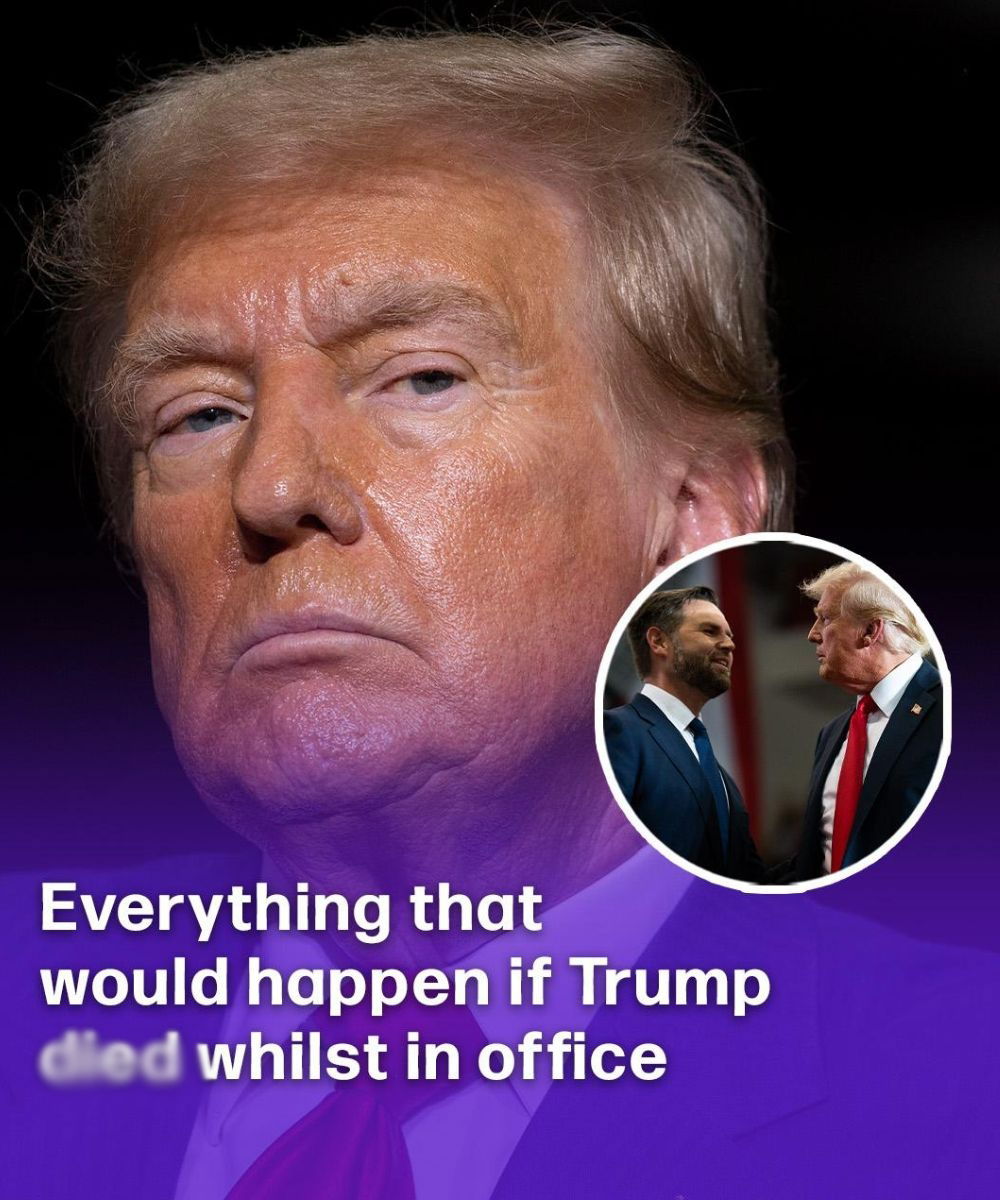
Donald Trump is serving the middle stretch of his second term and, at his inauguration, became the oldest person ever sworn in as President of the United States.
For many Americans, especially those who have lived through several administrations, the topic of age in the White House has taken on new prominence in recent years. While Joe Biden previously set the record as the oldest person elected president, Trump began his second term slightly older than Biden had been at the time of his own election. Trump was seventy-eight years and seven months old at the start of his second term, compared with Biden at seventy-eight years and sixty-one days when he first won office. Over time, both men continued to age in office, which naturally raised questions about health, security, and continuity of government.
History shows that the nation is prepared for difficult moments. Eight presidents have died while serving, with four lost to illness or natural causes and four assassinated. Those tragedies reshaped the country’s laws and traditions to ensure the government carries on smoothly, no matter the shock or sorrow of the moment. Because of that history, Americans today can be confident that there are clear, well-tested rules to guide the country through any sudden vacancy in the presidency.
In recent years, security concerns have been widely discussed. Trump has been the target of several highly publicized threats and attempts. The most serious incident took place in July 2024, when a gunman opened fire from a nearby rooftop during a campaign rally. A bullet grazed Trump’s right ear, and a supporter in the crowd was tragically killed. The swift response of security likely prevented greater loss of life. That event, along with later security incidents, refocused attention on how the nation would manage a worst-case scenario.
Not long after the rally attack, another alarming episode occurred near Trump’s Palm Beach golf resort. Authorities spotted a rifle barrel protruding through a fence line, and a suspect was arrested at the scene. Subsequent legal proceedings followed. More recently, an armed intruder entered the grounds of Trump’s Mar-a-Lago residence and was shot and killed by security. These events, while frightening, reinforced a simple truth: the Secret Service and related agencies treat presidential protection with the utmost seriousness, and the Constitution provides a straightforward path for leadership to continue should the unexpected occur.
More recently, an armed intruder entered the grounds of Trump’s Mar-a-Lago residence. The attacker was shot and killed at the scene.

Against the backdrop of international tensions, Trump also discussed the reasoning behind certain national security decisions. Following U.S. military strikes on Iran, he addressed a question about ordering a strike against Iran’s Supreme Leader, Ayatollah Ali Khamenei, indicating in an interview that he acted from a belief that it was necessary to move decisively before an adversary could act first, as reported at the time by major outlets. Regardless of how one feels about particular policies, moments like these remind us that the presidency carries weighty responsibilities—and that the nation’s system is designed to ensure continuity even in crisis.
What would happen if a sitting president died while in office?
The United States follows a careful, well-defined process if a president dies, resigns, is removed, or becomes unable to perform the duties of the office. These rules are set out in the Constitution, supplemented by laws passed by Congress, and supported by long-standing traditions. Together, they make sure there is no gap in leadership and that the chain of command remains unbroken at home and abroad.
The Presidential Succession Act of 1947 and the Twenty-Fifth Amendment to the Constitution are the cornerstones of this system. The law clearly identifies who takes over if the presidency becomes vacant, and the amendment provides guidance for filling a vacant vice presidency and for handling temporary or contested presidential disabilities. While the language can sound technical, the basic idea is simple: if the presidency is suddenly open, there is always someone ready and authorized to lead immediately.
Under this system, Vice President JD Vance would immediately become president.
If a president were to die in office, the vice president does not become an “acting” leader or a temporary placeholder. Under the Twenty-Fifth Amendment, Section 1, the vice president becomes president for the remainder of the term, with the full authority and responsibilities of the office. The change happens at once, by operation of law, so there is never a moment when the office is empty.
The oath of office is administered as soon as practicable. It can be taken in the White House, at the Capitol, on an airplane, or at any suitable location, as history has shown. After President John F. Kennedy’s assassination, Lyndon B. Johnson took the oath aboard Air Force One. When President Franklin D. Roosevelt died, Harry S. Truman was sworn in swiftly at the White House. The immediate swearing-in is not just a formality; it reassures the public, the military, allies, and financial markets that the government remains stable and fully functional.
Once sworn in, the new president may keep the existing cabinet in place or choose to make changes. A sudden transition does not automatically dismiss cabinet secretaries or senior staff. Continuity is the default approach, especially in the first days and weeks, because maintaining steady hands on the wheel of government helps calm the country and the world.
With the office of vice president now empty, the Twenty-Fifth Amendment, Section 2, allows the new president to nominate a replacement. That nominee must then be confirmed by a majority vote of both the House of Representatives and the Senate. Until a new vice president is confirmed, the office remains vacant. During that period, if the presidency were to become vacant again for any reason, the next in line would be called upon in accordance with the law.
What if the vice presidency is also vacant, or multiple offices are empty?
While rare, the law plans for unlikely scenarios. If both the presidency and the vice presidency become vacant, the next person in line is the Speaker of the House, followed by the President pro tempore of the Senate, and then the heads of the executive departments in the order their departments were created, beginning with the Secretary of State and then the Secretaries of the Treasury and Defense, and continuing down through the cabinet. These individuals must meet the constitutional requirements to serve as president, and any who do not are skipped. The goal is always the same: a swift, lawful transfer of authority without confusion.
This succession framework has been tested and refined over time. Gerald Ford, for example, became vice president under the Twenty-Fifth Amendment after a vacancy, then later became president when Richard Nixon resigned. Ford’s experience helped confirm that the constitutional tools for handling sudden changes in leadership work as intended.
How long could a successor serve as president?
The Twenty-Second Amendment limits how many times a person can be elected president. It also addresses what happens when someone serves part of another president’s term. The rule is straightforward in concept. If a person serves more than two years of someone else’s presidential term, that person can only be elected to the presidency once in their own right afterward. If the person serves two years or less of the previous term, that person can be elected to the presidency twice afterward.
In practical terms, that means the calendar matters. If a vice president takes office with, say, two years and three months left in a term, they could run for election once more after finishing that partial term. If the change happens with one year and ten months left, the new president could potentially run twice and serve up to two additional full terms, subject to the will of the voters.
There are historical examples that make this easy to picture. After President Kennedy’s death in 1963, Lyndon Johnson served approximately fourteen months of Kennedy’s term, less than the two-year threshold. Johnson then ran in 1964 and won. He was eligible to run again in 1968 but chose not to. By contrast, when President Nixon resigned in 1974, Gerald Ford served more than two years of that term, which meant he could be elected only once thereafter. He ran in 1976 but did not win. These examples are a reminder that the law balances continuity with the principle of regular elections.
What happens to policies, appointments, and the daily work of government?
When a vice president becomes president, the machinery of government keeps moving. Federal agencies continue their missions, military commands remain in place, and the courts operate as usual. Ongoing policies, executive orders, and regulations do not vanish. The new president can decide to maintain the prior approach or chart a new course. In the earliest days after a transition caused by tragedy, stability is typically the priority, with larger policy shifts considered only after thoughtful review.
The cabinet stays on unless and until the new president decides to make changes or the Senate declines to confirm new appointees. The same is true for ambassadors and senior officials. Congress remains Congress, with the same membership it had the day before. The Supreme Court and lower federal courts continue their work without interruption. In other words, the constitutional order holds steady, and any decisions to alter policy come through the usual democratic processes.
How does the government handle a president’s temporary incapacity?
Although the question here focuses on death in office, it may be helpful to understand how the Twenty-Fifth Amendment works when a president is only temporarily unable to carry out the duties of the office. Under Section 3, a president can voluntarily transfer power to the vice president for a short period, such as during a medical procedure that requires anesthesia, and then resume the office afterward by declaring recovery. Under Section 4, if a president is unable or unwilling to acknowledge a serious inability to serve, the vice president and a majority of the cabinet can declare that inability to Congress, making the vice president the acting president until the president recovers or the question is settled by Congress. These safeguards were designed precisely so that the country always has a fully empowered leader at every moment.
What about national security during a sudden transition?
Continuity of command is a top priority. The military’s chain of command flows through the president, and it is essential that there be no doubt about who holds the authority to give lawful orders. That is why the oath is administered promptly, the so-called nuclear football and other secure communications are transferred without delay, and briefings begin at once. Allies and partners are informed, and adversaries are reminded that the United States remains steady and capable. These steps are not dramatic; they are routine procedures refined over decades to guard against exactly the kind of instability America’s founders sought to prevent.
How is the nation’s mourning observed while the work of government continues?
Should a president die in office, the country enters a period of mourning, often marked by flags flown at half-staff, memorial addresses, and a state funeral. The late president may lie in state in the Capitol Rotunda to allow the public to pay their respects. A national day of mourning is typically declared, and the service may be held at the Washington National Cathedral or another significant place of worship, with family, friends, and former leaders in attendance. Amid this solemn observance, the new president continues the work of the office, addressing the nation, offering comfort, and guiding the government responsibly forward.
How might an unexpected transition affect elections?
If a president dies during a term, the timeline of scheduled elections does not change. Presidential elections remain every four years, and congressional elections proceed on their usual two-year cycle. If the transition happens in the middle of a term, the vice president who becomes president serves out the remainder and may decide whether to seek election according to the limits set by the Twenty-Second Amendment. If the vacancy occurs close to a national election, parties and state officials follow well-established rules to ensure ballots, electors, and certifications proceed lawfully and on time. While the details can be complex, voters can be confident that the democratic process moves forward as planned.
Why these safeguards matter to everyday Americans
For those who have watched the country move through periods of triumph, hardship, and change, the strength of the American system lies in its predictability. The rules do not depend on personalities. They are built on laws that apply the same way, every time. Whether you follow politics closely or prefer to tune it out, you can take comfort in knowing that the nation’s leaders, institutions, and laws have prepared for unexpected events. The presidency is bigger than one person, and the system ensures the responsibilities of that office are always carried out.
In practical, day-to-day terms, your Social Security checks arrive, Medicare continues, the mail gets delivered, and the lights stay on. The armed forces maintain their vigilance. Local schools and hospitals keep serving their communities. The stock market may react to news, but the underlying economy, the courts, and the laws hold firm. That is by design. Continuity of government is not a slogan; it is a daily commitment upheld by civil servants, military members, and elected officials from both major parties.
A calm, steady path if the unthinkable happens
No one wishes for tragedy, and thoughtful leaders in every administration work hard to avoid it. But should the worst occur, the path forward is clear. The vice president would immediately become president and take the oath. The cabinet and agencies would continue their work. A new vice president would be nominated and, if approved by Congress, sworn in. The country would mourn, and the government would carry on. That sequence has been tested by history and refined by law, and it reflects a simple promise: the United States will endure, and its democracy will function, regardless of the challenges it faces.
In that sense, the answer to what would happen if a sitting president died while in office is both straightforward and reassuring. There is no vacuum and no scrambling. There is a smooth handoff, the business of the nation continues, and the people remain firmly in charge through their representatives and regular elections. For Americans who have seen the country weather many seasons, this is not just procedure. It is a reflection of who we are: a nation anchored by the rule of law, prepared for hard days, and committed to meeting them together.