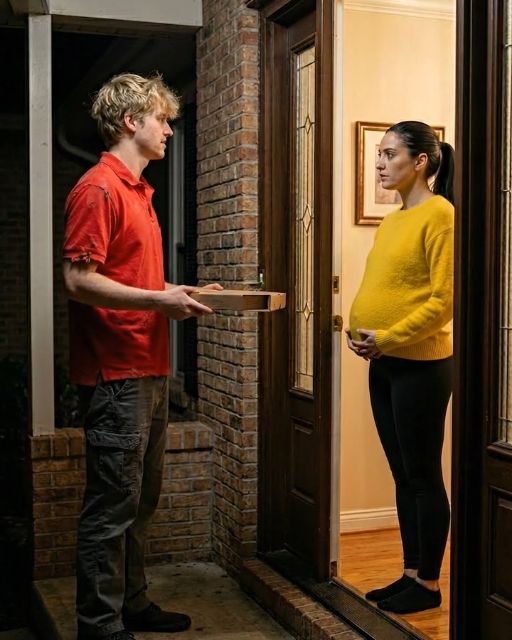
I was five months pregnant and craving pizza at 9 PM. I ordered from Tony’s. The delivery guy, a young kid named Curtis, arrived forty minutes late. I was annoyed until I opened the door.
He was out of breath, sweating, his uniform torn at the shoulder.
“I’m so sorry, ma’am,” he panted. “I need to ask you something really important. Do you smell gas?”
I froze. “What?”
“When I pulled up, I smelled it from the street. Strong. Like a leak.”
I hadn’t noticed anything. My husband was out of town. I’d been sitting on the couch all evening with the windows closed.
Curtis didn’t wait for permission. He pushed past me – polite, but urgent – and went straight to the kitchen. He turned off the stove. One of the burners was on, hissing softly. No flame. Just gas pouring into the air.
“How long has this been on?” he asked, his voice tight.
“I… I don’t know. I made tea around six.”
Three hours.
He opened every window in the house. Made me step outside. Called the gas company from his phone. Stayed with me on the porch until they arrived.
The technician confirmed it: another twenty minutes and the concentration would’ve been enough to ignite from the furnace kicking on.
I tried to tip Curtis everything in my wallet. He refused. “Just… be safe, okay?” He smiled, got back in his beat-up Civic, and drove off.
I thought that was the end of it.
Two days later, I went to Tony’s to thank him in person. The manager, a guy named Rick, crossed his arms when I mentioned Curtis’s name.
“He doesn’t work here anymore.”
“What? Why?”
Rick shrugged. “He was late to his next three deliveries that night. Customers complained. We got bad reviews. I had to let him go.”
“He was late because he saved my life!”
Rick didn’t blink. “Company policy. I can’t make exceptions.”
I left furious. I posted the story on the neighborhood Facebook group, thinking maybe someone could help him find a new job.
The post went viral.
By the next morning, it had 40,000 shares. Local news picked it up. People were tagging Tony’s Pizza in the comments, demanding Curtis be rehired.
Rick called me. “This is getting out of hand. People are boycotting us.”
“Good,” I said.
“Look, I’ll rehire him, okay? Just… ask people to stop.”
I didn’t respond. I hung up.
That afternoon, Curtis called me. His voice was shaking.
“Ma’am, I don’t know what you did, but my phone hasn’t stopped ringing. People are offering me jobs. Real jobs. Not just pizza delivery.”
I felt tears prick my eyes. “You deserve it, Curtis. You literally saved my baby’s life.”
“There’s more,” he said quietly. “A guy from the fire department called. Said they saw the news story. They want me to apply for their community outreach program. It’s a stepping stone to becoming a firefighter.”
I couldn’t speak. I just cried.
Curtis had been trying to become a firefighter for two years. He’d failed the physical exam twice. He was working three jobs to pay for EMT certification classes while supporting his mom, who had MS.
The news had included all of this. People were calling him a hero.
A week later, my husband and I invited Curtis over for dinner. He showed up in khakis and a button-down shirt, looking nervous and young.
“You didn’t have to do this,” he said at the door.
“Yes, we did,” my husband said, shaking his hand firmly. “You saved my wife and my kid.”
Over lasagna, Curtis told us everything. How his dad had died in a house fire when Curtis was twelve. How he’d grown up obsessed with prevention, with helping people, with never letting what happened to his family happen to someone else.
“That’s why I smelled the gas,” he said, pushing food around his plate. “My dad always told me to pay attention. To trust my gut. I almost didn’t stop. I was already late.”
“But you did,” I said softly.
“Yeah.” He smiled, but it was sad. “I just wish I could’ve done it for him.”
The next month was a whirlwind. Curtis started the fire department program. The local news did a follow-up story. Tony’s Pizza lost so much business that Rick ended up selling it to a new owner, who immediately changed the name and the entire staff policy.
But here’s where things got complicated.
Curtis called me one night, around ten. He sounded wrecked.
“Can I talk to you? I don’t know who else to call.”
“Of course. What’s wrong?”
“It’s my mom. The medical bills are piling up. I can’t work three jobs anymore because of the training schedule. I’m going to have to quit the program.”
My heart broke. “How much do you need?”
“No, no, I’m not asking you for money. I just needed to tell someone. I needed to say it out loud.”
But I’d already made up my mind. I called my husband after we hung up. We talked for an hour. We weren’t rich. We had a baby coming. But we had savings.
We sent Curtis fifteen thousand dollars.
He called me sobbing. “I can’t accept this.”
“Yes, you can. You saved our family. Let us help yours.”
“I’ll pay you back. I swear.”
“You don’t have to. But if you insist, pay it forward someday. That’s all I ask.”
Curtis stayed in the program. He graduated eight months later, right around the time my daughter was born.
He came to the hospital to meet her. Held her with the kind of gentle care that made me tear up all over again.
“What’s her name?” he asked.
“Wren,” I said. “Wren Curtis.”
He looked up, eyes wide. “You didn’t.”
“We did.”
Curtis became a permanent fixture in our lives after that. Not out of obligation. Out of genuine friendship. He babysat Wren when we needed a break. He fixed our leaky sink. He showed up with groceries when I was too exhausted to cook.
And two years later, Curtis saved another life.
He was off-duty, grabbing coffee, when he saw smoke coming from an apartment building. He ran inside and carried out an elderly man who’d fallen asleep with a cigarette.
The man’s daughter tracked Curtis down afterward. Turned out she was a lawyer. A really successful one.
She insisted on doing something for him. Curtis tried to refuse. But she was persistent.
She paid off his mom’s remaining medical debt. All of it.
Curtis called me that night, just like he had before. But this time, he wasn’t crying from stress. He was crying from relief.
“It’s over,” he whispered. “The debt. It’s all gone.”
“You deserve this,” I told him. “You’ve earned every bit of happiness coming your way.”
But the story doesn’t end there either.
A year after that, Curtis met someone. A teacher named Roslyn. She was smart and kind and thought the world of him.
They got married in a small ceremony at the fire station. Wren was the flower girl. My husband was a groomsman.
At the reception, Curtis gave a speech that had everyone in tears.
“I used to think life was just about surviving,” he said, looking around at all of us. “About getting through the day, paying the bills, taking care of my mom. I didn’t think I deserved more than that.”
He paused, his voice catching.
“But then I met people who showed me something different. People who saw value in me when I couldn’t see it in myself. Who helped me when I had nothing to offer in return. Who taught me that kindness isn’t transactional. It’s just what we’re supposed to do for each other.”
He looked directly at me and my husband.
“You saved my life too. Maybe not from a gas leak. But from giving up. From thinking I’d never be more than a broke delivery guy with impossible dreams.”
There wasn’t a dry eye in the room.
Wren is four now. She asks about “Uncle Curtis” constantly. He’s her favorite person in the world.
Last week, Curtis and Roslyn told us they’re expecting. A little boy. They’re going to name him after Curtis’s dad.
When Curtis told me, I hugged him so tight I thought I might break him.
“Full circle,” I whispered.
“Full circle,” he agreed.
Looking back, I think about how close we came to disaster that night. How a pizza delivery could’ve ended with tragedy instead of friendship. How one person’s choice to stop, to pay attention, to care about a stranger changed everything.
Curtis lost his job that night. Lost his income. Lost his stability.
But he gained something infinitely more valuable.
He gained a family. He gained a future. He gained proof that doing the right thing, even when it costs you, eventually comes back around.
Not always in the ways you expect. Not always on the timeline you want.
But it comes back.
Sometimes being a hero means losing everything in the moment. It means being late. It means getting fired. It means choosing someone else’s safety over your own convenience.
And sometimes the universe rewards that kind of courage in ways you never could’ve imagined.
Curtis didn’t save my life expecting anything in return. He didn’t do it for recognition or reward.
He did it because it was right. Because that’s who he is.
And the world gave him back everything he deserved.
The lesson here isn’t complicated. Be the person who stops when something feels wrong. Be the person who helps even when it costs you. Be the person who sees value in others even when they can’t see it in themselves.
Because that kind of goodness doesn’t go unnoticed. Maybe not immediately. Maybe not in obvious ways.
But it matters. It ripples outward. It changes lives.
Curtis changed mine. And without even realizing it, I got to be part of changing his.
That’s what being human is supposed to be about. Not keeping score. Not expecting payment. Just showing up for each other when it counts.
Just smelling the gas when everyone else walks by.