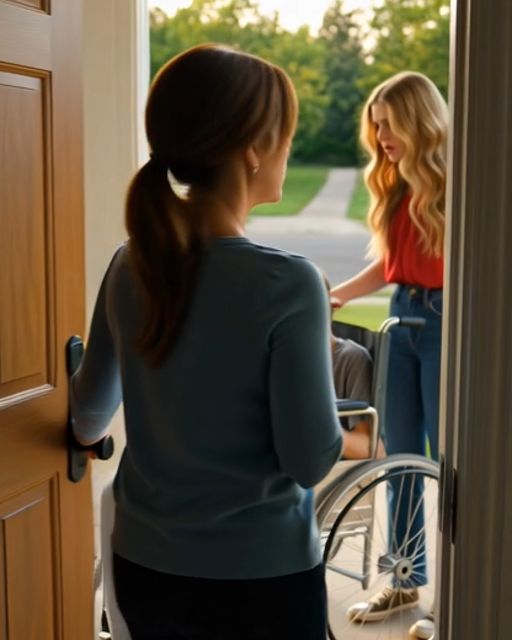
The doorbell rang at 7am on a Tuesday.
I opened it to find Kayla – the woman my ex-husband left me for – standing next to Vincent in a wheelchair. He looked skeletal. Gray. Nothing like the man who’d walked out of our marriage five years ago for “a fresh start.”
Find out what happens next… ⬇️
“He’s yours now,” Kayla said, already turning toward her car. “I didn’t sign up to be a nurse for a broke old man.”
Vincent wouldn’t meet my eyes.
She was gone before I could process what was happening. I stood there, staring at this stranger in my ex-husband’s body, and thought about closing the door. I should have closed the door.
But I didn’t.
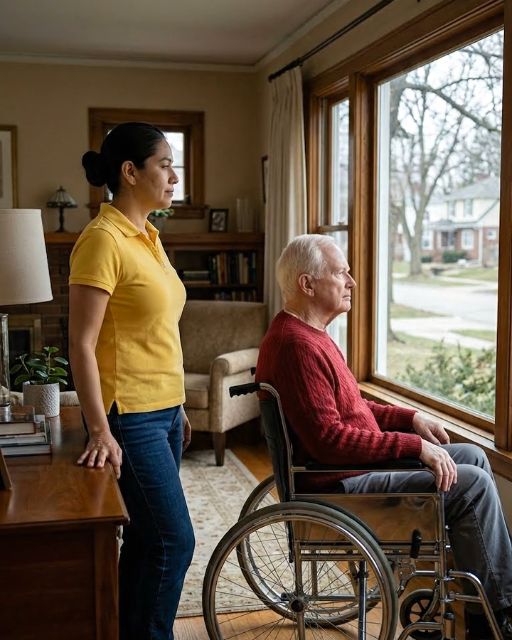
I took him in. Set up the guest room with the hospital bed his insurance paid for. Learned how to manage his medications. Watched him sleep and wondered how we’d gotten here—from the couple who slow-danced in the kitchen to this.
He died eight weeks later. Pneumonia. I was holding his hand.
At the funeral, I stood in the back. I’d done my duty. I didn’t need to perform grief for people who’d watched him leave me.
That’s when I saw her.
Kayla, in the front row, sobbing. Not the quiet, dignified tears of a girlfriend. The loud, possessive grief of a wife.
She ran to me after the service, mascara streaking down her face.
“Thank you,” she gasped. “Thank you for giving him what he wanted.”
I felt my blood go cold.
“He never stopped loving you,” she continued. ” When he got sick, he kept saying he’d wasted his life. He begged me to help him. Said if you saw me abandon him, you’d take pity. You’d take him back. So I did it. I pretended to leave him at your door.”
She smiled through her tears.
“It was all a performance, for you. So he could be with you at the end.”
My mind went blank. The world narrowed to the sound of blood roaring in my ears.
It was a performance.
Those eight weeks. The soft apologies he whispered when he was delirious with fever. The way he’d cried when I’d read to him from our favorite book. All of it.
“A performance?” I finally managed to say. My voice was a stranger’s, thin and sharp.
Kayla nodded eagerly, misinterpreting my shock for understanding. “He knew you were the only one who would do it right. The only one with a good enough heart.”
She made it sound like a compliment. My good heart was a tool they had used.
I looked past her, at the mourners giving us a wide berth. They were probably thinking how noble I was. How big of me.
I felt like the world’s biggest fool.
“So you didn’t abandon him,” I said, the pieces clicking into place with sickening clarity. “You dropped him off and went… where?”
“To a hotel nearby,” she said, her voice dropping to a conspiratorial whisper. “He insisted. He said I deserved a break. He’d call me every night, after you went to bed, to tell me how you were.”
He called her every night.
I remembered the nights I’d sit in the living room, too exhausted to climb the stairs, listening to the sound of his ragged breathing through the baby monitor. I thought he was sleeping.
He was reporting back to his mistress. Describing my compassion. Detailing my service.
The coldness in my veins turned to ice, then to fire.
“Get away from me,” I hissed, the words feeling like acid on my tongue.
Kayla’s smile faltered. “But I thought you’d be happy. He got his dying wish.”
“His dying wish was to use me,” I snapped, my voice finally rising. “To use me as a free hospice nurse so you didn’t have to get your hands dirty.”
Her face crumpled, the mask of the grieving widow falling away to reveal a petulant, confused woman.
“It wasn’t like that,” she insisted. “He loved you.”
“Love doesn’t look like this,” I said, turning my back on her. I walked away, not caring that people were staring. I walked out of that funeral home and left the ghost of my marriage, and the man I thought I knew, behind for good.
The drive home was a blur.
When I walked into my house, the silence was deafening. It was the same silence I’d lived with for eight weeks, but now it felt different. It felt mocking.
I walked into the guest room. The hospital bed was still there, the sheets neatly folded. I’d been waiting for a charity to come pick it up.
On the nightstand was a glass of water and the last of his pain medication. I had been so careful. I had set alarms in the middle of the night to make sure he was never in pain.
For what? So he could have a comfortable home base while his girlfriend enjoyed a hotel?
I started cleaning. I tore the sheets from the bed, stuffing them into a trash bag with a vengeance. I unplugged the oxygen machine. I packed up the few belongings he’d brought with him—a worn-out paperback, a pair of slippers, a framed photo.
The photo was of him and Kayla, smiling on a beach. He’d told me it was his sister. I had believed him.
Every memory of the past two months was now tainted, replaying in my head with a new, horrifying soundtrack.
I remembered one night, about a week before he died. He was lucid and quiet.
“I’m sorry, Clara,” he’d whispered, his hand finding mine. “I’m so sorry for everything.”
I had squeezed his hand, my heart aching with a complicated mix of old love and new pity. I thought he was apologizing for leaving me. For the years of heartache.
Now I knew the truth. He was sorry he’d gotten sick. Sorry his grand plan for a new life had been cut short. He wasn’t sorry for the pain he’d caused me; he was just sorry for himself.
And maybe, just maybe, he was sorry he had to manipulate me one last time to get what he wanted.
The next few days, I moved through life like a ghost. I had the hospital bed removed. I deep-cleaned the guest room until it smelled of bleach and lemon, erasing any trace of him.
But I couldn’t erase the feeling of being used. It clung to me like a shroud.
A week after the funeral, a thick envelope arrived in the mail. It was from a law firm.
My first thought was that it was a bill. Maybe for some of Vincent’s medical expenses that weren’t covered. I almost threw it away.
But my curiosity got the better of me. I sat at my kitchen table and slit it open with a trembling hand.
Inside was a letter from a man named Arthur Vance, a solicitor. It stated that I was named in Vincent’s last will and testament.
That made no sense. Why would he name me? He had Kayla.
The letter requested my presence for a reading of the will the following Tuesday. I called the number and confirmed I would be there. I had to know. This had to be the last chapter of this nightmare.
I walked into the solicitor’s office on Tuesday, my stomach in knots.
Kayla was already there. She was dressed in a chic black dress, looking more like a wealthy widow than a grieving girlfriend. When she saw me, her expression soured.
“What are you doing here?” she demanded.
“I was invited,” I said simply, taking a seat as far away from her as possible.
Mr. Vance, a kind-looking man with silver hair, entered the room and cleared his throat.
“We are here to read the last will and testament of Mr. Vincent Miller,” he began.
He read through the legal jargon, my mind drifting until he got to the important part.
“To my beloved partner, Kayla Jennings,” he read, “I leave the entirety of my estate. This includes my savings, my investment portfolio, and the full payout from my life insurance policy, valued at one million pounds.”
My breath caught in my chest. Kayla let out a small, triumphant sigh.
One million pounds.
“I didn’t sign up to be a nurse for a broke old man,” she had said on my doorstep.
It was all a lie. All of it. From the very beginning.
He wasn’t broke. He was a millionaire.
He had died in my guest room, receiving free, round-the-clock care from the woman he’d cheated on and abandoned, all so his fortune could pass, untouched, to the woman who wouldn’t even change his bedsheets.
The humiliation was so profound, it was almost paralyzing.
I barely registered Mr. Vance continuing.
“There is one other codicil,” he said, adjusting his glasses. “To my ex-wife, Clara Miller, for her kindness in my final days, I leave the contents of my lockbox, held at the downtown branch of Sterling National Bank.”
He handed me a small key.
Kayla scoffed. “Probably just some old love letters. How sentimental.”
I didn’t say a word. I took the key, stood up, and walked out of the office without looking back.
I drove to the bank in a daze. I didn’t care what was in the box. A part of me wanted to throw the key in the river and be done with it.
But another part, a stubborn, angry part, needed to see it through. I needed to see the final insult he had left for me.
The bank manager led me to a quiet room and brought out a small, metal box. I slid the key into the lock. It turned with a soft click.
I lifted the lid.
It wasn’t filled with old letters or sentimental trinkets. It was filled with documents.
On top was a single, handwritten letter addressed to me.
Clara,
If you are reading this, then our plan worked. I am gone, and you took care of me at the end. I knew you would. You were always the better person.
I’m sorry for how it happened. But I needed to know Kayla was taken care of. My financial planner said that if I died while she was my active caregiver, my estranged family might contest the will, claiming elder abuse or undue influence. She’s young. They wouldn’t have believed she loved me.
But with her ‘abandoning’ me and you taking over, no one would question it. You, my sainted ex-wife, were my alibi. It makes the will look clean. It makes her inheritance secure.
I know you hate me. You have every right. But I hope you can understand. I loved her.
Vincent
I dropped the letter as if it were on fire. It was worse than I could have ever imagined.
It wasn’t just a manipulation for comfort. It was a cold, calculated legal strategy. I wasn’t just his nurse; I was his pawn. My good name was the shield he used to protect his mistress’s inheritance.
Tears of rage, not sorrow, streamed down my face.
Underneath the letter were other documents. Old bank statements. Stock certificates. And a life insurance policy.
It was an old one, taken out when we were first married, twenty years ago. The beneficiary was listed as “Clara Miller, Spouse.”
It was for fifty thousand pounds. A pittance compared to what he’d left Kayla, but it felt like a final piece of hush money.
I was about to close the box, to go home and burn it all, when something caught my eye. A folded piece of paper tucked into the policy sleeve.
It was a change of beneficiary form. He had filled it out, changing the beneficiary from me to Kayla.
But it was never signed. It was never submitted.
I stared at it, my heart pounding. Why? Why would he leave this here? Did he forget? Or was it another cruel game, showing me what I had lost?
I packed everything up and took it home. The anger was gone, replaced by a cold resolve. I wasn’t going to let this go.
I called my old friend, Marcus, who was a solicitor. I hadn’t spoken to him much since the divorce, but I knew he was sharp and, more importantly, I knew he’d never liked Vincent.
I sat in his office the next day and laid everything out on his desk. The will. The letter from the lockbox. The unsigned insurance form.
He read everything in silence, his expression growing grimmer with each page.
When he finished, he looked at me over the top of his glasses. “The man was a monster, Clara. But he was a sloppy one.”
“What do you mean?” I asked.
“This letter,” he said, tapping the confession. “This is a confession to conspiracy to commit fraud. He and Kayla deliberately created a false narrative to secure an inheritance and circumvent potential legal challenges. He put it in writing.”
A tiny spark of hope ignited within me.
“And this old insurance policy,” Marcus continued, “is still valid. Because he never signed and submitted the change of beneficiary form, you are still the sole beneficiary.”
“So I get the fifty thousand pounds?”
Marcus smiled for the first time. “It’s a bit more than that. This type of whole-life policy accrues cash value over time. A significant amount. I’d have to check, but my guess is this policy is worth far more than its face value today.”
He spent the next two weeks digging. He was relentless.
He discovered that the million-pound policy Vincent left to Kayla was taken out just three years ago, after his diagnosis, and he had lied on the application about his health. The insurance company was already investigating.
He also discovered that most of Vincent’s “investment portfolio” was built on assets that were hidden during our divorce. Assets that I was legally entitled to half of.
And the old insurance policy? It was now worth nearly seven hundred thousand pounds.
Marcus presented Kayla and her solicitor with our findings. The confession letter. The evidence of financial fraud during the divorce. The insurance company’s fraud investigation into her policy.
Her case crumbled. Faced with a public lawsuit and the possibility of criminal charges for her part in the conspiracy, she agreed to a settlement.
She wouldn’t see a penny of the fraudulent insurance policy. The courts would decide how to divide the hidden marital assets, but I was guaranteed a significant portion.
And the seven hundred thousand pounds from the old policy was mine. Untouchably, legally mine.
I never knew why Vincent didn’t sign that form. Maybe it was a moment of guilt. A flicker of his old self. Or maybe, in his arrogance, he simply forgot. It didn’t matter in the end. It was the loose thread that unraveled his entire, ugly tapestry.
It’s been a year now.
My house is quiet again, but it’s a peaceful quiet. The guest room is now my art studio, filled with light and color.
I didn’t need the money, not really. But it was never about the money. It was about the truth. It was about reclaiming my story.
I wasn’t the pitiful, discarded wife. I wasn’t the noble, forgiving saint. And I certainly wasn’t the fool.
I was just a woman who had been wronged, and who finally found the strength to stand up for herself.
I donated a large portion of the money to a local hospice, to help families who can’t afford proper end-of-life care. I wanted something good to come from all the ugliness. I wanted to turn his selfishness into a legacy of kindness he never intended.
Sometimes I think about those eight weeks. I don’t see them as a period of humiliation anymore. I see them as a test. A test of my own compassion, my own limits, and my own worth.
I learned that forgiveness isn’t about absolving the person who hurt you. It’s about taking the power back. It’s about refusing to let their actions define your life or poison your heart. The greatest closure I received wasn’t from an apology or an explanation from him. It came from within, from knowing that I survived his betrayal and came out stronger, kinder, and finally, truly free.