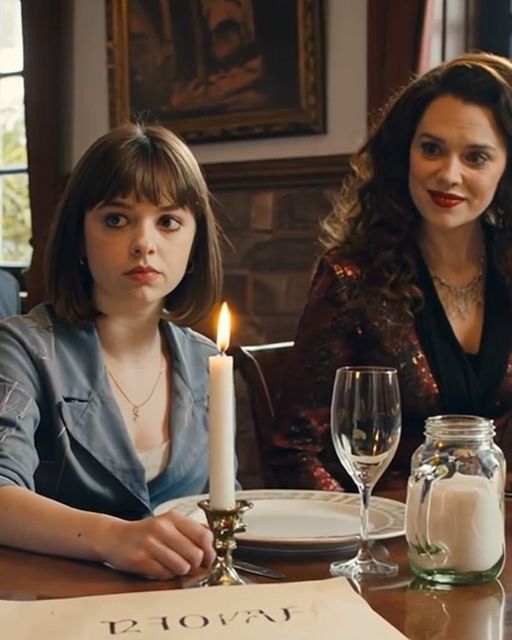
The restaurant was supposed to be safe.
Flickering candles, the low murmur of other families. I thought, for once, we could just be normal.
Then my mother opened her mouth.
“Your success means nothing,” she said, her voice sharp enough to cut glass. “Chloe is my gold.”
My sister Chloe, the golden one, just smiled. My father stared into his lasagna.
The words landed, but they weren’t the real weapon.
I pushed a manila folder across the tablecloth. It slid past the bread basket and came to a stop right next to her wine.
Her eyes narrowed.
“Take my mother’s gold,” I said. “And pay it back.”
Inside the folder was the truth. Bank statements. Screenshots. IP traces from my work computer.
And on the top page, one number.
$45,000.
My father’s fork slipped from his hand and clattered onto his plate. Chloe’s lipstick smile fractured.
Even my mother, for the first time, had no script.
For years, I was the background noise. The second-place ribbons they shoved in a drawer, the achievements they never mentioned.
Chloe got the lifeboats. I learned how to swim.
So I kept receipts. Every “loan” she never paid back. Every time she “borrowed” my information. Every lie they covered for her.
The bill had finally arrived.
My voice was steady. It felt like someone else’s.
“No more loans. No more keys. No access to my accounts. And a public apology.”
“You’re cruel,” my mother hissed, reaching for my hand.
I pulled it back.
“She’s your sister. She’s your blood.”
I stood up, the legs of my chair scraping against the floor. The whole room felt cold.
“You chose your gold,” I said, looking right at her.
“You can pawn it, you can polish it, or you can bury it.”
“But you don’t get to melt me down to pay for it.”
The silence that followed was heavier than anything I had ever felt.
I turned and walked away. I didn’t run. I walked with a purpose I hadn’t felt in years.
Each step toward the heavy oak door was a word in a sentence I had been writing my whole life.
The sentence was “I’m done.”
The cold night air hit my face like a splash of water, and for a second, I couldn’t breathe.
I fumbled for my car keys, my hands shaking so hard I could barely fit the key in the lock.
Once inside, I just sat there in the driver’s seat, the engine off, the parking lot lights making patterns on the dashboard.
I expected to cry. I had a whole reservoir of tears saved up for this moment.
But nothing came. I just felt empty. Hollowed out.
Then my phone buzzed. It was a text from my mother.
“I cannot believe the scene you just made. You have embarrassed this entire family.”
I stared at the words. Not ‘are you okay?’. Not ‘let’s talk about this.’ Just shame.
Another buzz. Chloe. Her name flashed on the screen as she tried to call.
I pressed the red button, silencing her.
A moment later, a text from her. “How could you do this to me? You know I was going to pay you back!”
The lie was so familiar, so worn-in, it was almost comfortable.
Then a third buzz. My father.
“Please, Sarah. Just come back. We can sort this out.”
I read his words, and a single, hot tear finally escaped and traced a path down my cheek.
He was the quiet one. The one I always hoped would step in.
But his version of sorting things out was always me giving in.
I turned my phone off and tossed it onto the passenger seat.
The silence that filled my car was mine. It belonged to me.
Driving home, the city lights blurred into long streaks.
My small apartment felt like a sanctuary when I finally closed the door behind me.
I didn’t turn on the lights. I just sank onto my couch in the dark.
And I remembered.
I remembered being sixteen, working all summer to save for a new laptop for my coding classes.
I remembered Chloe “borrowing” it for a weekend and it coming back with a cracked screen and a virus.
My mother had told me not to be so selfish. “It’s just a thing, Sarah. Chloe feels terrible.”
Chloe hadn’t felt terrible. She’d been annoyed she couldn’t use it anymore.
My father had quietly given me two hundred dollars toward the repair, a secret transaction that taught me love was something to be hidden.
The pattern was set. My work, my money, my stability – it was all just a community resource for them to tap when Chloe’s shine needed polishing.
I turned my phone back on hours later, the need to know winning out over the desire for peace.
Dozens of missed calls. A string of texts from my mother, each one more venomous than the last. They ranged from accusations of jealousy to threats of cutting me out of the family, which was laughable.
I was already out. I’d just been the last one to realize it.
But it was the folder that held the real story. The final, unforgivable act.
The $45,000 wasn’t from a hundred small cuts. It was from one giant, gaping wound.
A few months ago, I had started getting strange letters from a business loan company.
I’d ignored them at first, thinking it was junk mail.
But then the certified letters started. And the phone calls.
Chloe, it turned out, hadn’t just stolen money from my account.
She had stolen my identity.
She had used my perfect credit score, my financial history, and a forged digital signature to apply for a massive loan.
Her dream was to open an online boutique selling overpriced, fast-fashion jewelry.
The folder contained the loan application. My name. My social security number.
It also contained the business records. The boutique had folded in less than three months.
She had burned through the entire forty-five thousand dollars with nothing to show for it.
She had gambled with my future, my name, my entire financial stability, and lost.
And when I had first confronted her about it, alone, she had cried and said Mom and Dad told her it would be fine, that I had enough success to share.
They knew. Maybe not the details, not the forgery, but they knew she had taken something massive.
They had chosen to help her hide it, hoping I would never find out.
That was the twist of the knife. It wasn’t just Chloe’s recklessness. It was their complicity.
The next morning, my doorbell rang.
I wasn’t expecting anyone. I looked through the peephole and my heart sank.
It was my father, standing there alone, holding a bag from a coffee shop.
He looked tired. Older than he had last night.
I opened the door.
“Can I come in?” he asked, his voice soft.
I stepped aside and let him pass. He put the bag on my small kitchen counter.
“I brought you a latte. The kind you like,” he said, not looking at me.
We stood in silence for a moment.
“I’m not here to ask you to forgive her,” he finally said, turning to face me. “I’m not here to ask you to come back.”
He paused, and the next words seemed to cost him something.
“I’m here to ask you to show me. Show me everything. The real story, not the one your mother tells.”
I looked at him, searching for the trap. I didn’t find one.
I just saw a man who looked lost.
So I retrieved the folder from my bag. I spread the papers out on the counter, right next to the coffee he brought.
I walked him through it all. The loan application. My forged signature next to a box she’d ticked, claiming I was a silent partner in her business.
I showed him the default notices that were now coming to my address. I showed him the emails from the loan company threatening legal action.
His face, which had been pale, seemed to drain of all its remaining color.
He put a hand on the counter to steady himself.
He had known about the money. He had not known about the fraud. The crime.
He saw, right there in black and white, that this wasn’t about a spoiled child.
This was about a daughter who had committed a felony against her own sister.
And about parents who had looked the other way.
He sank into one of my kitchen chairs and put his head in his hands.
He didn’t speak for a long time. The only sound was the hum of my refrigerator.
“All these years,” he finally whispered, his voice muffled. “I just wanted peace.”
“There was never any peace, Dad,” I said, my voice gentle but firm. “You just had a quiet war.”
He looked up at me, his eyes full of a pain I’d never seen before.
“I’m going to fix this,” he said. It wasn’t a promise. It was a statement of fact.
He stood up and walked to the door.
“This isn’t on you anymore, Sarah. I’ll handle it.”
He left, and I didn’t know what to think. Part of me was relieved. Part of me was waiting for the other shoe to drop.
Two days later, a wire transfer notification popped up on my phone.
$45,000. Deposited into my account.
The reference was simple: “From your father.”
I stared at it, and this time, the tears came. Not of sadness, but of shock.
A week after that, my father called me.
“I need to tell you what happened,” he said.
He explained that he had a separate savings account. It was an inheritance from his own mother, my grandmother, who had passed away years ago.
He’d kept it secret from my mother, knowing her inability to manage money. It was his emergency fund.
“This was the emergency,” he said simply.
He had gone home that day and sat my mother and Chloe down at the same dining room table where they’d had the disastrous dinner.
He laid out the papers just as I had for him.
He told them he had paid the debt. But the payment came with terms.
His terms. Not mine.
Chloe had thirty days to find a job. Any job.
She was to start paying him back, even if it was a tiny amount each month, as a recognition of the debt.
She was also required to attend financial counseling sessions.
And she had to write me a letter. A real one.
My mother, he said, had exploded. She called him a traitor. She accused him of choosing me over them.
And for the first time in their forty-year marriage, my father didn’t back down.
He told her that her worship of one daughter had crippled her and nearly destroyed the other.
He gave her an ultimatum of his own. They would start marriage counseling together. If she refused, he was prepared to leave.
The golden pedestal she had built for Chloe had finally crumbled, and it had taken the foundation of their entire family with it.
A few weeks later, an envelope arrived. It was small and plain.
Inside was a single sheet of notebook paper, written in Chloe’s loopy, dramatic handwriting.
It wasn’t eloquent. It was full of crossed-out words and tear-stains.
It was a clumsy, rambling mess of excuses and self-pity.
But buried in the middle of it all was one sentence.
“I am so, so sorry for what I did to you.”
I folded the letter and put it away. It wasn’t forgiveness, not yet. But it was a start.
Months turned into a year.
I heard through my father that Chloe got a job as a receptionist at a dentist’s office.
Every month, a small transfer of $100 would appear in my account from her.
It wasn’t about the money. It was about the act. It was a quiet acknowledgment, month after month.
My father and I started having lunch every other Sunday.
We didn’t talk about my mother or Chloe much.
We talked about my work. About the books he was reading. We got to know each other, not as a buffer and a bystander, but as two people.
He told me that he and my mother were still in counseling. It was hard, he said. He didn’t know if they would make it.
But he was no longer afraid of the quiet.
My relationship with my mother and sister remained a vast, silent space. I had not seen them since that night in the restaurant.
Maybe one day that will change. Maybe it won’t.
But the emptiness I felt that night has been filled with something else.
Peace. A real, sturdy peace that I built myself.
My success, the thing my mother dismissed, is what saved me. Not because of the money, but because it taught me I was capable. It taught me I had value outside of what my family assigned me.
I learned that sometimes the most loving thing you can do is to walk away.
You have to draw a line, not out of cruelty, but out of respect for yourself.
True wealth isn’t gold you can hold in your hand.
It’s the quiet, unshakable knowledge of your own worth. And that is something no one can take from you.