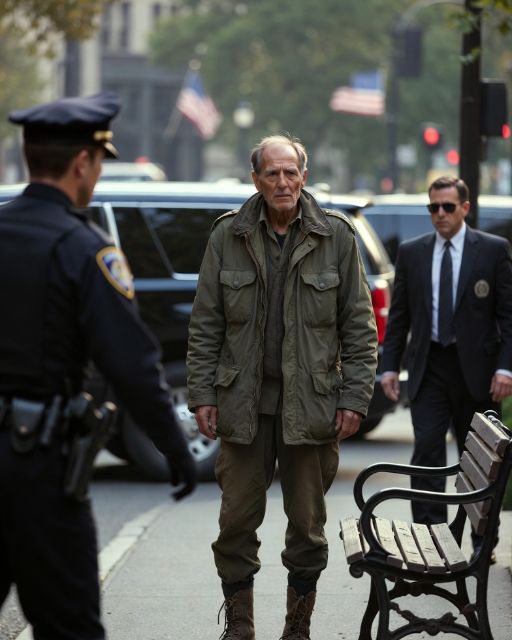
There’s an old man who sits on the park bench across from my hot dog stand every day. Wears a faded army jacket, even in the heat. Never asks for money, just stares. Today, a new park cop, young kid full of himself, decided to make a name. He told the old man to move along. The old man didn’t budge. So the kid called for backup to arrest him for loitering.
As they were trying to get the cuffs on him, two black cars, the kind you see in movies, pulled up silently. No sirens. Men in dark suits and sunglasses got out. They walked right up to the scene. The young cop said, “Stay back, this is police business.”
The man in the lead suit didn’t even look at him. He walked straight to the old beggar, who was now standing up. The agent spoke, his voice low and full of respect. “Sir. It’s time.”
The cop, confused, grabbed the agent’s arm. “Hey! Who the hell are you?”
The agent turned slowly. He opened his jacket to show a badge and a holstered gun. “We’re his security detail. Now take your hands off me before you cause an international incident with the man who taught the President how to tie his shoes.”
The world seemed to stop for a second. Even the pigeons paused their pecking.
The young cop, Miller, just stood there with his mouth hanging open, his hand still hovering where the agent’s arm had been. His partner looked like he’d seen a ghost.
The old man, who I’d only ever known as a silent fixture of the park, sighed. It was a deep, weary sound, the kind that holds years of weight. He looked at the lead agent. “Thorne, I told you. No fuss.”
“This qualifies as a fuss, Arthur,” the agent named Thorne replied gently. “We had an agreement. We keep our distance, unless your well being is compromised.” He gestured with his chin toward the handcuffs dangling from Officer Miller’s hand. “I believe this qualifies.”
I stood frozen behind my cart, the smell of sizzling onions suddenly seeming ridiculous and out of place. I’d seen Arthur every day for two years. Every morning, around ten, he’d arrive. Around eleven-thirty, I’d walk over and hand him a hot dog with mustard and a bottle of water.
He never asked for it. The first time I did it, he just looked at the food, then at me, with eyes that were a startlingly clear blue. He gave a single, slow nod. That became our ritual. A nod of thanks, and he’d eat in his slow, deliberate way. We never exchanged a single word.
Now, this man, this quiet, forgotten piece of the city, was surrounded by men who looked like they could topple governments. He wasn’t a beggar. He was… Arthur.
And he apparently taught the most powerful man in the world a basic childhood task.
Officer Miller finally found his voice, though it was shaky. “Security detail? For… for him?” He was looking at Arthur’s worn boots, the frayed cuffs of his jacket. His brain just couldn’t make the pieces fit.
Thorne didn’t bother to answer him. He was focused only on Arthur. “The President has been trying to reach you. He was worried when you didn’t answer the weekly check-in.”
Arthur ran a hand over his tired face. “There’s nothing to say. I’m fine.”
“With all due respect, sir, you’re about to be arrested for vagrancy,” another agent said, his tone dry.
A small, sad smile touched Arthur’s lips. “Irony is a cruel mistress, isn’t she?”
He looked over at me then, his gaze locking with mine from across the small plaza. That clear blue stare held a flicker of apology, as if our quiet understanding had been shattered and he was sorry for it. I just gave a small nod, the way he always did to me.
Thorne spoke into his wrist. “Situation is stable. Prepare for departure.” He then turned to Officer Miller, his expression unreadable behind the dark glasses. “Officer, your name.”
The kid swallowed hard. “Miller. Officer Ken Miller.”
“Officer Miller,” Thorne said, his voice flat and cold. “You are about to receive a call from your precinct captain. And after that, his commander. And after that, probably the mayor’s office. I suggest you answer.”
Miller’s face went from pale to sheet-white. He looked from Thorne to Arthur, a dawning horror spreading across his features. He hadn’t just tried to cuff a loiterer. He had tried to cuff a national treasure, or something very close to it.
The agents gently guided Arthur toward one of the black cars. He moved stiffly, like an old machine whose parts had started to rust. Before he got in, he paused and looked back at my hot dog stand. He looked at me.
Thorne followed his gaze. He saw me, standing there with a spatula in my hand.
“Frank,” Arthur said. His voice was raspy from disuse, but clear. It was the first time I had ever heard him speak my name. I didn’t even know he knew it.
“Yeah?” I managed to croak out.
“Thank you for the lunch,” he said. “Every day.”
Then he got into the car, and the door closed with a solid, expensive thud. The black cars pulled away as silently as they had arrived, leaving a stunned silence in their wake.
The only sound was the frantic squawking of Officer Miller’s radio.
The next day, the park felt empty. The bench was just a bench. I kept looking over, expecting to see that faded army jacket, but it was just wood and metal. I cooked hot dogs on autopilot, the whole scene from yesterday replaying in my head.
Taught the President how to tie his shoes. What did that even mean?
Around noon, a different kind of car pulled up. Not a black SUV, but a modest blue sedan. A woman in a simple pantsuit got out. She had a kind face and tired eyes. She walked right up to my cart.
“Are you Frank?” she asked.
“I am,” I said, wiping my hands on my apron.
“My name is Sarah. I’m a presidential aide,” she said, as if she were telling me she worked in accounting. “I was sent to give you this.” She handed me a thick envelope.
I looked at it. It had the official seal of the White House on it. My hands started to shake a little.
“What is this?”
“It’s from the President,” she said. “And from Arthur.”
I opened it right there on my cart. Inside was a letter, and a check. I read the letter first. The script was elegant, thoughtful.
It was from the President. He wrote that Arthur Abernathy had been his mentor at a boys’ club in a rough neighborhood a long, long time ago. His own father had left, and Arthur had become the father figure he desperately needed. Arthur taught him about integrity, about respect, about how to be a good man when the world was telling you not to be.
And yes, the letter confirmed, one afternoon when he was seven and frustrated, Arthur had sat with him on the floor of a dusty gymnasium for an hour, patiently teaching him the “bunny ears” method of tying his shoelaces, because no one else ever had. It was a small thing that meant everything.
The letter went on. Arthur had become a history teacher. He had a wife, a daughter. He lived a simple, good life. Then, about three years ago, a drunk driver had taken both of them from him in an instant.
Arthur broke. He lost his house, his pension, everything. He just… walked away from his life. The President had tried to help, offered him a place to live, money, anything. But Arthur, in his grief and pride, refused all of it. He said he needed to find his own way back.
So the President did the only thing Arthur would let him do. He assigned a discreet Secret Service detail to watch him from afar. Their orders were to be invisible. To let Arthur live how he chose, but to intervene if he was ever in real danger.
Officer Miller, in his arrogance, had constituted real danger.
The letter ended with a personal thank you. “Frank,” the President had written, “Arthur told me about you. He said in a world that had turned its back on him, you showed him kindness without asking for anything in return. You treated him like a human being. That is a debt I can never truly repay, but I hope this helps.”
I finally looked at the check. My breath caught in my throat. It was for fifty thousand dollars.
I looked at the aide, Sarah, my eyes wide. “I… I can’t take this.”
“You can, and you should,” she said with a soft smile. “It’s not a handout. It’s a thank you. Arthur insisted. He said you have a daughter starting college soon. He overheard you on the phone one day.”
I remembered talking to my daughter, Maria, telling her we’d figure out the tuition, not to worry, even though I was terrified about how we’d afford it. Arthur had been sitting on that bench, just staring. But he wasn’t just staring. He was listening. He was present.
That’s when the first twist really hit me. Arthur wasn’t some eccentric billionaire or a fallen general. He was just a man. A good man, broken by grief, who held onto his dignity with all his might. The President wasn’t his commander or his employee. He was the kid Arthur had saved, trying desperately to save him back.
But the story wasn’t over.
A week later, Officer Miller came to my cart. He looked smaller, humbled. He ordered a hot dog and paid for it.
“I wanted to apologize,” he said, not looking at me. “To you. For the scene I caused. And… well, you were his friend.”
“I just gave him lunch,” I said.
“No, you did more than that,” Miller replied, finally meeting my eyes. “My captain read me the riot act. Said I judged a man by his coat and not his character. He said I should come learn from the hot dog guy who understood that better than a sworn officer.”
He took a bite of his hot dog. “They didn’t fire me. They put me on notice. And they reassigned me. To a community outreach program, working with the homeless.”
It was a punishment, sure, but it was also a chance. A chance for him to see the Arthurs of the world for who they really were.
“That’s good,” I said. And I meant it.
Life went on. I paid for Maria’s first year of college. I thought about Arthur a lot. I hoped he was okay.
Then, about a month later, Thorne, the Secret Service agent, showed up at my cart. He wasn’t wearing the suit, just a polo shirt and slacks. He looked like a regular guy.
“Frank,” he said, nodding.
“Agent Thorne,” I replied.
“Just David today,” he said. “Arthur wants to see you. If you have time.”
He drove me out of the city, to a quiet little house by a lake. It was modest, but peaceful. On the porch, in a rocking chair, sat Arthur.
He wasn’t wearing the faded army jacket. He was in a clean flannel shirt. He’d shaved. The deep lines of grief were still on his face, but his blue eyes seemed clearer. He looked… lighter.
We sat there for a while, not saying much. I told him about Maria starting school, and he smiled a real smile.
“I couldn’t take the President’s charity,” he finally said, looking out at the water. “Felt like I’d failed. But I could accept a thank you from a friend. And Frank, I could accept a hot dog from a neighbor.”
He explained that after the incident in the park, he realized he couldn’t live like that anymore. It wasn’t fair to the people who cared about him. He agreed to let the President help him get back on his feet, but on his own terms. This house was a rental. He was seeing a grief counselor. He was starting over.
“I have one more thing for you,” he said, and he handed me a framed picture.
It was an old, black-and-white photo of a rundown gymnasium. A man who I recognized as a much younger Arthur was on the floor, his hands guiding the hands of a small, skinny kid with big ears and a determined frown. They were tying a shoe.
“He was a good kid,” Arthur said quietly. “Always was.”
That’s when the final, most important piece clicked into place for me. The second twist. I asked him the question that had been bothering me for a year.
“Arthur, why that bench? In that specific park? There are hundreds of benches in this city.”
He looked at me, and his expression was one of profound sadness, but also of love.
“That hot dog stand of yours, Frank,” he said slowly. “Before it was your stand, it was a little newsstand. And before that, it was a bus stop.”
He paused, gathering his thoughts.
“My daughter… my Sarah… she was an artist. She loved that park. The day she… the day of the accident… she was supposed to meet me for lunch. She was waiting for me at that bus stop.”
My heart stopped.
The bench he sat on every day wasn’t just a bench. It was the last place his daughter had been. He wasn’t just staring into space. He was looking at the spot where she last stood, trying to hold onto the final, fading memory of her. He wasn’t homeless because he’d lost his money. He was homeless because he’d lost his home when he lost his family. The park was his vigil.
And I, without knowing it, had set up my little cart of hope right in the middle of his grief. I had been a part of his daily memorial, a small, warm presence in his cold, lonely world.
The President’s money was an incredible gift, but this knowledge, this was the true reward. It was the understanding that you can touch a life in the most profound way without even knowing it.
We all just want to be seen. That’s the lesson. Whether you’re a president in a big white house or a man on a park bench, you just want someone to see the real you. To offer you a hand, or a hot dog, and not ask for anything in return. Kindness is a language everyone understands, even when no words are spoken. Arthur, in his silent grief, taught me that. And I guess, in my own way, I helped remind him that he was still worth seeing.