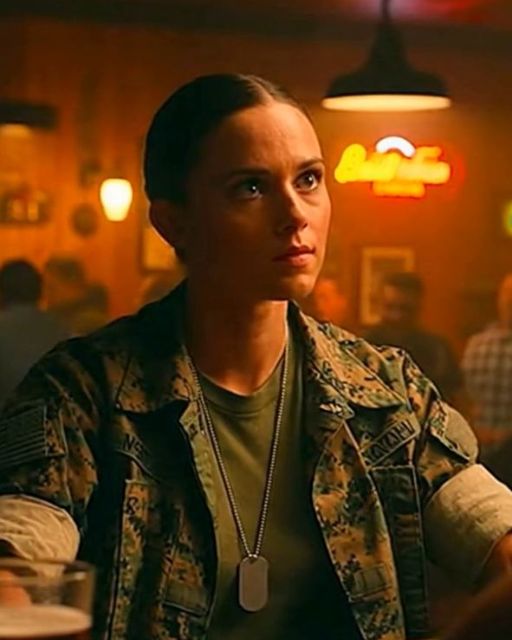
The laughter died the second our hands clasped over the sticky table. I was just home on leave, trying to have a quiet beer. But Daryl, the local arm-wrestling “king,” wouldn’t shut up about “women playing soldier.”
I saw red. Before I knew it, I was walking to his table. “Let’s go,” I said.
His friends howled. “Careful, honey, you’ll break a nail,” Daryl smirked, flexing a bicep twice the size of my own. The whole bar was watching, waiting for the joke to land.
He gripped my hand, expecting to slam it down in a second. I just breathed. I felt the familiar calm of focus. I used his own weight against him, twisted my wrist, and drove his knuckles into the wood.
SLAM.
Dead silence. Daryl stared at his hand on the table as if it had betrayed him. His face went purple. He snatched his hand back. “You got lucky,” he snarled. “You’re nothing.”
That’s when an old man from the corner of the bar stood up slowly. “You watch your mouth, boy,” he said, his voice quiet but carrying across the room. “You know who that is?”
Daryl scoffed. “Some girl who…”
“That’s the soldier your own father writes letters to every single month,” the old man cut in. “The one he calls his ‘guardian angel.’ He never told you what she did for him over there, did he? He was probably too ashamed to tell you the truth about…”
The old man’s words hung in the stale, beer-scented air. He let the sentence trail off, leaving a void that everyone in the bar seemed desperate to fill.
Daryl’s face, which had been a mask of rage, now twisted into confusion. “What are you talking about, old man?” he stammered, his bravado finally cracking.
The man was Mr. Henderson. He ran the hardware store down on Main Street and had been a fixture in this town longer than the oak tree in the square.
“I’m talking about your father, Robert,” Mr. Henderson said, taking a slow step forward. His eyes, usually clouded with age, were suddenly sharp as glass.
“My father is a hero,” Daryl spat, puffing his chest out again, but it was a hollow gesture. “He got wounded in action. He earned his medals.”
“He did get wounded,” Mr. Henderson agreed, his voice softening just a fraction. “But he never told you how. He never told you who was there.”
All eyes in the bar shifted from Daryl to me. I hadn’t moved. I just stood by the table, my heart thumping a slow, steady rhythm against my ribs. I never wanted this. I never wanted any of it.
The money Robert sent me every month was a secret I kept out of respect for him. It always arrived in a plain envelope with no return address, but I knew.
“My father and I served in the same theater, different units,” Mr. Henderson explained to the silent room. “We wrote to each other. He told me things, Daryl. Things a man can’t always tell his own son.”
Daryl looked like a cornered animal. His friends, who had been laughing moments before, were now inching away from him, their faces pale.
“He told me about the convoy,” Mr. Henderson continued, his gaze fixed on Daryl. “The one that got hit on the supply route to the outpost.”
I closed my eyes for a second, the memory flashing behind them. The dust. The sudden, deafening crack of gunfire. The smell of hot metal and fear.
“Your father was a supply sergeant,” the old man said gently. “A good one. But he wasn’t a combat guy. He wasn’t trained for that kind of firefight.”
“He fought back,” Daryl insisted, his voice cracking. “He told me he…”
“He told you what he needed to tell you, son,” Mr. Henderson interrupted. “The truth is, he froze. Anyone could have. It was a bad one.”
The silence in the room was now absolute. You could hear the hum of the beer cooler and the frantic beating of Daryl’s pride.
“The first round hit the engine of their truck,” he went on, painting the scene for everyone. “It stalled right in the kill zone. They were sitting ducks.”
I remembered Robert. He was a big man, bigger than Daryl, always loud and full of jokes back at the base. But in that moment, he had seemed so small.
He was curled up on the floor of the truck, his hands over his head, shaking uncontrollably. He was just trying to disappear.
“He was about to get hit,” Mr. Henderson’s voice was low and somber. “A piece of shrapnel from a grenade went right through the spot where his head had been a second before.”
“But it missed,” he said, and then he turned his head and looked directly at me. “Because she pulled him down. She dragged your father, a man twice her size, into cover behind the engine block.”
I could still feel the strain in my shoulders, the burn in my muscles as I hauled his dead weight across the metal floor.
“She was just a private then,” he said. “Just a kid, really. But she didn’t freeze. She kept her head.”
Daryl stared at me, his mouth hanging open. The “girl playing soldier” was suddenly someone else entirely. She was a ghost from his father’s past, standing right in front of him.
“She got on the radio while under fire,” Mr. Henderson’s story continued. “The comms officer was hit, but she patched the wires, got a signal, and called in their position. She coordinated a defense with the three other soldiers who weren’t wounded.”
I remembered the static, the frantic calls, the feeling that time was stretching and snapping all at once. It wasn’t bravery. It was just… procedure. It was training kicking in when everything else shut down.
“She held them off long enough for air support to arrive. She saved every single person in that convoy, Daryl. Including your father.”
Robert had been grazed by a bullet in the chaos. That’s where his “wound” came from. It was a scratch on his arm, but it was enough to earn him a ticket home.
“He was so ashamed,” Mr. Henderson said, his voice full of a sorrow that felt ancient. “Ashamed that he had panicked. Ashamed that a young woman had to save his skin. He couldn’t face you, his son, who thought he was John Wayne.”
So he created the myth. The brave soldier wounded in a firefight. And the “guardian angel,” an anonymous figure he could praise without ever having to admit the whole truth.
“The money he sends her every month?” Mr. Henderson looked around the bar. “That’s not charity. That’s his penance. It’s his way of saying thank you, because he was too proud and too broken to ever say it to her face.”
The story was finished. The secret was out. Daryl just stood there, his massive frame seeming to shrink before our very eyes. The town’s arm-wrestling king, the loudmouth bully, was just a boy whose hero had just been revealed as a man. A fragile, scared man.
He didn’t say a word. He just turned and stumbled out of the bar, pushing through the swinging doors and disappearing into the night.
The bar started to breathe again. A low murmur went through the crowd. Someone coughed. The bartender quietly started wiping down a glass.
Mr. Henderson walked over to me. His face was etched with a deep weariness. “I’m sorry, Sarah,” he said, using my name for the first time. “I shouldn’t have done that. It wasn’t my story to tell.”
I shook my head. “It’s okay, Mr. Henderson. Maybe… maybe he needed to hear it.”
“Maybe,” he agreed, though he didn’t sound convinced. He signaled to the bartender. “Get her whatever she wants. Put his beer on my tab, too.”
He was pointing to the half-finished bottle Daryl had left behind.
I spent the next couple of days lying low at my parents’ house. The phone rang a few times with calls from people who were at the bar, but I let my mom handle it. The whole town was buzzing with the story.
I felt a strange mix of emotions. I was angry that my privacy had been violated, but I was also relieved. The secret had been a weight I didn’t realize I was carrying.
Robert’s shame wasn’t mine to own. I never judged him for what happened that day. Fear is a funny thing. It’s a part of the job. You just hope your training is stronger. Sometimes it is, sometimes it isn’t.
On the third day, I was in the garage, my hands covered in grease, trying to fix the carburetor on my dad’s old pickup truck. It was my go-to therapy. The logic of an engine, the satisfaction of making something broken work again.
I heard footsteps on the gravel driveway. I looked up, wiping my forehead with the back of a greasy hand, and saw Daryl standing there.
He looked terrible. His eyes were red-rimmed, and he hadn’t shaved. The usual arrogance was gone, replaced by a raw, uncertain humility.
He just stood at the edge of the garage, shifting his weight from one foot to the other. He looked like a kid waiting to be scolded.
“Hi,” he finally managed to say. His voice was hoarse.
“Hey,” I said, turning back to the engine. I wasn’t going to make this easy, but I wasn’t going to be cruel either.
“I, uh… I went and talked to my dad,” he said, taking a hesitant step forward.
I paused, my wrench hovering over a bolt. I looked at him.
“He told me everything,” Daryl said, his eyes welling up. “Mr. Henderson was right. About all of it.”
He swallowed hard. “He cried. I’ve never seen my dad cry before. Not once in my whole life.”
I didn’t know what to say to that. So I just listened.
“All these years,” he continued, his voice thick with emotion, “he built this whole life around being a hero. The VFW, the parades, the stories he’d tell me and my friends… it was all he had.”
“He built me on that story, too,” Daryl admitted, looking at his own hands. “I tried to be like him. Big. Strong. Fearless. Turns out, I was just being loud.”
A long silence stretched between us, filled only by the chirping of crickets in the afternoon heat.
“He told me something else, though,” Daryl said, his voice dropping to a near whisper. “Something he never even told Mr. Henderson.”
This was new. I put my wrench down on the fender.
“It wasn’t just… random fear,” he struggled to explain. “It was more than that. My grandfather, my dad’s dad… he was killed in service.”
I nodded slowly. I knew that part. His photo was on the wall at the VFW hall.
“What my dad never told anyone,” Daryl said, looking me straight in the eye, “is how he died. It was an ambush. On a supply convoy. Almost the exact same situation.”
The air went out of my lungs.
“My dad was just a boy. He heard whispers his whole life. That his father was careless. That he shouldn’t have been there. That maybe he was a coward who got himself and his men killed.”
The pieces clicked into place. Robert hadn’t just joined the army to serve his country. He had joined to fight the ghost of his own father. To prove he wasn’t a coward.
And when he found himself in the exact scenario that had claimed his father’s life, the generational trauma, the deep-seated terror, came rushing to the surface. It wasn’t just his own life he was afraid of losing. It was the fear of repeating a history that had haunted his family for decades.
“He panicked,” Daryl said, a tear finally tracing a path through the stubble on his cheek. “Not just because of the bullets. But because he thought he was becoming his father. He thought he was proving all the whispers right.”
Suddenly, it all made sense. The shame. The secrecy. The money sent in a plain envelope. It wasn’t just about a soldier freezing under fire. It was about a son terrified of failing a father he barely knew.
“I’m sorry,” Daryl said, his voice breaking completely. “For what I said. For how I acted. For everything. I was a fool.”
I looked at him, really looked at him, for the first time. I didn’t see the town bully anymore. I saw a man whose entire world had been built on a fragile lie, a lie created to protect a family’s broken heart.
I picked up my wrench again, then looked from the engine to his large, capable hands.
A small smile touched my lips. “You know anything about carburetors?”
He looked surprised, then a flicker of a smile appeared on his own face. “A little,” he said. “My dad taught me.”
“Good,” I said, tossing him a rag. “Get in here. This thing is being a real pain.”
For the rest of the afternoon, we worked on that engine together. We didn’t talk much about that day in the desert, or about his father, or about the bar. We just talked about spark plugs and gaskets and the right way to tune an engine.
It was a start.
My leave ended a week later. On my last night, I went back to the bar for a farewell drink with my parents. The atmosphere was completely different.
Daryl was there, sitting with some of his friends. When I walked in, he didn’t smirk. He just raised his glass to me in a quiet salute. I nodded back.
The story had made its way around town, but it had changed in the telling. It was no longer a story about a bully getting his comeuppance. It was a story about two soldiers, and the complicated, messy nature of courage.
The day before I left, a letter arrived. It was from Robert. It was the first one that wasn’t in a plain envelope. It had his name and return address.
Inside, there was no check. There was just a single sheet of paper.
“Sarah,” it began. “I don’t know how to thank you. For years, I thought you only saved my life that day. But I was wrong. You saved my life, and last week, you saved my son. You gave me the chance to finally tell him the truth. You freed me. I will never be able to repay you for that. With deepest gratitude, Robert.”
As my dad drove me to the airport, I looked out at the familiar streets of my hometown. It looked the same, but it felt different. I felt different.
Strength, I realized, isn’t about how much you can lift or how loud you can shout. It’s about the quiet things. It’s about pulling someone to safety when you’re just as scared as they are. It’s about admitting you were wrong. It’s about forgiving someone for being human.
Courage isn’t the absence of fear; it’s doing the right thing even when your hands are shaking. We’re all fighting some kind of battle, haunted by our own ghosts. The greatest victories aren’t the ones where we knock someone down, but the ones where we help them get back up.