This woman, Maya Washington, showed up at the airfield looking like she belonged at a bake sale. Faded jeans, a flannel shirt, gray hair in a ponytail. She wanted to rent a Cessna 172. Fine.
People do it all the time.
Then she hands me her requested flight path. High-G turns, stall recoveries, a vertical climb that would tear the wings off. I laughed.
I told her, “Ma’am, this is a Sunday flying school, not Top Gun. Go home and bake some cookies.” I was trying to be nice, you know?
Keep her safe.
She just looked at me, dead calm, and said she’d stick to a simple loop. She went to the desk, signed the papers, and took the keys.
I figured she’d putter around for a bit and land.
But the moment her wheels left the ground, she became something else.
The plane didn’t climb. It launched. She pulled that old Cessna into moves that break physics.
People at the airshow stopped eating their food. Everyone was just staring at the sky.
It wasn’t reckless. It was perfect.
Too perfect. It felt like a threat.
I did what I had to do. I called it in.
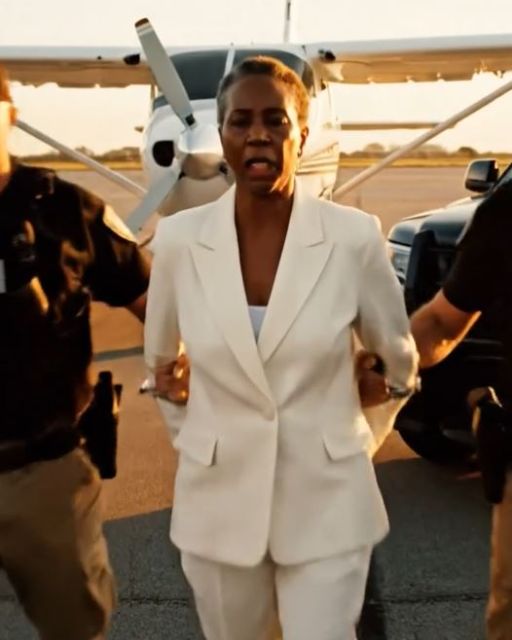
When she landed, smooth as silk, three black SUVs from Homeland Security swarmed the tarmac. They cuffed her right there.
I felt a little bad, but relieved. We had no idea who she was.
I was in the station when they were processing her. She wouldn’t say a word.
Just sat there, staring at the wall. The lead agent was getting angry.
He yanked her arm and the cuff slid down her wrist, showing a bit of dark ink.
“Roll up that sleeve,” he ordered.
Slowly, she pushed the flannel up her forearm. It wasn’t a flower or a name.
It was a single, stark tattoo: a black raptor perched on a series of numbers. The agent stopped cold.
His face went pale. He grabbed his radio, his hand shaking, and whispered into it.
“Command, we have a Ghost Eagle. I repeat, we have a Ghost Eagle. The number on her wrist is 0-7-7.”
A silence fell over the room that was louder than any shouting. The agent, a guy named Miller who looked like he chewed rocks for breakfast, slowly lowered his radio.
He looked at Maya not as a criminal, but as a ghost.
His entire demeanor changed. He walked over and gently, almost reverently, removed the cuffs from her wrists.
“Ma’am,” he said, his voice now a respectful murmur, “we need you to come with us.”
She just nodded, not a flicker of surprise on her face. It was like she’d been waiting for this moment for fifty years.
They didn’t take her to a jail cell. They took her somewhere else.
I went home that night, but I couldn’t sleep. The image of that plane, a simple trainer, dancing in the sky like an F-22, was burned into my mind.
And the look on that agent’s face when he saw the tattoo. It was pure, unadulterated shock.
Who was this woman? And what in the world was a Ghost Eagle?
My name is Sam Peterson. I inherited this little airfield from my father, a retired Air Force colonel who passed away five years ago.
He was a quiet man who loved planes more than people, I think. He taught me everything I know.
I felt a pit of guilt in my stomach. I’d called the feds on a woman who, for all I knew, was a national hero.
My dad had an old friend, a General Fitzpatrick, still kicking around the Pentagon. I hadn’t spoken to him since the funeral.
With trembling hands, I found his number. I had to know.
“Sam, my boy, good to hear from you,” he boomed over the phone. “What’s on your mind?”
I told him the whole story. The old lady, the Cessna, the impossible flight, and the tattoo.
When I said the words “Ghost Eagle,” the line went dead silent. For a long, uncomfortable moment, I thought he’d hung up.
“Fitz?” I asked.
“Sam,” he said, his voice low and serious. “Where are you right now? Are you alone?”
He told me things that shouldn’t have been real. Things that sounded like they belonged in a spy movie, not my life.
The Ghost Eagles were a legend. A myth. An unofficial, unsanctioned program from the height of the Cold War.
They took the best of the best. Pilots who were more instinct than training. They flew experimental aircraft, pushed the absolute limits of what was thought possible.
They were deniable assets. Their records were scrubbed. Officially, they never existed.
And Maya Washington, code-named “Raptor,” was their ace. She was the best pilot anyone had ever seen.
“What happened to them?” I asked.
“The program got too good, too independent,” Fitz explained. “A certain faction in Washington, led by a man named Marcus Thorne, saw them as a threat to the established order. So he shut them down.”
He didn’t just shut them down. He had them declared traitors.
Thorne fabricated evidence that they were selling secrets to the Soviets. He turned the country against its own hidden heroes.
Most of them were captured, imprisoned, or just disappeared. Maya was the only one who got away.
She’d been living off the grid, a ghost in her own country, for nearly half a century.
The number on her wrist, 0-7-7, was her service number. Her only proof of who she was.
After I hung up, I sat in my father’s old office, the smell of leather and oil still lingering in the air. I felt sick.
I had been the one to end her fifty years of freedom. My snap judgment, my condescending little comment about baking cookies.
I had to fix this. I didn’t know how, but I had to.
I started digging through my father’s old things in the attic. Trunks full of uniforms, medals, and flight logs.
I wasn’t looking for anything specific. I just wanted to feel close to him, to maybe find some guidance.
Tucked away in the bottom of a dusty footlocker, I found something I’d never seen before. A set of leather-bound journals.
My father wasn’t a writer. He was a man of few words. Seeing his neat, precise handwriting filling page after page was a shock.
I opened the first one. The entry was dated 1974.
“September 12th. Met the new recruits for Project Nightingale today. They’re calling them Ghost Eagles. These kids… they fly like they were born in the sky.”
My heart stopped. Project Nightingale.
My father was there. He was part of it.
I read for hours, my world tilting on its axis with every page. He was a junior officer, an administrator for the program.
He wrote about the pilots with awe. He described their camaraderie, their impossible skill.
He wrote about Maya Washington most of all.
“Raptor flew the Aurora prototype today,” one entry read. “She took it to the edge of space. We clocked her at Mach 5. The machine couldn’t keep up with her. She is something beyond human.”
Then the tone of the journals changed. He wrote about Marcus Thorne, a rising star in military intelligence.
He described Thorne’s jealousy, his paranoia, his hunger for power. My father saw the end coming.
“Thorne is manufacturing a case against them,” he wrote, his handwriting becoming frantic. “He’s twisting flight data, creating false transmissions. He’s going to burn them all to the ground to advance his own career.”
The last entry was gut-wrenching.
“They took them last night. All of them. Except Raptor. She vanished. I tried to speak up, to present my evidence of Thorne’s lies. I was reassigned to a desk in Alaska. My career is over. God help them. God help us all.”
My father had tried to save them. He was silenced. He carried that failure with him his entire life.
That was why he was so quiet. That was the sadness I always saw in his eyes.
I now held the proof. The original flight logs he’d copied, the notes on Thorne’s fabricated evidence. My father had kept everything.
He hadn’t failed. He had left a weapon for someone else to find.
He left it for me.
The next morning, I called Agent Miller. I told him I had information about Maya Washington. He was wary, but he agreed to meet me.
We met at a diner off the highway. I slid my father’s journal across the table.
“My father was Colonel Robert Peterson,” I said. “He was part of Project Nightingale.”
Miller’s eyes widened. He opened the journal and began to read.
As he read, I saw the hard lines of his face soften. He looked up at me, his expression a mixture of disbelief and hope.
“My first mentor in the agency,” Miller said softly. “A guy named Ben Carter. He always talked about a pilot named Raptor. Said she was the greatest he’d ever seen. He vanished one day. No explanation.”
Ben Carter’s name was in my father’s journal. He was one of the Ghost Eagles.
Miller wasn’t just an agent on a case anymore. This was personal for him, too.
“Marcus Thorne,” Miller said, the name like a curse on his lips. “He’s a four-star general now. Untouchable. Sits on a dozen oversight committees.”
“Not anymore,” I said. “Not with this.”
We had a plan. Miller used his authority to arrange a transfer for Maya. He told the brass she was a national security asset with historical intelligence.
They moved her to a secure debriefing room at Andrews Air Force Base.
General Marcus Thorne was “invited” to oversee the debriefing. His ego wouldn’t let him refuse.
I was there, listed as a civilian consultant. I walked into that sterile, windowless room and saw her for the first time since the airfield.
She sat at a long metal table, wearing a simple gray jumpsuit. She looked small, but her presence filled the entire room.
General Thorne strode in, flanked by two aides. He was old now, but he still had the arrogant swagger of a man who had never been told no.
He looked at Maya with a dismissive sneer. “So, this is the ghost that’s come back to haunt us. Fifty years is a long time to hide, traitor.”
Maya didn’t flinch. She just looked at him with those calm, steady eyes.
“I wasn’t the traitor, Marcus,” she said. Her voice was quiet, but it cut through the room like a razor.
Thorne laughed. “You have no proof. Your word against a decorated General of the United States Armed Forces.”
“She doesn’t need to say a word,” Miller said, stepping forward. He placed my father’s journal on the table.
“This is the personal log of Colonel Robert Peterson,” Miller announced. “He was the administrative officer for Project Nightingale. He documented everything.”
Thorne’s face went white. He stared at the journal as if it were a snake.
“Lies,” he sputtered. “Fabrications.”
“He kept copies of the original flight data, General,” I said, my voice shaking slightly. “The data you altered. He kept your memos. He kept it all.”
For the first time in her life, Maya Washington smiled. It was a small, sad, but triumphant smile.
The aides behind Thorne began to back away slowly. The truth was in the air, undeniable and suffocating for him.
He was ruined. Decades of lies, all undone by a quiet colonel’s journal and a son who wanted to right a wrong.
There was no public trial. Thorne was allowed to retire quietly, stripped of his rank and honors. It was a disgrace he had to live with in the shadows, just as he’d forced Maya to do.
The official records on the Ghost Eagles were unsealed. The surviving members, a handful of old men scattered across the country, had their names cleared.
Their stories were finally told, not in the news, but in quiet ceremonies with their families. Their honor was restored.
A few weeks later, Maya showed up at my airfield. She was wearing the same faded jeans and flannel shirt.
“I heard you give flying lessons,” she said.
I laughed. “I think you’re probably a bit over-qualified, ma’am.”
“My name is Maya,” she said, extending her hand. “And I think you and I have a lot to talk about.”
We went up that afternoon in the old Cessna. She let me fly for a while.
Then she took the controls.
She didn’t do any high-G turns or impossible climbs. She just flew.
We soared over the fields and forests, the setting sun painting the clouds in shades of orange and purple.
She flew with a kind of peace I’d never seen before. It wasn’t a performance. It wasn’t a threat.
It was just a woman, free at last, returning to the only place she ever truly felt at home.
I learned a lot that day. Not just about flying, but about the lives people carry inside them.
You can never know the battles someone has fought, the skies they’ve conquered, or the burdens they’ve carried in silence.
Every person is a story, sometimes a legend, hidden in plain sight. All you have to do is be willing to look past the surface and see the truth waiting in their eyes.