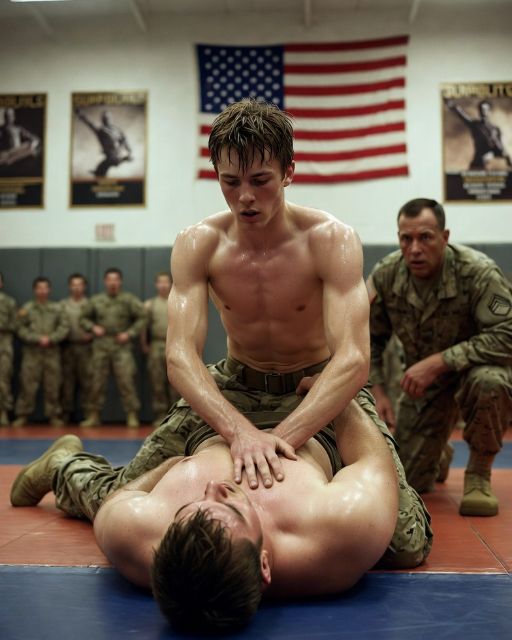
“Get up, Vance!” Sergeant Croft barked. But I couldn’t. Corporal Dixon had my face pressed so hard into the wrestling mat I could taste the sweat of a hundred other recruits. The whole platoon was laughing.
Dixon was the biggest guy in our training cycle, a 240-pound monster who made it his personal mission to break me. I was 155 pounds, soaking wet. Today’s “combatives” session was supposed to be his big show.
“One more round,” Dixon sneered, letting me up just to throw me down again. “Let’s show the little man what a real soldier looks like.” He charged. This time, I didn’t try to block. I didn’t try to dodge. As he lunged, I did exactly what my grandfather taught me to do if my life was ever on the line.
It was over in two seconds. Dixon was flat on his back, gasping for air, with my forearm pressed against his throat. The laughter stopped. Dead silence.
Sergeant Croft walked over slowly, his eyes not on the defeated Dixon, but on my grip. His face went pale. He knelt down, pointing a shaky finger at my hand placement. “No recruit is taught that hold,” he whispered, his voice trembling. “That takedown was retired from the special forces field manual twenty years ago. There was only one man who ever used it.”
He looked up from my hands and stared directly into my eyes. “Son… what’s your last name again?”
I told him. The Sergeant stumbled backward as if he’d been shot. He looked at the rest of the platoon and his voice was barely a whisper when he said, “Dismissed. All of you. Hit the showers.”
The recruits scrambled to their feet, their eyes wide, a mix of shock and confusion on their faces. They glanced from me, to the still-gasping Dixon, to the ghost-white Sergeant. No one dared to say a word.
“Vance,” Croft said, his voice now sharp and commanding. “My office. Now.”
I released Dixon and helped him to his feet. He looked at me, not with anger, but with a bewildered sort of respect. He just nodded and limped away with the others.
The door to Sergeant Croft’s office clicked shut behind us. The tiny room was suddenly the most intimidating place on Earth. He didn’t tell me to sit. He just stood there, staring at me, his gaze so intense it felt like he was trying to see into my past.
“Where did you learn that takedown?” he asked, his voice low and serious.
“My grandfather taught me,” I said honestly. “He said it wasn’t about strength, but about leverage. Using an opponent’s own momentum against them.”
Croft let out a long, shaky breath and finally collapsed into his chair. He ran a hand over his crew cut, looking a decade older than he had ten minutes ago.
“Your grandfather,” he repeated softly. “Elias Vance. We called him ‘The Ghost’.”
My heart hammered in my chest. No one ever talked about my grandfather’s service. He was just a quiet old man who ran a small hardware store and taught me how to fish and defend myself.
“You knew him?” I asked, my voice cracking slightly.
“Knew him?” Croft let out a hollow laugh. “Son, I was the rookie on his last team. Elias Vance saved my life more times than I can count. He was a legend. The best operator I ever saw.”
He leaned forward, his eyes locking onto mine. “But his name isn’t in any of the official records of valor. He left the service under a dark cloud. Discharged.”
I felt a cold knot form in my stomach. My grandfather, a disgrace? It didn’t make sense. He was the most honorable man I’d ever known.
“Why?” was all I could manage to say.
“That’s the mystery,” Croft said, shaking his head. “One mission went bad. A real mess. Afterward, Elias was gone. The official story was dereliction of duty. That he froze. But I was there. I know what I saw.”
He paused, looking at some distant, painful memory. “Elias Vance didn’t have a fearful bone in his body. Something else happened. Something they covered up.”
He stood up and walked to the window, looking out at the training grounds. “From this moment on, things are going to be different for you, Vance. I see him in you. That quiet confidence. That way you observe everything.”
“I’m going to push you harder than any recruit I’ve ever trained,” he continued, turning back to me. “Because if you have even a fraction of his skill, you’re destined for more than just the infantry. I’m going to find out what you’re made of.”
And he was true to his word. Basic training became my own personal hell. While others were running five miles, Croft had me running seven with a weighted pack. While they were on the rifle range, he had me practicing marksmanship until my arms ached.
But it was different from Dixon’s bullying. This was purposeful. Croft wasn’t trying to break me; he was trying to build me. He was forging me into something stronger.
The platoon’s attitude changed, too. The laughter was gone, replaced by a quiet respect. Dixon, surprisingly, became my staunchest defender. He’d seen firsthand that strength wasn’t just about size.
One evening, he sat next to me in the mess hall. “Vance,” he started, fumbling with his fork. “About that day on the mat… I was an idiot.”
“Forget it, Dixon,” I said.
“No, I can’t,” he insisted. “I thought being the biggest meant I was the strongest. You showed me… you showed all of us that’s not true. What you did… it was like watching a magician.”
From that day on, an unlikely friendship formed. I helped him with strategy and tactics, and he helped me with the pure, brute-force stuff I still struggled with. We made each other better soldiers.
Weeks turned into months. The final test of basic training loomed ahead of us: a grueling, three-day field exercise known as “The Crucible.” It was designed to push us to our absolute physical and mental limits.
On the second night of The Crucible, our platoon was tasked with a night navigation exercise through dense, unforgiving forest terrain. A storm had rolled in, turning the ground into a muddy soup and visibility to near zero.
We were moving in formation, cold, wet, and exhausted. Sergeant Croft was with us, observing, his face an unreadable mask in the intermittent flashes of lightning.
That’s when it happened. A loud crack echoed through the trees, followed by a scream. We rushed forward to find a massive oak branch had split in the wind and crashed down. Dixon was trapped underneath it, his leg pinned at an awkward angle.
Panic started to set in. A few recruits tried to lift the branch, their boots slipping in the mud, but it was too heavy. It would take six men to lift it, but the way it had fallen, only two could get a decent grip.
The platoon medic was trying to get to Dixon, but the branch was too unstable. Every time they tried to lift, it would shift, threatening to crush Dixon’s leg completely.
“Hold still!” Croft yelled, his voice cutting through the rain. “Don’t move it! We need a better plan.”
Everyone froze, looking at the Sergeant. But Croft wasn’t looking at the branch. He was looking at me. It was a look I’d come to understand. It wasn’t an order; it was a question. “What would he do?”
My grandfather’s voice echoed in my mind. “Never fight the force, son. Redirect it. Use what the world gives you.”
I looked around frantically. My eyes landed on a smaller, fallen log a few feet away and the thick webbing of our packs. An idea, crazy but possible, sparked in my mind.
“Sergeant!” I shouted over the wind. “I need two packs and that log! We can make a lever!”
Croft’s eyes widened slightly. He just nodded. “Do it, Vance!”
I grabbed the log while two other recruits stripped the webbing from their packs, tying them together to create a strong, makeshift rope. We jammed one end of the log under the heavy branch, right next to Dixon. I placed a rock under the log to act as a fulcrum.
“Dixon, on my command, you pull your leg out. Don’t hesitate,” I yelled. He grunted in understanding, his face pale with pain.
I wrapped the webbing around the long end of our makeshift lever. “Everyone on the webbing! When I say pull, you pull like your life depends on it!”
The entire platoon grabbed the webbing. We were a single, unified machine.
“PULL!” I roared.
We all heaved backward. The log groaned, the rock fulcrum dug into the mud, and slowly, impossibly, the massive oak branch began to lift. It only rose a few inches, but it was enough.
“NOW, DIXON!”
With a cry of pain, he yanked his leg free. The moment he was clear, I yelled, “Release!”
The branch crashed back down into the mud, right where his leg had been moments before.
Silence, broken only by the rain and our heavy breathing. Dixon was safe.
Croft walked over to me, the rain dripping from his cap. He put a heavy hand on my shoulder and squeezed. He didn’t say a word. He didn’t have to. In his eyes, I saw pride, relief, and something else… closure.
The rest of The Crucible was a blur. We finished, not just as a platoon, but as a brotherhood forged in the mud and the rain.
On the day of our graduation, the sun was shining brightly. We stood in our dress uniforms, proud and ready. A high-ranking officer, a General I didn’t recognize, was giving the commencement speech.
At the end of the ceremony, the General said, “We have one final piece of business today. It’s a matter of correcting a long-standing injustice.”
My heart began to pound. Sergeant Croft, standing off to the side, caught my eye and gave me a slight, almost imperceptible nod.
“Twenty years ago,” the General announced, his voice booming across the parade ground, “a soldier of incredible skill and courage made a difficult choice. In a mission gone wrong, he took the blame for a command failure to protect his unit and the men serving under him. He sacrificed his career and his reputation for his brothers. He left the service in disgrace, but his actions that day were nothing short of heroic.”
A murmur went through the crowd of families and friends.
“His name was Master Sergeant Elias Vance,” the General declared. “Thanks to new testimony, the Army has officially reviewed his case. Today, we are posthumously awarding Master Sergeant Vance the Silver Star for his gallantry.”
He paused, and his eyes found me in the formation. “Would Private David Vance please come forward to accept this medal on his grandfather’s behalf?”
My legs felt like lead. The entire platoon turned to look at me, their faces filled with awe. Dixon gave me a shove forward, a huge, proud grin on his face. I walked onto the stage in a daze.
The General pinned the prestigious medal to my uniform. He leaned in and whispered, “Your grandfather was a great man, soldier. Sergeant Croft made sure we all knew the truth. Make him proud.”
I walked back to my spot, the heavy silver medal a testament to the man I’d always known my grandfather to be. I looked over at Croft. A single tear was tracing a path down his weathered cheek. He’d carried that burden of silence for two decades, and now, he was finally free. He had repaid his debt to the man who saved him.
My own journey was just beginning, but I now understood the path I was on. It wasn’t just my own. I was carrying a legacy.
True strength is not measured in the size of your muscles or the volume of your voice. It is measured in the quiet courage to do the right thing, the intelligence to see a better way, and the character to put others before yourself. It’s a legacy passed down not through words, but through actions, a quiet strength that can, when needed, move mountains.