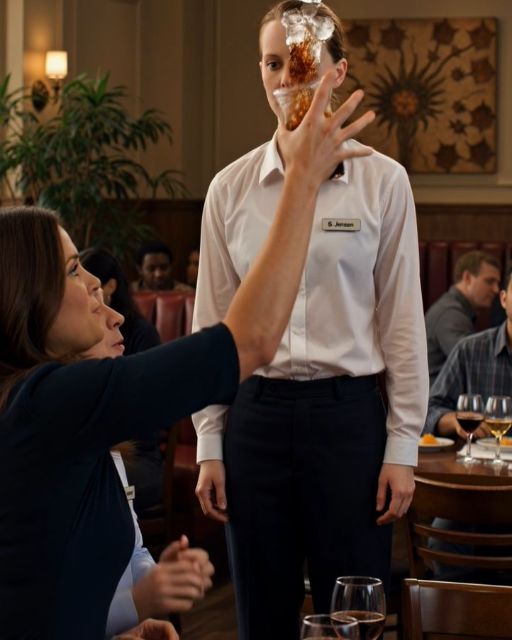
The ice stung my cheek. Cold soda soaked through my thin white shirt, sticking to my skin.
The whole restaurant went quiet.
The woman, Barbara, stood there with her empty cup, her face twisted in rage.
“This is what you get for bringing me a Diet Coke,” she snarled. “Are you stupid?”
Her husband, a meek guy named Tom, looked like he wanted the floor to swallow him whole.
He jumped up, fumbling with napkins. “Barb, my god! I’m so, so sorry,” he stammered at me, trying to dab at my shirt.
“Please don’t call the manager. We have a big day tomorrow, we can’t have any trouble.”
I just stood there, dripping. I didn’t say a word.
Tom kept babbling, his hands shaking. “It’s a mortgage meeting, you see. A final approval. Our whole life depends on it. The loan officer’s name is… ”
He trailed off. He was staring at the small plastic name tag pinned to my shirt.
His face went white. He grabbed his wife’s arm, his voice a choked whisper.
“Barb… that’s her. That’s the name. S. Jensen. That’s the woman who is approving our…”
His words hung in the silent, heavy air of the diner.
Barbara’s face, which had been a mask of smug fury, slowly began to crumble.
She looked from my name tag, to my face, then back to her husband’s terrified expression.
“No,” she whispered, the single word barely audible. “It’s not possible.”
I finally found my voice, though it was quiet and shaky.
“Is there a problem with your order?” I asked, the professional training kicking in despite the humiliation.
My manager, a kind man named Mr. Henderson, was already rushing over.
“What’s going on here?” he asked, his eyes taking in my soaked shirt and the puddle on the floor.
Before Tom could say anything, Barbara snapped back into her defensive mode.
“Your waitress is incompetent!” she spat, pointing a trembling finger at me. “She can’t even get a simple drink order right.”
Mr. Henderson looked at me, his expression softening with concern.
“Sarah, why don’t you go get cleaned up in the back? I’ll handle this.”
I gave a small, grateful nod and turned to walk away, the eyes of every customer following me.
I could hear Tom’s frantic, hushed tones behind me. “You don’t understand, Barb! We have to fix this! Now!”
In the cramped employee breakroom, I peeled the sticky shirt off my skin.
I stared at my reflection in the small, cracked mirror.
My name was Sarah Jensen.
I was a 38-year-old widow with a ten-year-old son named Daniel.
Six months ago, I had been a senior analyst at a top firm.
Then my husband, Mark, had a sudden heart attack, and my world fell apart.
The life insurance barely covered the mountain of medical debt he’d left behind.
I lost my job in the subsequent restructuring, a casualty of a company that saw grief as a liability.
So I took the first job I could get: a loan officer at a regional bank.
It wasn’t glamorous, and the base salary was a joke, but the commission had potential.
The problem was, my official start date wasn’t for another week.
Rent was due, and Daniel needed new shoes.
So here I was, working evenings at a diner, swallowing my pride for sixty dollars a shift plus tips.
I splashed cold water on my face, trying to wash away the sting of the soda and the shame.
I thought about the couple in booth four. Tom and Barbara.
Their file had been on my desk yesterday for a preliminary review.
It was a big loan, a beautiful house in a gated community.
Their financials were stretched thin, borderline at best.
The approval was entirely at my discretion. It depended on the final in-person meeting.
Tomorrow. At 9 AM.
A bitter laugh escaped my lips.
My whole life depends on it, he’d said.
I put on a spare uniform shirt, the starchy fabric stiff and unfamiliar.
When I walked back out, the couple was gone.
Mr. Henderson pulled me aside. “They paid and left. He left you a two-hundred-dollar tip.”
He handed me the crisp bills. “Are you okay, Sarah?”
I nodded, not trusting myself to speak.
The money felt dirty in my hand. It wasn’t a tip; it was a bribe. A down payment on my forgiveness.
The rest of the shift was a blur.
Every customer’s face seemed to be watching me, pitying me.
When I finally got home at midnight, the tiny apartment was quiet.
Daniel was asleep on the couch, a book resting on his chest.
I gently picked him up, his small body warm and heavy in my arms.
As I tucked him into his bed, he stirred. “Mom? Was work okay?”
“Work was fine, sweetie,” I lied, stroking his hair. “Go back to sleep.”
I sat at our small kitchen table, the two hundred dollars spread out in front of me.
It was enough for rent. It was a lifeline.
But it came at the cost of my dignity.
I thought about Barbara’s sneer. “Are you stupid?”
I thought about the cold, sticky liquid running down my neck.
I thought about the power I now held.
I could crush their dream with a single word. “Denied.”
It would be so easy. It would be justice.
I could walk into that meeting tomorrow, look Barbara in the eye, and give her a taste of the helplessness she’d made me feel.
I barely slept that night, my mind a battlefield of anger and responsibility.
The next morning, I stood in front of my closet.
On one side hung my waitress uniform. On the other, my single good suit.
It was a symbol of the two worlds I lived in, the two people I was forced to be.
I put on the suit. It was a little tight now; I’d lost weight from the stress.
But as I buttoned the blazer, I felt a shift inside me.
I wasn’t Sarah the waitress anymore.
I was S. Jensen, the loan officer.
When I arrived at the bank, I felt a nervous energy I hadn’t felt in months.
I sat at my new, polished desk, the ‘S. Jensen’ nameplate gleaming under the fluorescent lights.
At precisely 9 AM, my assistant buzzed.
“Mr. and Mrs. Peters are here to see you.”
I took a deep breath. “Send them in.”
Tom and Barbara walked into my office.
They looked like they hadn’t slept at all. Tom’s face was pale and drawn.
Barbara’s expensive makeup couldn’t hide the dark circles under her eyes.
She was wearing a demure dress, a stark contrast to the flashy outfit from last night.
Tom rushed forward, his hand outstretched. “Ms. Jensen, I cannot tell you how sorry…”
I didn’t take his hand. I gestured to the chairs in front of my desk.
“Please, have a seat.”
They sat down, stiff as boards. The silence was deafening.
I opened their file, pretending to read it, though I had already memorized every line.
“So,” I began, my voice cool and professional. “The property on Oakwood Lane. A big step.”
“Yes,” Tom squeaked. “It’s our dream.”
Barbara finally spoke, her voice soft and saccharine. “We are just so grateful for this opportunity. And, about last night…”
She gave a little, tinkling laugh that didn’t reach her eyes.
“I was having a terrible day. A migraine. I’m just not myself when I’m in pain. I am so, so terribly sorry for the misunderstanding.”
A misunderstanding.
That’s what she called it.
I looked at her, really looked at her, and saw no real remorse.
I saw fear. The same raw, animal fear her husband had shown.
She wasn’t sorry for what she did. She was sorry she got caught.
I leaned back in my chair, my gaze unwavering.
“It wasn’t a misunderstanding, Barbara. You called me stupid. You called me trash. You threw a drink on me because I was a waitress and you thought you could.”
Her fake smile vanished.
“You didn’t see a person. You saw a uniform. And you decided that gave you the right to humiliate me.”
Tom buried his face in his hands.
Barbara’s jaw tightened. A flicker of the old anger returned to her eyes.
“I said I was sorry.”
“No,” I replied calmly. “You made an excuse. There’s a difference.”
I turned the file around to face them.
“Your application is borderline. Your debt-to-income ratio is high. Frankly, I could deny this, and no one would question my decision.”
The color drained from Barbara’s face.
Tom looked up, his eyes pleading. “Please, Ms. Jensen. Sarah. We’ll do anything. We need this house. It’s a new start for us.”
And then, something unexpected happened.
Tom turned to his wife. His voice, for the first time, wasn’t meek. It was strong.
“No, Barb. That’s not what this is about.”
He stood up, his hands flat on my desk.
“She’s right,” he said, looking at Barbara. “You were cruel. It wasn’t a migraine. It’s how you are. You look down on people you think are beneath you. The valet, the delivery guy, the waitress.”
Barbara stared at him, aghast. “Tom!”
“I’ve been letting you do it for years because I was afraid,” he continued, his voice cracking with emotion. “Afraid of your anger, afraid of being alone. But last night, watching you… I wasn’t just embarrassed. I was ashamed. Ashamed of you, and ashamed of myself for not stopping you.”
He turned back to me, his eyes filled with genuine tears.
“Deny the loan, Ms. Jensen. You should. We don’t deserve it. Or at least, she doesn’t. And I don’t deserve it for letting her be that way.”
He took a shaky breath.
“I’m done. I’m done with this. I’m done being this person.”
He looked at his wife, a decade of suppressed frustration finally boiling over.
“We were supposed to be partners, Barb. To build each other up. Not tear other people down to feel big.”
The office was silent except for Barbara’s sharp, ragged breathing.
I watched Tom, a man I had dismissed as weak and spineless.
In that moment, he was the strongest person in the room.
He wasn’t trying to save his mortgage. He was trying to save his soul.
I looked down at the file. At the numbers, the projections, the risk assessments.
None of it mattered as much as what had just happened.
I picked up my pen. I clicked it once.
I signed my name on the approval line.
Then I pushed the file back across the desk.
Tom stared at it, confused. “What… what is this?”
“Your loan is approved,” I said quietly.
Barbara let out a gasp of relief, a triumphant smile starting to form. I held up a hand to stop her.
“I’m not approving it for you, Barbara,” I said, my eyes locked on hers. “And I’m not approving it because of this pathetic, last-minute apology.”
I turned my gaze to Tom.
“I’m approving it because he,” I said, nodding towards him, “just showed me something that doesn’t appear on any financial statement. Character.”
“I believe people can change. I believe in second chances. But they have to be earned.”
I stood up, signaling the end of the meeting.
“Enjoy your new home, Tom. I hope it’s the new start you’re looking for. What you do with it, and who you share it with, is your decision.”
Barbara was speechless. Tom just nodded, tears streaming down his face as he whispered, “Thank you.”
They left my office without another word.
Three months later, a letter arrived at the bank for me.
It was from Tom.
He wrote that they had bought the house, but he wasn’t living in it.
He and Barbara had separated.
He’d left his high-pressure sales job and was working for a non-profit, helping build homes for low-income families.
He said he hadn’t felt this happy or this much like himself in twenty years.
He ended the letter with a simple sentence.
“You didn’t just approve a loan that day. You approved a life. My life. Thank you for showing me what decency looks like.”
I folded the letter and put it in my desk drawer.
I was recently promoted to branch manager. Daniel was doing great in school, and we were finally comfortable.
I no longer worked at the diner, but I ate there once a week.
I always made sure to know my server’s name.
And I always tipped well over the standard.
Because sometimes, a little bit of kindness is the only thing that separates a person from their breaking point.
And you never, ever know whose hands your life might end up in.
Every person you meet is fighting a battle you know nothing about.
A person’s job is what they do. It’s not who they are.
Dignity is not for sale, and character is the one asset that can’t be bought. It can only be built, one decent act at a time.