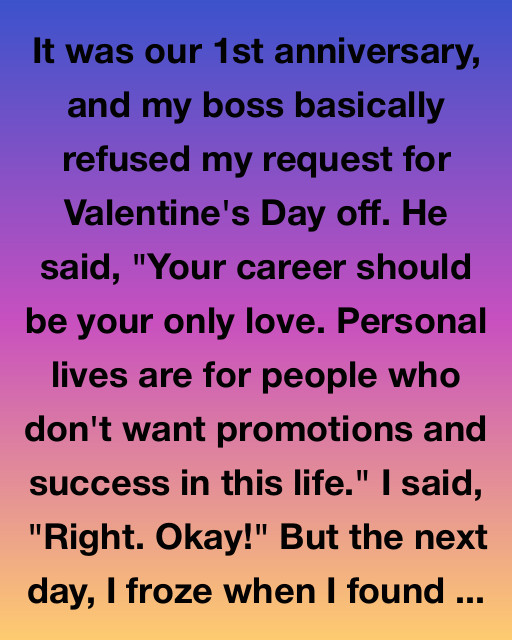
It was our 1st anniversary, and my boss basically refused my request for Valentine’s Day off. He said, “Your career should be your only love. Personal lives are for people who don’t want promotions and success in this life.” I said, “Right. Okay!” But the next day, I froze when I found a small, handwritten note tucked into the side pocket of my laptop bag.
The handwriting was unmistakably my boss’s, Mr. Sterling, a man known for having a heart made of cold, calculated granite. The note didn’t say “get back to work” or “fix that spreadsheet by noon,” which were the only phrases I had heard from him in six months. Instead, it was a list of coordinates for a high-end restaurant and a single sentence: “Do not let the clock win tonight.”
I stood there in the middle of the office lobby, feeling the cold air from the automatic doors hitting my back. My husband, Silas, had been so patient with my long hours, but I could see the light fading from our relationship lately. We were both exhausted, chasing ghosts of careers that seemed to demand everything while giving back very little.
I shoved the note deep into my pocket, my heart racing with a mix of confusion and a strange, bubbling hope. If Mr. Sterling was playing a trick, it was a cruel one, but the coordinates pointed to a place I knew we could never afford. It was the kind of place where you had to book a table six months in advance and dress like you owned a small island.
Throughout the day, I tried to focus on the quarterly projections, but my eyes kept drifting to the clock on the wall. Every tick felt like a heartbeat, reminding me that time was the only currency that really mattered in the end. I wondered why a man who preached about career obsession would suddenly point me toward a romantic dinner.
At exactly five o’clock, I expected Mr. Sterling to drop a fresh pile of files on my desk as he usually did. I kept my head down, typing away at a report that felt increasingly meaningless with every word I added. I heard his heavy footsteps approaching, the rhythmic thud of his expensive leather shoes on the carpeted floor.
He stopped right at the edge of my cubicle, but he didn’t say a word about the projections or the upcoming board meeting. He simply tapped the wood of my desk twice and whispered, “The reservation is for seven, and the traffic across the bridge is already building up.” I looked up, stunned, but he was already walking away toward his private office without looking back.
I didn’t ask questions; I just grabbed my coat, shut down my computer, and practically ran to the elevator. The ride down felt like it took a lifetime, my mind spinning with images of Silas and the look on his face when I told him we were actually going out. We had planned to just heat up some leftovers and call it a night because we were both so drained.
When I got home, Silas was already there, slumped on the sofa in his work clothes, looking at a stack of bills on the coffee table. I walked over and pulled the note from my pocket, laying it right on top of the electric bill. He looked at the coordinates, then at me, his eyes widening as he realized what they represented.
“Is this a joke?” he asked, his voice a little raspy from a long day of dealing with difficult clients at his own firm. I shook my head, laughing for the first time in weeks, and told him that the “Ice King” himself had handed me a ticket to a real evening. We scrambled to get ready, pulling out the nice clothes we hadn’t worn since our wedding day a year ago.
The restaurant was even more beautiful than the photos online, tucked away on a cliffside overlooking the shimmering lights of the harbor. We were seated at a small table by the window, the candlelight reflecting in the dark glass and making everything feel like a dream. For the first hour, we didn’t even talk about work; we just talked about us, our dreams, and the quiet moments we had missed.
The food was incredible, but the atmosphere was what really mattered—the feeling that for one night, the world had stopped demanding things from us. I felt a sense of gratitude toward Mr. Sterling that I couldn’t quite explain, wondering what had changed in him. He was a man who usually valued a person’s output over their humanity, yet here we were.
As we were finishing our dessert, the waiter approached our table with a small, silver tray. On it was not the bill, but another envelope, thick and cream-colored, with my name written on the front in that same sharp handwriting. Silas reached across the table and took my hand, his thumb tracing circles on my palm as I opened the seal.
Inside was a letter that changed everything I thought I knew about the man I worked for. It wasn’t a promotion, and it wasn’t a bonus; it was a story about a man who had chosen the office over his wife forty years ago. He wrote about the night he missed his own first anniversary to close a deal that eventually made him a millionaire.
“I won the success I thought I wanted,” the letter read, “but I sat in this very restaurant alone every year since she left.” He explained that he had seen the same “hunger” in my eyes that he once had, a hunger that eats everything else in its path. He didn’t want me to wake up in forty years with a corner office and an empty house.
The twist was that Mr. Sterling hadn’t just given me a night off; he had used his own personal membership to pay for the entire evening. He had spent his evening making sure I didn’t repeat the singular mistake that had defined his entire lonely existence. I felt a lump in my throat as I realized the “career over everything” speech had been a test, or perhaps a warning he hoped I would ignore.
We left the restaurant in a daze, the cool night air feeling like a fresh start for both of us. Silas looked at me as we walked toward the car, and I knew we were thinking the same thing about our future. We needed to work to live, not live to work, and that balance was something we had to fight for every single day.
When I went into work the next morning, I expected things to be awkward, but Mr. Sterling was his usual stern self. He didn’t mention the dinner, the letter, or the fact that he had essentially played Cupid for his most overworked employee. He just nodded at me as I passed his office, a quick, nearly invisible gesture of acknowledgment.
However, a few hours later, I noticed something different on my company’s internal portal. A new policy had been posted regarding “Personal Wellness Days,” encouraging staff to take time off for family milestones without fear of losing their standing. It was signed by the board, but the language was unmistakably the same as the letter I had received.
I realized then that Mr. Sterling wasn’t just changing my life; he was trying to fix the culture he had helped build for decades. He was a man seeking redemption in the only way he knew how—by ensuring the next generation didn’t end up as solitary as he was. It was a silent, professional sort of penance that carried more weight than any public apology ever could.
Weeks turned into months, and the atmosphere in the office began to shift from one of frantic desperation to one of steady, focused productivity. People were leaving at five, spending time with their kids, and coming back the next day with more energy and better ideas. I found myself actually enjoying my job again, no longer feeling like I was sacrificing my soul for a paycheck.
One afternoon, I was called into Mr. Sterling’s office for my annual review. I sat down, bracing myself for the usual critique of my billable hours and project turnaround times. He looked at my file for a long time, his face unreadable behind his spectacles, before finally closing the folder and looking me in the eye.
“Your numbers are slightly lower than last year,” he said, and my heart sank for a moment. But then he smiled, a genuine, rare expression that reached his eyes and softened the hard lines of his face. “But your quality of work is thirty percent higher, and your team is the happiest in the building.”
He stood up and walked to the window, looking out at the city he had spent his life conquering. “I spent my life thinking that more hours meant more value,” he confessed softly. “But a person who has nothing to go home to eventually has nothing to bring to the table here either.”
He handed me a small box, a gift for my second anniversary which was approaching in a few weeks. It wasn’t jewelry or a gadget; it was a set of high-quality luggage, a hint that he expected me to take a real vacation. I thanked him, not just for the gift, but for the lesson that had likely saved my marriage and my sanity.
As I walked out of his office, I saw Silas waiting for me in the lobby, as we had started carpooling to save money and spend more time together. We walked out into the sunlight, talking about where we might go on our first real trip away from our phones and laptops. The world felt wider, brighter, and much less heavy than it had just a year before.
I learned that day that sometimes the people who seem the hardest are the ones carrying the heaviest regrets. They use their masks to protect others from the mistakes they made, even if they don’t always know how to say it out loud. Mr. Sterling taught me that success isn’t a destination you reach by leaving everyone else behind.
Real success is being able to look at the person next to you and know that you didn’t trade their presence for a title. It’s the quiet dinners, the shared laughs over bills, and the ability to say “no” to a boss so you can say “yes” to a life. We often think that our careers define us, but they are really just the background music to the main story.
The story is who we love and who loves us back when the lights in the office finally go out. I still work hard, and I still aim for that promotion, but I do it on my own terms now. I make sure to leave the note from Mr. Sterling in my bag, a constant reminder of the coordinates that led me back to what truly matters.
Life is a series of choices between the urgent and the important. Most of the time, we let the urgent scream in our ears while the important waits patiently in the corner until it’s too late. I was lucky enough to have someone scream back at the darkness for me, showing me the way toward a better balance.
Now, whenever I see a coworker staying too late or looking frayed at the edges, I pass along a little bit of that wisdom. I tell them that the work will always be there tomorrow, but the moments we miss with our loved ones are gone the second they pass. It’s a small way to keep Mr. Sterling’s new legacy alive in a world that still values the grind over the heart.
Looking back, that 1st anniversary was the most important day of my career, not because of what I achieved, but because of what I refused to give up. We are more than our output, and we are certainly more than our job titles. We are the time we give to others, and that is the only thing we truly own.
So, if you’re reading this and feeling like the clock is winning, take a breath and remember that you have the power to stop it. Don’t wait for a sign or a note from a boss to tell you that your life is worth living outside of a cubicle. Take the time, hold the hands of the people you love, and never let the pursuit of “success” rob you of your joy.
I hope this story reminds you to cherish the people who stand by you during the long hours and the stressful weeks. They are the ones who will be there when the career eventually fades, and they are the only ones who truly know your worth. Let’s all try to be a little more like the man Mr. Sterling became, rather than the man he started as.
Be sure to cherish every moment and never take your loved ones for granted. If this story touched your heart or reminded you of someone special, please like and share it with your friends and family. Let’s spread the message that time is the greatest gift we can give, and it’s never too late to start giving it.