What he said next silenced the whole store.
The voice cut through the hum of the grocery store like a shard of glass.
One second, fluorescent lights and the gentle roll of shopping carts. The next, a sound so full of jagged edges it made my teeth hurt.
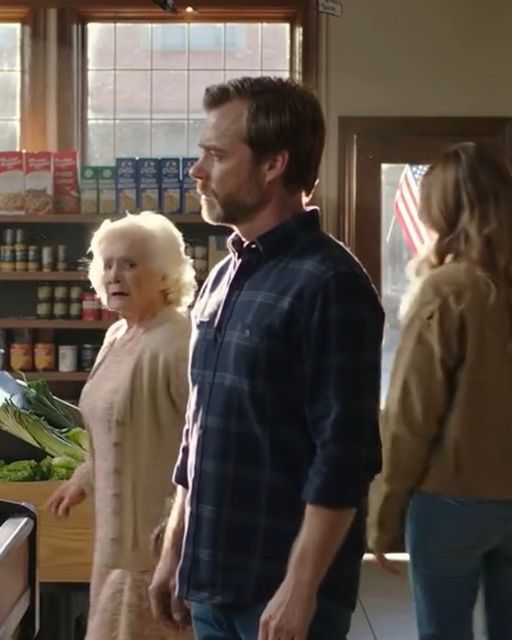
An older woman stood by the apples, her face a knot of fury.
At first, we all did what people do. We looked away. We pretended we didn’t hear the muttering.
But you can only pretend for so long.
Her voice climbed, getting sharper, colder. It wasn’t just noise anymore. It was aimed.
A mother pulled her child close. The teenage cashier froze, his hand hovering over a box of cereal. My own heart started beating a little too fast.
The air grew thin.
And that’s when I saw who she was talking to.
David Chen.
He was a guy from the neighborhood. Quiet. Always gave a little wave, but that was it. I heard he was a veteran once. He was just standing there, holding a bag of fruit, as if he were waiting for a bus.
He didn’t move. He didn’t even blink.
He just stood there, absorbing it all. A rock in a river of poison.
Her voice started to crack then. Not with anger anymore. With something underneath it. Something broken.
Phones came out. I could feel the silent tension of a dozen little screens starting to record.
David didn’t seem to notice. He just looked at her.
And it wasn’t a normal look. It was like he could see straight through the noise, past the rage, and right into the wound she was screaming from.
He took one, slow breath.
The entire store held its breath with him.
Then, he spoke.
His voice wasn’t loud. It wasn’t a command. It was quiet. So quiet it made everything else in the world feel like a shout.
He said one thing. A single sentence.
It wasn’t an argument. It wasn’t an insult. It was a mirror.
The woman’s rage just…stopped. It evaporated. Her face crumpled, the anger draining away to reveal a grief so raw it was hard to look at.
Her lips trembled.
No one moved. No one breathed. The only sound was the low hum of the refrigerators.
We all just stood there, trapped in the silence he had created.
Because what he said didn’t just answer her. It changed the shape of the room.
And what happened after that silence broke is something I will never forget.
He said, “Your son, Michael… he saved my life.”
The sentence hung in the air, heavy and fragile all at once. It landed in the quiet space between the organic produce and the dairy aisle.
The woman, whose name I later learned was Eleanor Vance, let out a sound. It was a small, wounded gasp, the sound of a balloon popping in a quiet room.
Her shoulders, which had been squared in aggression, suddenly slumped. The fight went out of her like air from a tire.
She dropped her gaze from David’s face to the scuffed linoleum floor.
The phones that had been so eager to capture the drama were slowly, one by one, lowered. The faces of the people holding them were washed with a sudden, uncomfortable shame.
We weren’t watching a fight anymore. We were intruding on a memorial.
David took a single, careful step toward her. He didn’t reach out. He just closed a little of the distance she had created with her anger.
“I’m so sorry, Mrs. Vance,” he said, and his voice was still that same impossible quiet. “I should have come to see you sooner.”
Her hand flew to her mouth, stifling a sob that shook her entire body. Tears she had clearly been holding back for years began to trace paths through the wrinkles on her cheeks.
The teenage cashier, whose name tag read ‘Sam’, finally moved. He walked out from behind his register, holding a small bottle of water.
He didn’t say anything. He just held it out to her.
Eleanor Vance looked at the bottle, then at the boy’s kind, nervous face, and she took it. Her hand was trembling.
It was a tiny gesture. An offering of water in a sea of grief. But it felt like the first drop of rain after a long, terrible drought.
David gave the cashier a small, grateful nod. Then he turned his attention back to Eleanor.
“Can we… can we sit down for a minute?” he asked gently.
She couldn’t speak. She just nodded, her eyes still fixed on the floor.
David looked around and spotted the little seating area near the front of the store, a couple of plastic tables and chairs where people sometimes had a coffee.
He put a hand very lightly on her elbow, guiding her as if she were made of glass.
The rest of us, the silent audience, began to disperse. We pretended to be interested in cereal boxes and cans of soup.
But no one really went back to their shopping. The spell was broken, but the feeling remained. We had all witnessed something intensely private, and the mundane task of buying groceries felt wrong now.
I watched as David sat Eleanor down at one of the tables. He pulled up a chair for himself.
He started to talk. I was too far away to hear the words, but I could see the way he spoke. His hands moved slightly, painting a picture in the air.
I saw Eleanor listen. At first, she was hunched over, a fortress of sorrow.
But slowly, as he spoke, she began to uncurl. She leaned forward, her eyes locked on his face.
I couldn’t hear the story, but I knew what it was. It was the story of her son. It was the story of Michael.
A story she had probably never heard before, not the real version anyway. Not from someone who was there.
I left my half-full cart in the aisle and walked out of the store. It felt like the only decent thing to do.
The next few days, the incident was all anyone in the neighborhood talked about. The story spread, pieced together from different witnesses.
Michael Vance was a hero. That was the official line. He’d died in combat five years ago.
But Eleanor had been consumed by it. She saw David Chen around town, the man who was in her son’s unit, the man who came home when Michael didn’t.
Her grief had curdled into a terrible, misdirected anger. In her mind, David was a constant, living reminder of what she had lost.
So she had finally snapped in the middle of the grocery store, aiming all her pain at the one person she felt deserved it.
And he had met her anger not with anger, but with the truth. A truth that was both heartbreaking and healing.
A few weeks later, I was back in that same store. I saw the cashier, Sam.
He looked different. Less like a bored teenager, more like a young man who was thinking about things.
I was in the checkout line, and he was bagging my groceries.
“That was a kind thing you did,” I said quietly. “With the water.”
He looked up, a little surprised. “Oh. Uh, thanks. It just felt… right.”
He fumbled with a carton of eggs for a moment, his brow furrowed.
“I felt so bad,” he admitted, his voice low. “I had my phone out too. I was recording it.”
He looked me in the eye, and I saw a profound sense of shame there.
“When he said that… about her son… I felt about an inch tall,” Sam continued. “I realized I was treating their pain like it was some kind of reality show.”
He finished bagging and handed me my receipt.
“I deleted the video,” he said. “And I went and found him. David, I mean.”
My curiosity was piqued. “You did?”
“Yeah. I found his house. I knocked on the door. I just wanted to apologize for… well, for being a jerk.”
He leaned against the counter, the line behind me forgotten for a moment.
“We got to talking,” Sam said, a small smile touching his lips. “He’s an amazing guy. The stuff he’s been through…”
Sam shook his head in awe.
“He told me about Michael. Said he was the bravest person he ever knew. Said he was funny, too. Always telling bad jokes when everyone was scared.”
I saw a change in Sam’s eyes as he spoke. He was inspired.
“I’ve been kind of lost, you know?” he confessed. “No idea what I want to do after high school. My grades aren’t great. I was just… drifting.”
He straightened up, looking more determined than I’d ever seen him.
“David and I, we’ve been meeting up. He’s helping me fix up his old car. He’s teaching me about engines. He talks to me about discipline, about having a purpose.”
This was the first twist I hadn’t seen coming. That single moment of empathy had sent out ripples I couldn’t have predicted.
It hadn’t just reached Eleanor. It had reached a lost teenager in the checkout aisle.
The story didn’t end there.
I started seeing Eleanor Vance around more often. But she was a different woman.
The hard, angry shell was gone. Her face was still sad—I think a part of it always would be—but it wasn’t bitter anymore.
One day, I saw a flyer pinned to the community board at the library.
It was for a new support group. “Northwood Gold Star Families.”
At the bottom, under contact information, was the name: Eleanor Vance.
She had taken the story of her son, the one given back to her by David in the middle of a grocery store, and she was using it to build a space for others who understood her pain.
She was turning her wound into a sanctuary.
The seasons changed. Winter melted into a wet spring, which then bloomed into a warm summer. Our small town kept on turning.
About a year after the incident in the grocery store, there was a community picnic at the local park.
I was there with my family, sitting on a blanket, watching kids fly kites.
And then I saw them.
David, Eleanor, and Sam. They were all together at a picnic table.
They weren’t just three people who had collided in a moment of crisis. They looked like family.
Eleanor was laughing. It was a full, genuine laugh that reached her eyes. She was talking to another woman, her hand resting on the woman’s arm in a gesture of comfort.
Sam was manning the grill, flipping burgers with a confidence I’d never seen in him before. He looked taller, more sure of himself.
He called out to David, and David looked over and smiled.
And David’s smile… it was different. The haunted, far-off look I’d sometimes see in his eyes was gone. The quiet man who always seemed to be carrying a heavy weight on his shoulders looked lighter.
He had honored his friend’s memory. He had helped a grieving mother find peace. He had set a lost young man on a new path.
In saving them, it seemed he had also saved a part of himself.
I watched them for a long time. This strange, beautiful family forged in the crucible of a stranger’s grief.
It all started in a grocery store. It started with a scream of pain that was disguised as anger.
Most people would have met that anger with more anger. Or with silence. Or with judgment.
But David Chen did something else. He looked past the sharp edges and saw the broken heart behind them.
He didn’t try to win the argument. He tried to heal the wound.
He offered a memory. A truth. He offered a piece of her son that she thought she had lost forever.
That single sentence—”Your son, Michael… he saved my life”—was more than just a piece of information.
It was a key. It unlocked years of pain and let the light in. It transformed an aisle of a grocery store into a place of grace.
And in doing so, it didn’t just silence a room. It started a conversation that rippled outwards, changing lives in ways no one could have ever imagined.
It taught me that the loudest anger often comes from the deepest pain. And the most powerful response isn’t to shout back, but to listen to the silence underneath.
It is a reminder that in a world that feels increasingly divided and loud, a single, quiet act of empathy can be the most courageous and revolutionary thing of all. It can rebuild a person, a friendship, and even a community, one heartfelt word at a time.