“Five minutes, boys,” Sergeant Davis smirked, puffing up his chest. “We go in, we find grandpa, and we’re at the bar by nine.”
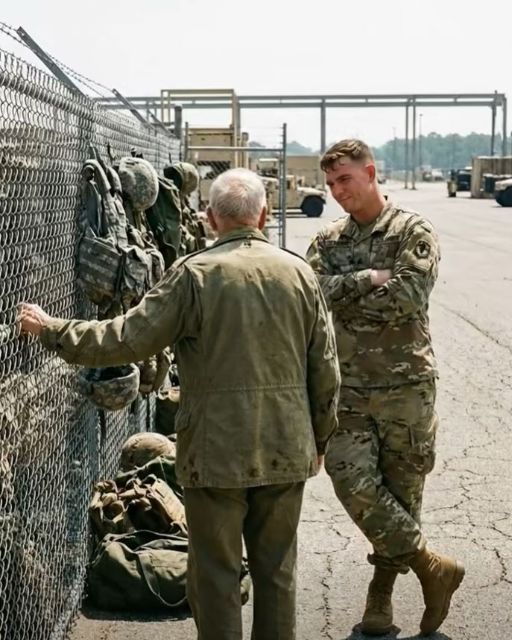
He was talking about Mr. Clark. The old man sat on a folding chair, sipping from a metal flask, saying nothing. He was our “target” for the night’s exercise. Just some retired contractor they brought in. Gray hair, a slight limp, eyes that seemed half-asleep. Davis had been mocking him all day.
The lights to the training facility cut out. Total black. We clicked on our night vision. “Go,” Davis whispered into the comms.
We moved like a six-man snake into the dark. Ten feet in, a cold draft hit my neck. I turned. Johnson was gone. No sound, no struggle. Just an empty space where a man used to be. Davis hissed, “Keep moving.”
Another fifty feet down a hall. We heard a single, soft click from above. Miller, our point man, just crumpled. A touch on the shoulder from the dark is all it takes to signal a kill. We never saw a thing. Four of us left. The air got thick. This wasn’t a game anymore.
We stacked up on the final door. Davis was breathing hard now, his cockiness gone. He gave the signal. We burst in. The room was empty. “Where is he?” Davis stammered, his light beam shaking.
Then we heard a voice from the doorway we had just come through. It was calm. Quiet.
“You’re dead,” Mr. Clark said. He wasn’t even breathing hard. Davis spun around, his weapon light catching the old man’s face. But the light beam was wide. It spilled onto the wall next to the door. It hit a polished brass plaque we’d all missed in the dark. It was the building’s dedication plaque. Davis’s mouth fell open. He read the first line out loud, his voice cracking.
“This facility is dedicated to Command Sergeant Major…”
His voice trailed off as he read the last name on the plaque. Clark.
The full name was William “Ghost” Clark. A name we’d all heard. A legend from conflicts we’d only read about in history books. The man who supposedly cleared an entire enemy compound alone to rescue a downed pilot. Stories you thought were exaggerated to boost morale.
Standing before us was the ghost himself. Not a frail old man, but a specter of war in a flannel shirt.
The main lights flickered on, flooding the kill house in a sterile, unforgiving white. The illusion was shattered. We weren’t operators in the dark anymore. We were just four guys standing in a plywood room, looking like fools.
Across the training floor, sitting on a bench, were Johnson and Miller. They weren’t hurt, just looking down at their boots like kids who got caught drawing on the walls. Johnson had a small piece of blue tape on his shoulder. Miller had one on his helmet.
Mr. Clark, or Command Sergeant Major Clark, walked slowly toward the center of the room. The limp was still there, but it didn’t look like a weakness anymore. It looked like a testament to something survived.
“Exercise concluded,” he said, his voice no louder than before, but now it carried the weight of a mountain.
Davis just stared, his rifle hanging limply in his hands. He was still processing the name on the wall and the man in front of him. The swagger he wore like a second skin had completely evaporated.
“How?” Davis finally managed to ask, his voice barely a whisper.
Clark stopped and looked at him. His half-asleep eyes were now wide open, and they were sharp. They saw everything.
“You told me how,” Clark said simply. “All day.”
He looked over at Johnson. “You told me you always check your six, but you only check it when you think you have to. I was in the rafters before the lights even went out. You walked right under me.”
He then looked at Miller. “You were so focused on the floor in front of you, on tripwires and pressure plates, that you never once looked up. A simple string and a bolt dropped from the ceiling vent. You never felt a thing.”
He then turned his gaze to the four of us who made it to the final room. “You were loud. Your gear clinked. You breathed like you were running a marathon. But your biggest mistake was your leader.”
All eyes, including my own, fell on Sergeant Davis.
“You came in here to win,” Clark said, his gaze locked on Davis. “I came in here to teach. There’s a difference.”
He walked over to the empty doorway we had charged through. “You assumed the target would be in the final room, hunkered down, waiting. It’s what the textbook says. It’s the ‘stronghold’ objective.”
“You never considered the target wouldn’t play by your rules,” he continued. “You never considered the target was hunting you.”
He pointed to a small, almost invisible seam in the wall next to the door. “Service panel. I was inside it. I watched you stack up. I listened to you panting. When you burst through, I just stepped out behind you.”
The simplicity of it was crushing. He didn’t use fancy tech or superhuman speed. He used patience. He used our own expectations against us. He used the arrogance that Davis had fostered in all of us.
We were escorted to a debriefing room. The walk was silent. The usual post-exercise chatter and jokes were replaced by a heavy, shameful quiet. Davis walked like a man in a trance.
The debriefing room had a large screen at the front. Command Sergeant Major Clark stood beside it, holding a remote. He didn’t look angry or smug. He looked tired, but in a patient way, like a father about to explain a difficult truth to his son.
“Let’s begin,” he said, and a video feed appeared on the screen. It was from a camera in the rafters. We watched ourselves enter, a tight formation full of confidence.
He fast-forwarded. “Here,” he said, pointing. The video showed Johnson walking right under a dark shape clinging to the support beams. The shape dropped silently, tapped Johnson on the shoulder, and melted back into the shadows before the rest of us even knew he was gone.
He showed us every mistake. Every loud footstep. Every time we scanned a room but didn’t truly see it. He showed us how our reliance on night vision gave us tunnel vision, making us blind to anything outside the small, green circle we were looking through.
“You have the best gear. You have the best training,” Clark said, turning off the screen. “But you left your best weapon in the locker room. Your humility.”
He looked directly at Davis. “A leader sets the tone, Sergeant. You called me ‘grandpa.’ You told your men this would be easy. You taught them to underestimate their opponent. That lesson will get them killed. Not in a training facility with blue tape. Out there.”
He pointed toward the window, toward the world beyond the base. “Out there, the enemy doesn’t care how tough you think you are. They don’t care about your reputation. They only care if you make a mistake. You taught your team to make a dozen of them tonight.”
Davis sank lower in his chair. I’d never seen him look so small. He was the guy who was always the fastest, the strongest, the first to volunteer for any tough assignment. He was a good NCO, hard on us but always fair. But his pride… his pride was a blinding sun.
Just then, the door to the debriefing room opened. A full-bird Colonel walked in. It was Colonel Masters, the base commander. We all jumped to our feet.
“At ease,” the Colonel said, his eyes finding Clark. “I see the lesson is going as planned, Bill.”
“It is,” Clark said with a nod.
Colonel Masters turned to us, his expression serious. “Do you men know why Command Sergeant Major Clark is here? Why we asked him to come out of a very comfortable retirement in Montana?”
No one said a word. We just stood there, confused.
“It wasn’t just to run a standard evaluation,” the Colonel said. He looked over at Sergeant Davis. “It was specifically for you, Sergeant.”
Davis looked up, his face a mask of confusion. “Sir?”
The Colonel’s expression softened slightly. “Your file is impressive, Davis. Commendations, top of your class in every course. But there’s a recurring note from your instructors. ‘Highly skilled, but prone to overconfidence.’ ‘A natural leader who sometimes lets pride cloud his judgment.’”
He paused, letting the words sink in. “Those notes reminded me of another good soldier I used to know. A man who served under Command Sergeant Major Clark twenty-five years ago. A man with all the talent in the world, but with that same fire, that same reckless pride.”
A knot formed in my stomach. I think I knew where this was going.
“That soldier was your father, Sergeant. Staff Sergeant Michael Davis.”
The air was sucked out of the room. Davis swayed on his feet, his face turning pale. He had told us his dad had been killed in action, but he never, ever talked about the details. It was a locked box inside him.
Clark finally spoke, his voice gentle now. “Your father was the best man on my team, Mark. Fearless. Strong. He would have run through a brick wall if you’d asked him to. But he never learned when to stop, when to listen to that quiet voice that tells you to wait. That tells you something isn’t right.”
He took a step closer to Davis. “The day we lost him… it was a bad call. My call. But it was his pride that made him push forward when I told him to hold. He thought he could do it. He underestimated the situation. Just like you did tonight.”
Tears were welling in Davis’s eyes. He wasn’t a sergeant anymore. He was a boy hearing about his dad.
“I live with that day every single morning I wake up,” Clark said, his voice thick with an ancient pain. “I couldn’t save your father from himself. When Colonel Masters called me, when he told me about a young sergeant with the same name, the same fire, and the same damn pride… I knew I had to come.”
The twist wasn’t just that “grandpa” was a legend. It was that he was a ghost from Davis’s own past, a man tied to the single greatest tragedy of his life. This wasn’t a training exercise. It was an intervention. An act of redemption decades in the making.
“I didn’t do this to humiliate you, son,” Clark said, putting a hand on Davis’s shoulder. “I did this so your men don’t have to carry your flag home. I did this so you get to live the long life your father never did.”
Davis finally broke. He collapsed into his chair and put his head in his hands, his shoulders shaking with silent sobs. The rest of us quietly filed out of the room, led by the Colonel, leaving the two of them alone. We left a sergeant and a command sergeant major in that room, but we were really leaving a grieving son and the man who had watched over him from afar for his entire life.
We didn’t go to the bar that night. We went back to the barracks and sat in silence. The whole world felt different. Our job, our lives, the man we followed… everything had been put into a new perspective.
A few hours later, Davis came back. His eyes were red, but his back was straight. The arrogance was gone, replaced by a quiet solemnity. A deep humility.
He stood before us. “I failed you all today,” he said, his voice steady. “As a leader. I let my pride put you in a position to fail. It won’t happen again. I promise you that.”
And it never did.
The next morning, Mr. Clark was there at PT. And the morning after that. He didn’t leave. He stayed on for the next six months, not as a contractor, but as a mentor. He ran drills with us. He broke down tactics. But more than that, he taught us.
He taught us how to listen to the silence. He taught us that true strength wasn’t in being the loudest man in the room, but the most observant. He taught us that respect is earned not through intimidation, but through wisdom and character.
He and Davis formed a bond that was incredible to watch. It was part commander-to-soldier, part father-to-son. Clark would tell stories about Davis’s dad, the good things, the funny things. He filled in the gaps of a man Davis had only known as a photograph on the mantelpiece. He gave him back his father.
Our team became the best on the base. Not the fastest or the cockiest, but the quietest. The most efficient. The most cohesive. We moved like one man, thinking and anticipating, because we had learned to check our pride at the door.
On Clark’s last day, we were all out on the range. He walked down the line, giving each of us a quiet word of advice. When he got to Davis, he just clapped him on the shoulder.
“You’re a good leader, Mark,” he said. “Your father would be proud.”
Davis just nodded, his eyes shining. “Thank you, Sergeant Major. For everything.”
We watched him get into his old pickup truck and drive away, leaving a cloud of dust on the road. He left us a better team, and he left Davis a better man.
Sometimes, the greatest lessons don’t come from a textbook or a drill sergeant’s shouts. They come from the quiet wisdom of those who have walked the path before us. We often dismiss them, blinded by our own youth and pride, seeing them as relics of a time gone by. But the truth is, their experience is a map, and their scars are a guide. The most profound act of strength is the humility to admit you have more to learn, and the greatest gift is the mentor who appears, not when you want them, but exactly when you need them.