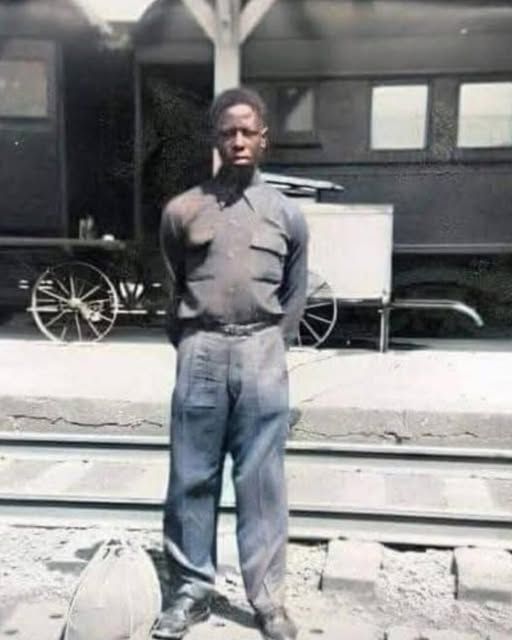
In the summer of 1952, an 18-year-old Black man stood at a train station with $1.50 in his pocket, two changes of clothes in his bag, and a quiet determination in his heart. He wasn’t chasing fame—he was chasing work. That man was Henry “Hank” Aaron.
He boarded a train to Indiana to play for the Indianapolis Clowns in the Negro Leagues. It was the start of a journey that would reshape baseball forever.
The air in the small town where Hank Aaron grew up smelled of fresh grass, sweat, and the distant sound of a ball hitting a bat. It was a scent that would define his childhood, shaping his future in ways he couldn’t have known at the time. Hank grew up in Mobile, Alabama, where the color of his skin determined his place in society long before the game of baseball could ever define him. For most, this would have been an obstacle too great to overcome. But Hank? He was built for more.
From an early age, he had a ball in his hand, and it wasn’t just the desire to play—it was the hunger for a better life, one where his worth would be measured by his talent and not the color of his skin. He had big dreams that were bigger than the segregated world around him, and he was determined to chase them.
Hank Aaron’s path was never going to be easy. When he first stepped onto that train bound for Indianapolis, he had no way of knowing how hard the road ahead would be. His skills were undeniable, and the Negro Leagues had become a vital springboard for young Black talent. Yet, Hank still faced the bitter truth that his dream would require more than just ability—it would require grit.
At the Indianapolis Clowns, Hank didn’t just play the game—he fought the system. In those days, the Negro Leagues were more than just a baseball league. They were a refuge, a place where Black players could showcase their talents despite being systematically denied access to the major leagues. But even within the Clowns, Hank wasn’t shielded from the harsh reality of racism. He faced racial prejudice from teammates, opposing players, and even fans. Despite all of it, he kept his head down and his bat steady.
In 1954, Hank received an offer from the Milwaukee Braves—a call that would change everything. It wasn’t just any opportunity; it was a chance to step into the white-dominated world of Major League Baseball. It was a chance to make history, but Hank knew the pressure would be immense.
He boarded another train, this time bound for Milwaukee, armed with nothing but his bat, his glove, and the quiet resolve that had carried him this far. But Hank Aaron wasn’t a man of loud speeches or bravado. He was a man of action, one who believed that silence, humility, and hard work would speak louder than anything else.
The early years in Milwaukee were grueling. Hank, despite his evident talent, was far from a household name. He was expected to prove himself over and over again, each swing of the bat a declaration of his right to be there. In those days, being a Black man in the major leagues wasn’t just about playing the game—it was about enduring the cruelty of racism that seeped into every aspect of life.
He faced racial slurs from fans and players alike. He received hate mail, death threats, and insults that would’ve broken a lesser man. But Hank never showed anger. Never showed fear. He was determined to let his performance on the field speak louder than anything else. For Hank, every at-bat, every pitch, every swing was an act of defiance against the world that tried to keep him down.
Then came that moment—April 8, 1974. Hank Aaron stood at the plate at Atlanta-Fulton County Stadium, the eyes of the world upon him. He was just one home run away from breaking Babe Ruth’s legendary record of 714 career home runs. It was a moment that would forever cement Hank Aaron as one of the greatest to ever play the game. But it wasn’t just about the home run. It wasn’t just about the record.
The significance of that moment lay in what Hank had overcome to get there. He wasn’t just breaking records—he was breaking barriers. His achievement wasn’t just a personal victory; it was a victory for every Black player who had ever dreamed of playing in the big leagues, for every person who had been told that they couldn’t achieve greatness because of the color of their skin.
When Hank hit his 715th home run, the crowd went wild. But it wasn’t just the roar of the fans that echoed in his ears—it was the sound of every obstacle he had faced over the years, every insult, every threat, all falling away in that one glorious moment. Hank didn’t raise his fist in triumph; he simply tipped his cap, acknowledging the achievement with the quiet dignity that had defined his career.
But even with the record behind him, Hank Aaron’s journey wasn’t over. He would go on to hit 40 more home runs, ultimately retiring with 755 career home runs—an achievement that would stand for decades. But Hank didn’t just leave his mark on the field. He left a legacy that went far beyond the numbers.
After his retirement, Hank Aaron became an advocate for equality and justice. He used his platform to fight against racism and to help those who had been marginalized in the world of sports. His quiet strength, his unwillingness to be defined by anything other than his ability, made him a hero not just to baseball fans but to anyone who had ever faced discrimination.
As the years passed, Hank’s legacy grew. He became a symbol of perseverance in the face of adversity, a reminder that greatness isn’t defined by the number of records you break but by the character you show when no one’s watching. His life story was a testament to the power of humility, hard work, and belief in one’s self.
In the final years of his life, Hank Aaron reflected on his journey—not with pride, but with gratitude. He never sought fame or glory; he only sought the chance to play the game he loved, to be judged for his talent rather than his skin color. And in the end, that quiet determination was enough to change the world.
Hank Aaron passed away in 2021, but his legacy lives on. His name will forever be associated with baseball, not just for his unmatched statistics but for the way he carried himself—through every hardship, every struggle, and every triumph. He proved that you don’t have to be loud to make a difference. You don’t have to be flashy to be great. Sometimes, the most powerful statement you can make is the one you don’t say.
His story continues to inspire countless individuals who are fighting for their dreams, for justice, and for a better tomorrow. Hank Aaron didn’t just play the game—he changed it. And in doing so, he showed the world that true greatness is never about being the loudest or the fastest—it’s about staying true to who you are, no matter what.
And so, we carry on Hank’s legacy—not in the ballparks, but in our hearts. In every moment where we feel like giving up, in every instance when we’re told we don’t belong, we can remember Hank Aaron. We can remember that quiet strength, that determination, and that ability to rise above. Because in the end, it’s not the records you break—it’s the lives you touch and the way you inspire others to do the same.
For Hank Aaron, greatness was never just about the game. It was about using that game to make a real difference in the world. And that’s a legacy that will live on, long after the last home run is hit, long after the final game is played. It’s a legacy that will continue to inspire for generations to come. So, the next time you face a challenge—remember Hank. Remember that greatness doesn’t come with a loud roar; it comes with quiet, steady resolve. And in the end, that’s what will make all the difference.
Share this story with others who need a reminder that persistence, humility, and integrity can change the world. Like and share this post to keep Hank Aaron’s legacy alive.