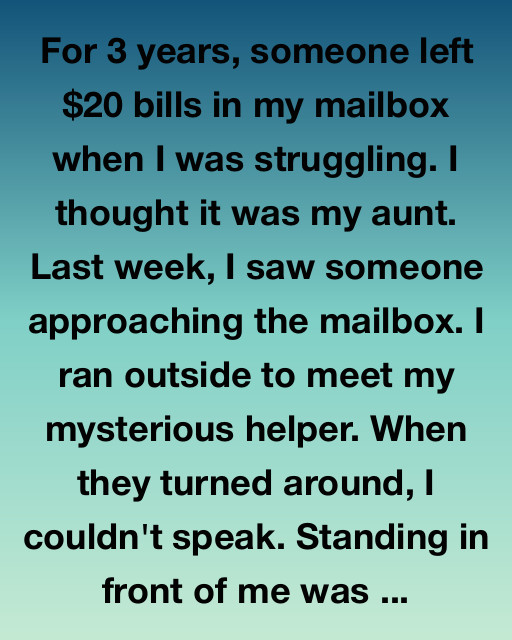
For 3 years, someone left $20 bills in my mailbox when I was struggling. I thought it was my aunt, who always had a soft spot for me.
Last week, I saw someone approaching the mailbox through the kitchen window. I ran outside to meet my mysterious helper, my heart pounding with a mix of gratitude and nerves.
When they turned around, I couldn’t speak. Standing in front of me was Mr. Henderson, the retired shopkeeper from the corner store that had closed down five years ago.
He wasn’t wearing his usual crisp apron, but a faded windbreaker that looked older than I was. He looked startled to see me, his hand still hovering near the metal flap of the box.
“Mr. Henderson?” I stammered, my voice barely a whisper in the quiet afternoon air. “I don’t understand. Why would you do this for me?”
He looked down at his shoes, a faint, sheepish smile playing on his weathered face. He looked much smaller than I remembered from my childhood, more fragile somehow.
“I didn’t mean for you to catch me, Nora,” he said, his voice as gravelly and warm as it had been when he sold me penny candy. “I just wanted to make sure things were okay over here.”
I looked at the crisp twenty-dollar bill still clutched in his trembling fingers. I thought about the times that money had meant the difference between a meal and an empty stomach.
“But you closed your shop because you were struggling,” I said, remembering the ‘Going Out of Business’ signs. “How could you afford to give anything away?”
He gestured for me to sit on the porch steps, moving with a slow, deliberate caution that spoke of aching joints. I sat beside him, the wood cold beneath me.
“Do you remember your father, Nora?” he asked, looking out at the street where the oaks were shedding their autumn leaves. “He was a good man, but he was a quiet one.”
I nodded, my chest tightening at the mention of him; he had passed away nearly a decade ago. He had been a man of few words and even fewer grand gestures.
“When I first opened that little grocery store, I was drowning in debt,” Mr. Henderson confessed. “I didn’t have enough to keep the lights on, let alone stock the shelves.”
He told me how my father had walked in one rainy Tuesday and placed an envelope on the counter. Inside was enough cash to cover the rent for three months.
“He told me it wasn’t a loan, but a ‘community investment’,” the old man whispered. “He made me promise never to tell a soul, especially not your mother.”
I felt a lump form in my throat as I realized my father’s hidden legacy was standing right in front of me. I never knew he had that kind of money, or that kind of heart.
“I spent my whole life trying to pay him back, but he’d never take a dime,” Mr. Henderson continued. “He told me to just keep the neighborhood going.”
When my father died, Mr. Henderson felt the weight of that unpaid debt shifting onto his shoulders. He watched me struggle through my early twenties after the inheritance ran dry.
“I saw you working those three jobs, coming home late with your head down,” he said softly. “I knew I couldn’t give much, but I could give something.”
I was overwhelmed by the realization that this man had been sacrificing his own small pension to honor a dead man’s kindness. It felt like a circle was finally closing.
“Mr. Henderson, you’ve done more than enough,” I said, reaching out to take his hand. “Please, keep your money. I’m finally on my feet now.”
He shook his head firmly, his eyes shining with a stubborn kind of pride. He told me that the giving gave him a reason to walk down the block every week.
“It keeps me moving, Nora,” he joked, though his eyes remained serious. “If I stop being useful, I might just turn into one of these old trees.”
We talked for an hour about the old days, about the way the neighborhood used to smell like fresh bread and gasoline. It was the first time I felt truly connected to my home in years.
Before he left, he handed me the twenty dollars one last time, insisting it was for a “celebratory dinner.” I watched him walk away, his gait slow but purposeful.
The next morning, I went to the local community center where I knew they needed volunteers for the food pantry. I realized that the best way to honor my father and Mr. Henderson wasn’t just to say thanks.
I started spending my Saturdays sorting cans and packing boxes for families who were in the same position I had been in. It felt right to be the one handing things out for a change.
A few months passed, and I noticed that Mr. Henderson hadn’t been by my mailbox in three weeks. A cold dread settled in my stomach as I walked toward the corner store.
The building was still empty, but the small apartment above it had the curtains drawn tight. I knocked on the side door, hoping for the sound of his gravelly voice.
A younger woman answered, her eyes red-rimmed and tired. She introduced herself as his niece, Sarah, and told me he had been taken to the hospital.
“He’s been talking about a Nora,” she said, looking at me with curiosity. “He said he had an appointment he couldn’t miss at a mailbox.”
My heart broke as I followed her to the local clinic. I found him in a small room, looking smaller than ever beneath the white hospital sheets.
He smiled when he saw me, though it took a visible effort for him to stay awake. I sat by his bed and told him about my work at the food pantry.
“I’m glad,” he whispered, his hand feebly patting mine. “The investment is still growing, then.”
He passed away two days later, peacefully, in his sleep. At the funeral, I was surprised to see dozens of people from the old neighborhood.
One by one, they came up to Sarah and me, telling stories of small envelopes, free groceries, and “community investments.” My father hadn’t just helped one man.
It turned out my father had started a chain reaction of quiet generosity that had sustained half the street during the hard years. Mr. Henderson had been the keeper of those secrets.
After the service, Sarah pulled me aside and handed me a heavy, rusted metal box. She said it was the only thing her uncle had specifically left for me in his will.
“He told me you’d know what to do with the ‘surplus’,” she said, looking confused. I took the box home and sat on my porch, the same spot where we had talked.
Inside the box were hundreds of letters—thank you notes from neighbors, old receipts, and a ledger. But at the bottom, there was a thick stack of cash.
It was nearly five thousand dollars, meticulously saved over decades. There was a note on top in Mr. Henderson’s shaky handwriting: “For the next person who looks like they’re carrying the world.”
I didn’t spend a cent of it on myself. Instead, I used the money to start a small foundation in the neighborhood called “The Mailbox Fund.”
We don’t have a fancy office or a big sign. We just look for the people who are working three jobs and still falling behind.
Every week, a volunteer walks down a different street and leaves a small gift in a mailbox. We never sign our names, and we never ask for anything in return.
I often think about my father and the shopkeeper. They taught me that the most powerful thing you can do is help someone without needing them to know it was you.
True kindness doesn’t need an audience or a round of applause. It just needs a willing heart and a quiet moment at a mailbox.
The world can be a cold place, but it only takes one person to start a fire. Sometimes, that fire is just a twenty-dollar bill and a bit of faith.
I’m no longer the girl struggling to pay her rent. I’m the woman making sure the next girl doesn’t have to struggle alone.
The reward isn’t in the money, but in the look on a stranger’s face when they realize someone cares. It’s the feeling of a debt finally, beautifully paid in full.
Life has a funny way of bringing things back to you when you least expect it. My father’s investment didn’t just save a shop; it saved my soul.
I hope that one day, the people we help will find their own ways to keep the chain going. That’s how a neighborhood becomes a family.
I look at my mailbox every morning and I don’t look for money anymore. I look for the opportunity to be the one putting something inside it.
The lesson I learned is simple: you never really know the battles people are fighting. A small gesture might be the anchor that keeps them from drifting away.
Be the person who leaves the twenty dollars, even if you only have ten to spare. The universe has a way of balancing the books in the most wonderful ways.
Kindness is a quiet language, but it’s the only one that everyone understands. Let’s keep talking to each other, one mailbox at a time.
If this story touched your heart, please like and share it to spread the message of kindness. You never know who might need to hear this today.