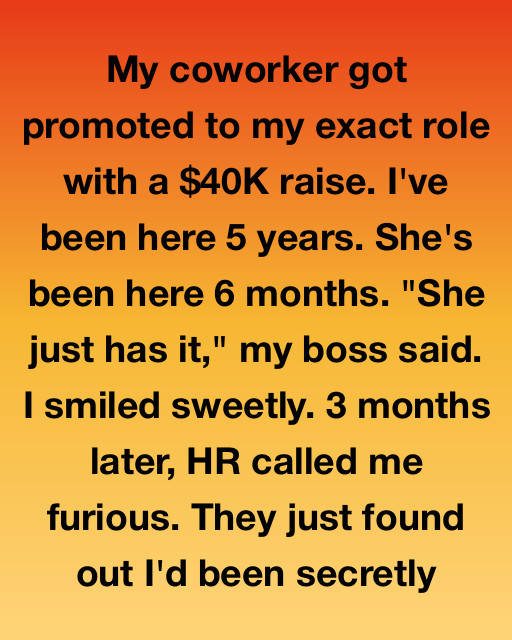
I’d been at Meriton Systems for five years, and honestly, I thought I’d seen every flavor of workplace nonsense there was. But nothing—and I mean nothing—prepared me for the day my manager waved a letter in the air like it was the Holy Grail and said, “Good news! We’re promoting Hollis.”
I blinked, waiting for the second half of that sentence.
He didn’t add it.
So I asked, “To what role?” even though I already had a horrible guess.
“To your role,” he said cheerfully. “Well… the same title. Same responsibilities.”
I don’t know what kind of expression crossed my face, but he kept going.
“She just has it, you know? That spark. That instinct. You’ve been great, but she’s got this natural leadership quality.”
Hollis had been here six months. Six.
She still asked me how to submit PTO requests.
Then he told me the salary increase.
Forty. Thousand. Dollars.
More than I’d gotten in five years total.
My stomach sank, but I kept smiling. I’m annoyingly good at smiling when I want to scream.
“Well,” I said in my sweetest tone, “congratulations to her. I hope she does really well.”
He thanked me like I’d given him a gift instead of swallowing an insult whole.
But inside?
Inside I was already planning.
Not revenge.
Not sabotage.
Just… survival.
The quiet kind, the smart kind, the kind people undervalue until suddenly they don’t.
The truth was simple: I had been doing two jobs for years and getting paid for half of one.
So I made a decision.
If they wanted to undervalue me, I’d let them.
But I wouldn’t keep doing unpaid work out of loyalty they didn’t deserve.
So over the next few months, I slowly, quietly, methodically stopped doing everything that wasn’t explicitly listed in my job description.
Everything I’d been doing just because “you’re so dependable.”
Everything that had kept this whole department glued together.
I wasn’t childish about it.
I didn’t dump work on anyone or create chaos.
I just stopped being the safety net.
If someone assigned me tasks meant for the “senior role,” I politely redirected them to Hollis.
If people asked me questions that weren’t mine to answer anymore, I gently told them, “That’s above my pay grade now.”
Was it petty?
Maybe.
But it was also the truth.
And people don’t like the truth when it exposes a lie they’ve built their house on.
About six weeks after Hollis got the promotion, the cracks were already showing.
Our weekly reports were late because no one realized I’d been assembling them for years.
The new intern sat for an entire afternoon waiting for onboarding instructions because, apparently, I had always handled that “voluntarily.”
Payroll got messed up for three people because the spreadsheet I used to maintain “for fun” wasn’t being updated.
Hollis tried her best.
She really did.
But the poor woman had been thrown into a role she wasn’t equipped for and everyone knew it.
She looked exhausted every day.
Her hair frizzed permanently.
She stopped wearing lipstick.
Still, not my circus.
Then came the client presentation.
Our biggest one of the year.
The kind of meeting that could make or break a quarter.
My boss called me in as if nothing had ever happened.
“Can you help Hollis get ready for the presentation deck? You’re good at this.”
I kept the same polite smile I’d worn the day she got her raise.
“Oh,” I said lightly, “that falls under her responsibilities now, right? I wouldn’t want to step on her toes.”
His left eye twitched.
Just a bit.
Like a dying moth.
By the time three months had passed, upper management had questions.
Real ones.
Why were deadlines sliding?
Why were there new errors?
Why were clients emailing asking for me specifically?
I didn’t gloat.
I didn’t smirk.
I didn’t brag.
I simply did my job… the one they paid me for.
Nothing more.
Then one Thursday morning, HR emailed me asking me to come in immediately.
The wording felt sharp.
Not the usual polite corporate fluff.
It read like someone had spilled coffee on their keyboard while typing it.
When I walked in, the HR director—normally calm and almost painfully monotone—looked stormy.
“Why didn’t you tell us?” she demanded.
I blinked. “Tell you what?”
“That you’ve been doing the workload of two roles for the last two years!”
She dropped a thick folder on the table.
Printed emails.
Old task lists.
Performance summaries.
Evidence.
It looked like someone had dug through every corner of the building and found every trace of the work I’d been doing quietly, invisibly, reliably.
“We were never informed these duties were yours,” she said, flipping through pages. “Your workload exceeded your job description by nearly seventy percent.”
She turned a page so aggressively the paper bent.
“And now,” she said, “everything is falling apart because the work you used to do isn’t getting done.”
I sat there.
Calm.
Polite.
Smiling a little.
“Why,” she continued, “didn’t you report this? We didn’t know you were carrying so much of the department on your back.”
I shrugged softly.
“I assumed management knew. They assigned the work. I just stopped doing the responsibilities that weren’t tied to my title once they promoted someone else to the role.”
She pinched the bridge of her nose.
Then she whispered, “This is a mess.”
Turns out, upper management was furious.
Not with me.
With my boss.
A promotion is supposed to be based on skill, contribution, and readiness—not favoritism, assumption, or vibes.
And promoting someone without understanding the actual workload?
Apparently that’s a pretty big HR no-no.
Within a week:
My boss was “transitioned into a different opportunity,” which is corporate for fired.
Hollis was reassigned to a more appropriate position—she cried with relief.
And I was called into a meeting with the HR director and the COO.
The COO looked at me like I’d been hiding gold bricks in my desk.
“We didn’t know,” he said plainly. “But now that we do, we want to fix this.”
They offered me the senior role.
The full title.
The responsibilities I’d been carrying.
And the raise they should have given me a year ago.
But that wasn’t the twist.
The twist was what THEY proposed.
A raise fifty percent higher than the one Hollis had received.
“Consider it backpay,” the COO said, “for the work you’ve been doing all this time.”
I didn’t cry.
Not in front of them.
But my chest felt warm in a way it hadn’t in a long time.
I accepted.
A week later, Hollis stopped by my desk with a muffin and a whisper.
“I’m really sorry,” she said. “I think we both knew I wasn’t ready for that job. But they told me you didn’t want it.”
I stared at her.
“Who told you that?” I asked.
She hesitated.
Then said my former boss’s name.
Of course.
He had convinced her that I’d refused the role.
That I didn’t want more responsibility.
That she’d been his brave choice.
She thought I’d been supporting her the whole time.
No wonder she’d been so awkward.
“I never said that,” I told her gently. “You didn’t do anything wrong.”
She puffed out a breath, looking relieved.
“Then I’m glad things worked out. You deserve it.”
Funny how the person who’d gotten the unfair promotion was the only one who acted with kindness from the start.
In the months that followed, everything changed.
The department stabilized.
Clients were happy again.
Workflows became structured instead of chaotic.
And I noticed something unexpected.
People treated me differently.
Not because of the title.
Not because of the money.
But because now they knew.
They saw the work I had carried.
The knowledge I had built.
The foundation I had quietly been holding up for years.
Recognition isn’t about applause.
It’s about truth finally being seen.
One afternoon, the HR director caught me by the elevator.
She said, “For what it’s worth, this exposed a bigger problem. We’re now reviewing workloads company-wide. You may have saved a lot of people from the same thing happening to them.”
I hadn’t meant to start a ripple.
But I guess ripples happen when you stop letting people walk on water they didn’t realize was frozen.
The last twist happened during the annual company town hall.
The COO called me up—me, not any of the higher-ups—to talk briefly about “sustainable workload management.”
In front of the entire company, he said, “Sometimes the most valuable people are the quiet ones doing the work no one bothers to look at. Today, we want to acknowledge what happens when one employee’s dedication goes unnoticed.”
Everyone applauded.
Hollis clapped louder than anyone.
And for the first time in years, I felt… seen.
Truly seen.
Sometimes life doesn’t reward hard work right away.
Sometimes people overlook you because they assume you’ll always hold things together no matter how much they pile on you.
But the moment you stop carrying weight that isn’t yours?
The truth reveals itself.
Recognition isn’t about begging to be valued.
It’s about stepping back long enough for people to notice what happens when you’re not there.
And when karma finally comes knocking, it tends to bring interest.
If this story hit you somewhere deep, share it with someone who needs the reminder—and don’t forget to like it, too.