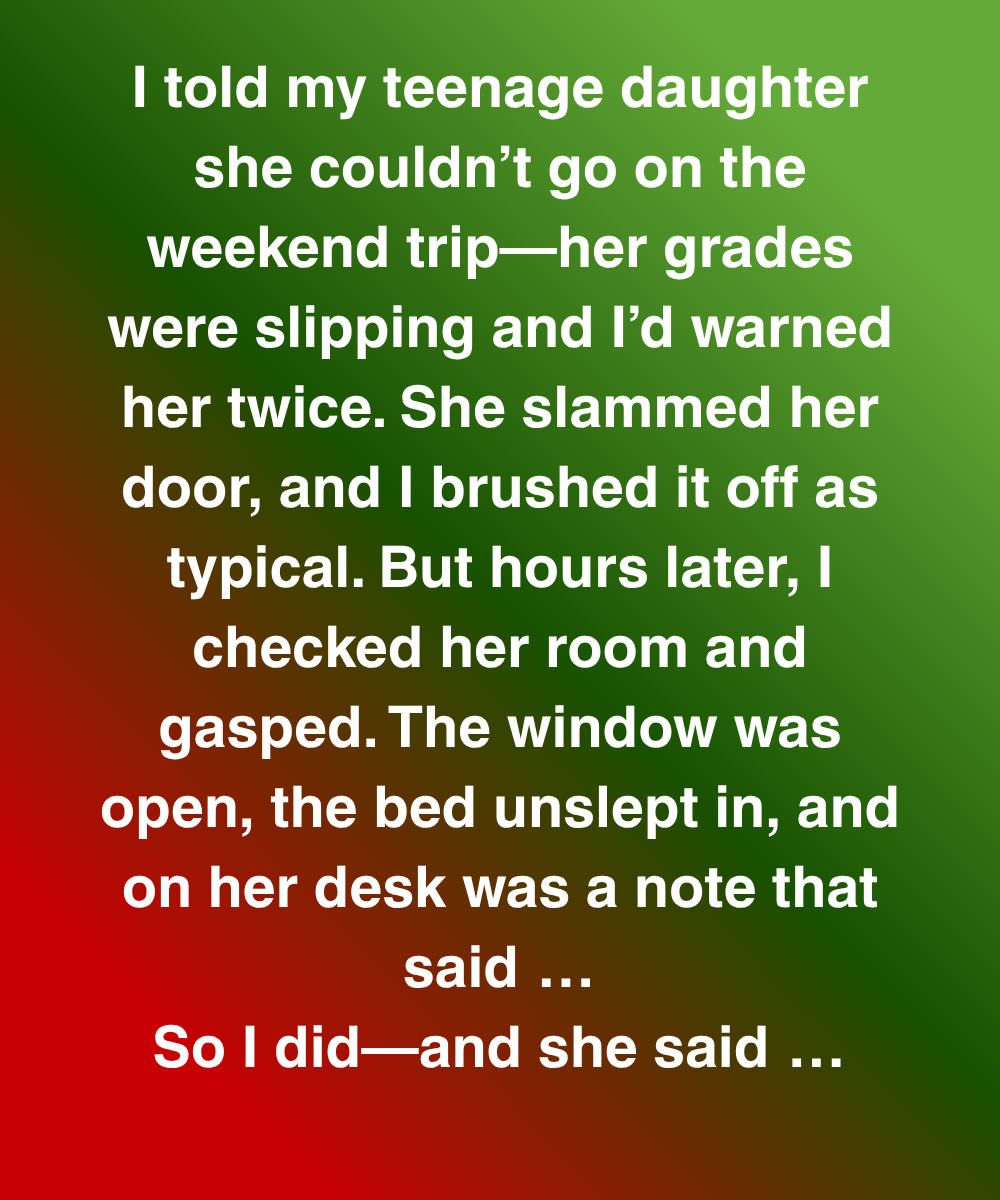
I told my teenage daughter she couldn’t go on the weekend trip—her grades were slipping and I’d warned her twice. She slammed her door, and I brushed it off as typical. But hours later, I checked her room and gasped. The window was open, the bed unslept in, and on her desk was a note that said:
“Don’t come looking for me. I’ll be fine. I just need to be where people don’t treat me like I’m a failure.”
I sat on her bed, the note trembling in my hands. My heart pounded, drowning out every logical thought. I read it again, hoping I’d misunderstood, but the words were blunt, raw, and full of hurt.
Her name was Natalie. She was sixteen. Headstrong, smart, sensitive—too sensitive sometimes. Ever since her mom passed when Natalie was nine, we’d been stuck in this strange push-pull relationship. I tried to be strong for her, but I never quite figured out when to hold on and when to let go.
I called her phone, straight to voicemail. I tried her best friend Mina, who answered groggily.
“I don’t know where she is,” she said. “She told me she wasn’t going on the trip.”
I asked her again, voice breaking, “Are you sure she didn’t say anything?”
“She just said she’d be home all weekend,” Mina mumbled.
I called the school trip coordinator—Natalie hadn’t snuck onto the trip bus. I drove through our small town, checking every spot she used to go when she was younger—the park, the library steps, the bridge near the train station. Nothing.
Back home, I sat in her room and stared at the window. That’s when I noticed something odd: a hoodie folded neatly on her chair. It wasn’t hers. It was black and had a stitched logo that said Cooperstown Baseball 2002. I hadn’t seen it before.
I ran down to the garage and started searching through the bins where she’d thrown her old notebooks. Buried between her sketchbooks, I found a crumpled envelope. Inside were four twenty-dollar bills, a handwritten map with bus routes, and the name Aunt Rachel.
Rachel was my wife’s younger sister. We hadn’t spoken since the funeral—over seven years. Things ended badly after a fight over Natalie’s custody. Rachel had wanted to take her in. She said a girl needed a woman around. I’d refused, saying Natalie needed stability. Neither of us ever called again.
I sat there staring at the envelope. My hands shook as I picked up the phone.
Rachel answered on the third ring. “Hello?”
“It’s me,” I said. “Natalie’s missing. I think she might be coming to you.”
There was silence on the line.
“I—she hasn’t shown up,” she said quietly. “But if she does, I’ll call you. I swear.”
Something in her voice made me pause.
“You sure she hasn’t already called you?” I asked.
“I said no.”
I almost believed her.
I waited all night by the front door. The next morning, I filed a missing person’s report. The police asked for a recent photo and a list of friends. I gave them everything, but deep down, I didn’t think they’d find her that way. Natalie was clever. If she wanted to disappear for a few days, she’d do it.
By Sunday afternoon, I got a text—from a number I didn’t recognize.
“I’m okay. Don’t call. I just need time to think. Please don’t tell anyone you heard from me.”
No name, but I knew it was her. The writing style was unmistakable.
I replied immediately: “Where are you? Please come home. I love you.”
No response.
Then I noticed the area code. It was from Albany.
I drove four hours straight and parked outside Rachel’s old address, a duplex near Lark Street. I waited in my car until evening. Around 6 p.m., I saw someone step out—thin frame, hoodie over her head. She didn’t see me.
I jumped out. “Natalie!”
She froze.
Her face was pale, eyes red from crying.
“Dad,” she whispered.
We stood there in silence. I didn’t yell. I didn’t ask her why she ran. I just walked over and hugged her, tight. She started sobbing.
Inside Rachel’s place, everything was exactly how I remembered it—cluttered but warm. Rachel didn’t say much, just made us tea and sat at the other end of the couch. She looked older, tired. When Natalie went to the bathroom, I turned to her.
“Why didn’t you call me when she showed up?”
“She asked me not to,” Rachel said. “And I figured—maybe she needed this.”
I clenched my jaw. “I’m her father. You don’t get to decide.”
She looked me in the eye. “And yet she didn’t run to you, did she?”
That stung.
But I stayed quiet.
On the drive home, Natalie finally spoke.
“I just couldn’t take it anymore. You’re always on my back about school. It’s like… no matter what I do, I disappoint you.”
I kept my hands on the wheel. “I never meant to make you feel like that.”
“You don’t mean it, but that’s how it feels. You act like my grades are all that matter.”
I sighed. “I thought if I stayed on top of you, it would keep you from falling behind. I wanted you to have options. That’s all.”
“I get that. But I need room to figure things out too. And not feel like a failure every time I mess up.”
That night, she slept in her own bed again. I didn’t say much. I just brought her favorite pancakes in the morning and left them outside her door. She came down eventually and sat across from me. We talked—not about grades, not about school. Just life.
Over the next few weeks, I tried harder. Not perfect. But better. I asked more questions and listened more. Less judging, more understanding.
Then came the second twist.
About a month later, I found an envelope in the mailbox—no return address. Inside was a note written in Natalie’s handwriting, but it wasn’t meant for me.
It was addressed to Rachel.
I only read the first few lines before I stopped myself:
“Thank you for letting me breathe. You didn’t try to fix me, just let me sit with what I felt. I wish things had been different between you and Dad.”
I swallowed hard and resealed it.
That night I drove to Rachel’s. I handed her the note.
“I opened it by accident,” I admitted.
She smiled faintly. “It’s okay.”
We sat on her porch. I looked out at the street.
“I think you were right,” I said. “Maybe she did need a woman around.”
Rachel blinked at me. “That fight we had back then… I never wanted to take her from you. I just wanted to help. You looked so lost.”
“I was,” I said. “Still am some days.”
“I’m here now. We can both help.”
After that, Rachel started coming down once a month. Sometimes she and Natalie went out just the two of them. Other times she stayed for dinner. It wasn’t some fairy tale reunion. But it was something real.
And Natalie started changing too.
She still had off days, still snapped sometimes, still rolled her eyes. But I saw her start to trust me again. She’d show me her artwork, tell me about her weird dreams. One day, out of the blue, she hugged me and said, “Thanks for not freaking out back then.”
I choked up. “I was freaking out on the inside.”
“I know,” she smiled.
We both laughed.
By spring, she brought her grades up on her own. Not straight A’s, but better. More importantly, she seemed steadier. More herself.
Looking back now, I realize I was so focused on protecting her future, I forgot to be present in her now. I thought love meant pushing her to do better. But sometimes love just means sitting quietly beside someone who’s hurting and letting them know you’re not going anywhere.
The biggest surprise came on Father’s Day.
She handed me a small, handmade card. Inside, she’d written:
“Thanks for learning how to love me better. I’m still figuring it all out, but I’m glad you’re here for it. Love, Nat.”
I cried, right there at the table. Didn’t even try to hide it.
It wasn’t just a card. It was proof I hadn’t lost her. That even after all my mistakes, there was still room for repair.
If you’re a parent reading this, here’s what I’ll say: don’t wait until your kid runs away—physically or emotionally—before you start hearing them. Sometimes they’re not asking for answers. They just want to be seen, even in their mess. Especially in their mess.
Natalie and I still argue. We’re human. But now, we both fight to stay in the room. We keep showing up.
And that’s what matters most.
If this story touched you in any way, share it with someone who might need it. You never know whose heart it could reach. And if you’ve been there too—drop a like. Let’s remind each other that growth doesn’t come from perfection. It comes from showing up, again and again.