The air in the restaurant always went thin on Tuesdays.
It was a cold, quiet dread that settled over the polished tables and flickering candles. The staff moved differently. Slower. Their shoulders tight.
Because Tuesday was his night.
Arthur Vance. The man who owned half the skyline. He came not for the food, but for the sport. They called him the waiter killer. He collected broken spirits like other men collected art.
Tonight, he arrived like a storm front, silent and severe, flanked by two men built like refrigerators. He didn’t acknowledge the hostess. He simply took his table, the one that watched the entire room.
His server was a young man named Mark. Good kid. Strong. Now he was just sweating through his starched white shirt.
Vance didn’t even let him speak.
“You’re perspiring,” he said, his voice a flat, dead thing. “It’s unappetizing.”
Then came the smudge on the glass only he could see. The whisper of a threat to buy the building by morning.
Five minutes later, Mark was gone. Fired. Another Tuesday, another victim.
And in the stunned silence of the kitchen, a voice cut through the fear.
“I’ll take him.”
Every head turned. It was Clara. Four days on the job. A back waiter. She wasn’t even supposed to take tables.
The manager’s face went pale. “He will ruin you. He will end you in this city.”
He gave her the rules. Don’t make eye contact. Don’t argue. Swallow every insult and say thank you.
But Clara was running on four hours of sleep and three jobs. Fear was a luxury she couldn’t afford anymore. Hospital bills for her little brother were waiting.
She just nodded, straightened her apron, and walked into the lion’s den.
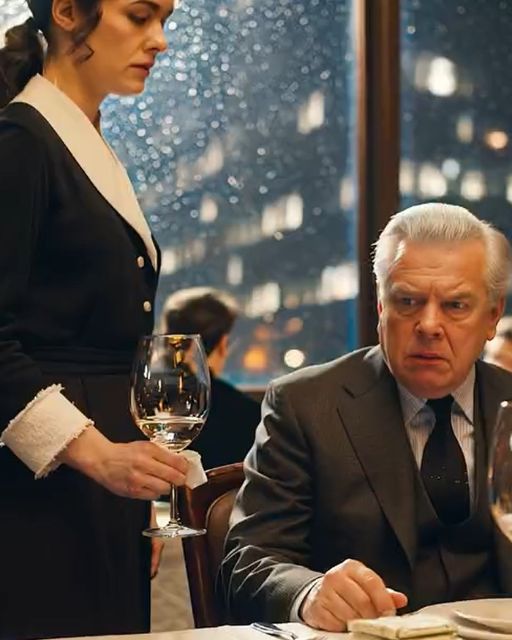
Vance watched her approach, his eyes like chips of ice.
“You’re new,” he stated. “And you’re nervous.”
She wasn’t. She was focused. Her hands were steady as she reset his table. She moved with a quiet purpose that seemed to bother him more than fear ever could.
So he decided to set a trap.
“The ‘82,” he ordered, pointing to a wine on the list that cost more than her rent for a year. “You will open it here. Now. If the cork breaks, you’re buying me the bottle.”
A collective breath was held by the staff hiding in the wings. An old bottle like that? The cork would be dust. It was an impossible test.
Clara retrieved the wine. But instead of the standard corkscrew, she pulled a thin, two-pronged opener from her apron. An old tool for a delicate job.
The room was silent. The only sound was the faint scrape of metal on glass.
Her hands didn’t shake.
She worked the prongs down the side of the cork. A slow, careful motion. The cork groaned. It threatened to crumble into a thousand pieces.
Then, with a final, smooth pull, it slid out.
Whole. Perfect.
A quiet ripple of shock went through the room.
Vance’s jaw tightened. He tasted the wine, swirled it, and dismissed it with a single word.
“Adequate.”
For the next hour, he tried to break her. He sent back perfect steaks. He changed his mind a dozen times. He made her run until her legs ached.
She never flinched. She just served.
Finally, he stopped pretending.
He stared at her worn shoes. Then he pulled a thick wad of cash from his pocket and let five hundred-dollar bills flutter to the floor by her feet.
“Pick it up,” he said, his voice low. “It’s yours. But don’t use your hands.”
The air crackled. This was it. The final humiliation.
Five hundred dollars. A week of peace. A payment on a medical bill. For a second, the exhaustion nearly made her do it. Her body swayed.
Then she heard her mother’s voice in her head, from a long time ago. Your dignity is the one thing they can’t take.
Clara took one step back from the money.
“No.”
The word hung in the air.
Vance’s mask of calm finally cracked. His face flushed a deep, ugly red. He stood up, bellowing for the manager, demanding she be fired on the spot.
She lost the job. She lost the night’s pay.
But as she stood there, under the glare of the expensive lights, she didn’t feel broken. She felt… clear.
For the first time, she truly looked at him. Not the legend, not the monster. Just the man.
And she saw it.
A face she knew. A face she had stared at a thousand times in a single, faded photograph her mother kept hidden in a drawer.
Slowly, deliberately, Clara reached up and pulled the pins from her hair. Dark waves fell over her shoulders.
She walked toward his table, her eyes locked on his. The entire restaurant was a statue.
“You don’t remember me, do you?” she asked, her voice no longer a server’s whisper.
He frowned, confused by the sudden change.
She leaned in close, so only he could hear.
And she spoke the name of the woman he had abandoned twenty-four years ago.
“Sarah.”
The name landed like a stone in a silent pool. It was nothing to the room, but to Arthur Vance, it was a ghost.
His composure, the one he wore like impenetrable armor, fractured. For a split second, something flickered in his cold eyes. Recognition. Then, it was gone, replaced by a rage so profound it seemed to suck the warmth from the air.
“Get this grifter out of here,” he snarled, not looking at her, but at the terrified manager.
But Clara didn’t move. The fear she should have felt was absent. All that was left was a strange, hollow calm.
“She kept your picture,” Clara said, her voice steady, though her heart was pounding against her ribs. “In a box with her nursing school degree.”
He flinched, a tiny, almost imperceptible movement.
“She said you loved the way the city looked from the old bridge at dawn,” she continued. “That you dreamed of owning it all.”
She was reciting the fragments of a story her mother had rarely told, a story of a poor boy with impossible ambition and a girl who believed in him.
“Well, you got it,” Clara said, her gaze sweeping the opulent room. “Congratulations.”
Vance’s two security men moved forward, but he held up a hand, stopping them. He wanted to handle this. He wanted to crush it himself.
“I don’t know what pathetic story you’ve concocted,” he said, his voice dripping with contempt. “But if you think mentioning the name of some woman from my past gets you a payday, you are sadly mistaken.”
He gestured to the money still on the floor. “That was your chance. Now you get nothing.”
Clara gave a small, sad shake of her head. “You still think this is about money.”
She straightened up, her spine like steel. “I don’t want your money, Mr. Vance. I never did.”
She turned and began to walk away, past the stunned staff, past the whispering patrons.
The manager intercepted her at the kitchen door. “Your final check will be mailed,” he mumbled, unable to meet her eyes.
“Thank you,” she said, and she meant it.
She walked out the back door into the cold alley. The city air felt clean on her face. For a moment, she just breathed.
She hadn’t shattered. She hadn’t even bent.
Inside, Arthur Vance sat back down, but the sport was gone. The victory felt like ash in his mouth.
He signaled to one of his men, a serious man named Philip who had been with him for a decade.
“Find out everything about her,” Arthur commanded, his voice a low growl. “I want to know where she sleeps, what she eats, every sad detail of her miserable life. I want to be sure.”
Philip nodded and disappeared.
Clara took two buses to her second job, cleaning offices in a deserted downtown tower. The repetitive motion of wiping down desks and emptying trash cans was a comfort. It allowed her mind to settle.
She hadn’t planned to confront him. She hadn’t even been sure it was him until she saw his face up close, the lines of cruelty unable to fully erase the boy in the photograph.
It was an impulse born of exhaustion and a lifetime of unanswered questions.
The next two days were a blur of work and worry. Her brother, Thomas, had a bad turn. The doctors spoke in hushed tones about new treatments, experimental options, all with price tags that sounded like phone numbers.
She sat by his bed, holding his small hand, the rhythmic beep of the machines a torturous lullaby. He was only eight. He had her mother’s smile and, she now realized with a sickening lurch, Arthur Vance’s eyes.
On Thursday, as she was leaving the hospital, a sleek black car pulled up to the curb. Philip, the serious man from the restaurant, got out.
“Mr. Vance requests your presence,” he said. It wasn’t a question.
Clara’s first instinct was to say no, to run. But what was the point? A man like Vance could find her anywhere. And a sliver of her, a sliver she didn’t want to admit to, was curious.
The car took her to the Vance Tower, a spire of glass and steel that pierced the clouds. The penthouse was a world of sterile white marble and panoramic views. It was less a home and more a monument to a man’s ego.
Arthur Vance stood by the window, his back to her. He didn’t turn around.
“The background check was thorough,” he began, his voice flat. “Clara Jenkins. Born twenty-four years ago. Mother, Sarah Jenkins, a nurse. Deceased.”
Clara felt a fresh stab of grief. Her mother had died two years ago, worn down by long shifts and a broken heart.
“You work three jobs. You live in a two-room apartment. You have no savings.” He paused. “And you have a brother. Thomas.”
He finally turned, a file in his hand. His face was unreadable.
“He has Von Hippel-Lindau syndrome. A rare genetic disorder. It causes tumors to grow throughout the body.” He tapped the file. “A condition that has a 50% chance of being passed down from a parent.”
He looked directly at her, and for the first time, his icy composure seemed to have a hairline crack in it.
“A condition I carry.”
The words hung in the vast, silent room. This was the trap he’d set for her, but it had sprung on him. He had gone looking for dirt and found a mirror. He’d meant to expose a lie and had unearthed a devastating truth.
Clara felt the floor tilt beneath her feet. All these years, she’d blamed bad luck, a cruel twist of fate. But it wasn’t fate. It was a legacy. An inheritance of pain from a man she’d never known.
“What do you want?” Arthur asked, the question rough, almost desperate. “A hospital? A research wing? Name it. A check will be cut. You and the boy will be taken care of. Then you will disappear.”
He was trying to fix it the only way he knew how: by writing a check, by turning a son into a transaction.
The anger that rose in her was cold and pure.
“He has a name,” she said, her voice shaking slightly. “His name is Thomas. He likes drawing superheroes and he hates the color green. He’s afraid of thunderstorms.”
She took a step forward. “He is not a problem to be solved, Mr. Vance. He is your son.”
The word ‘son’ hit him like a physical blow. He actually took a step back.
“I won’t be bought,” Clara said. “My mother couldn’t be, and neither can I. We don’t want your money. We never did.”
She turned and walked to the door. “Goodbye, Arthur.”
She left him there, alone with his skyline and the ghost of a family he never knew he had.
The next few days were the hardest. News of her firing had spread. Finding a new third job was impossible. The bills were piling higher. Thomas was scheduled for another risky surgery. Hope was becoming a luxury.
Then, the story broke.
A diner at a nearby table had discreetly filmed the final moments of the confrontation. The video was grainy, the audio muffled, but the image was clear: the city’s most feared billionaire, red-faced and furious, and a young waitress standing over a pile of cash, refusing to bend.
It went viral. “The Waitress and the Tyrant.” The city loved it. Clara became an anonymous folk hero. Donations started pouring into a fund someone set up for her. It wasn’t life-changing money, but it was enough to cover rent. It was breathing room.
Arthur Vance, meanwhile, was being crucified in the court of public opinion. His company’s stock took a slight hit. It was a PR nightmare.
But this was all happening at the worst possible time for him. Vance Enterprises was facing a hostile takeover. He was locked in a battle for the soul of his own company. The deciding vote belonged to one man: a deeply traditional, old-money board member named Albert Harrison, who believed a man’s character was his most important asset. Harrison was already wary of Arthur’s brutal reputation. The video was making him reconsider everything.
Arthur was losing. The empire he’d built on fear was about to be taken from him.
Reporters found Clara. They swarmed her outside the hospital, microphones and cameras in her face. This was her chance. She could bury him. She could tell the whole world who he really was. She could have her revenge.
She looked into the cameras, her face tired but her eyes clear.
“Please, just leave us alone,” she said. “I have no comment about Mr. Vance. My only concern is my brother. He’s sick. That’s all that matters.”
She didn’t give them the story. She gave them her dignity.
That evening, Arthur sat in his empty penthouse, watching her interview on a giant screen. He watched her protect him, a man who had given her nothing but pain. He didn’t understand.
He pulled out an old, worn wallet from a safe. Tucked inside was a faded photo of a young woman with a brilliant smile. Sarah. Behind it was a sonogram picture. A tiny, grainy image he had stolen from her apartment before he left, a secret he had carried for over two decades. He had known. He had just chosen to forget.
The next morning, for the first time in years, Arthur Vance didn’t go to his office. He went to the children’s wing of the city hospital.
He didn’t announce himself. He just stood in the hallway, an expensive suit in a world of cartoon animals painted on the walls. He saw Clara through the window of a room, sitting by a small bed, reading a book aloud.
He saw Thomas. A small, pale boy with a shock of dark hair, listening intently. His son.
Arthur watched for a long time, unseen. He saw the easy affection between them, the quiet strength that filled the small room. It was a world he had no part in, a language of love he didn’t know how to speak. And he felt a longing so sharp it was a physical ache.
Later that day, he met with Albert Harrison. Harrison was cold, ready to deliver the final blow.
“Arthur, I’ve seen the news. Your conduct is…”
“I know,” Arthur cut in, his voice quiet. “It was monstrous.”
Harrison was taken aback by the admission.
“The girl… Clara… she’s my daughter,” Arthur said. The words felt foreign in his mouth. “And the boy in the hospital is my son. He is sick because of me. I abandoned them.”
He laid his entire, ugly history on the table. No excuses. No spin. Just the truth.
“I spent my life building an empire of things,” Arthur finished, his voice raw. “And I realized I have nothing. She has nothing, and she is richer than I will ever be.”
He looked at the old man. “I don’t care if I lose the company, Albert. I’ve already lost everything that ever mattered. I just… I have to try to fix it.”
Albert Harrison stared at him for a long, silent minute. He had come to bury a tyrant. Instead, he saw a broken man trying to find his way back. He had been looking for Arthur’s character, and for the first time, he saw a glimmer of it.
“A legacy is not built of steel and glass, Arthur,” Harrison said softly. “It’s built of people.”
At the board meeting, Albert Harrison cast the deciding vote. Arthur Vance kept his company.
But he was a changed man. The victory felt different this time. It wasn’t a conquest; it was a chance.
He didn’t just pay Thomas’s medical bills. He established The Thomas and Sarah Jenkins Foundation, pouring hundreds of millions into research for rare genetic diseases. He started using his power not to break people, but to build them up.
He started, clumsily, to be a father. He would show up at the hospital, not with gifts, but with his time. He’d sit for hours while Thomas slept. He learned what superheroes the boy liked.
One afternoon, Clara found him in the hospital room, trying to draw a picture of a superhero for Thomas. It was a terrible drawing. They both knew it.
“He needs a cape,” Clara said from the doorway.
Arthur looked up, startled. “I’m not very good at this.”
“Neither am I,” she admitted, a small smile touching her lips. “We can learn together.”
He offered her a position running the foundation. She accepted, but on her terms. She would be his partner, not his employee.
The healing was slow. It was awkward and painful and full of long silences. A lifetime of hurt could not be undone in a day. But it was a start.
One evening, months later, Thomas was finally being discharged from the hospital. As Clara packed his bag, Arthur was crouched by his bed, showing him a coin trick. Thomas laughed, a real, full-bellied laugh.
It was the most beautiful sound Arthur had ever heard. It was the sound of a future he never thought he’d have.
He had spent his life believing that strength was about how much you could take from the world. But as he looked at his daughter, her face softened by the evening light, and his son, whose small hand had found his, he finally understood the truth.
True strength, real wealth, is not about what you can collect or conquer. It’s about what you have the courage to give back.