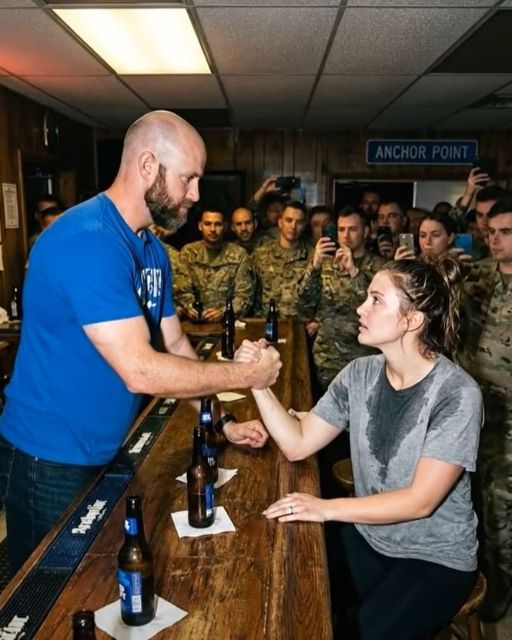
The IPA soaked my gray scrubs. I didn’t move. I just watched the foam settle on the cheap fabric. “Watch where you’re standing, sweetheart,” the man grunted. He was huge. Crew cut. SEAL team t-shirt. His buddies at the high-top laughed. To them, I was just a tired woman in the way of their darts game.
I reached for a napkin to dry off.
“Hey,” he barked, grabbing my arm. “I’m talking to you.”
His grip was tight. He wanted me to flinch. But I didn’t flinch. I felt my heart rate slow down. It’s a reflex. My feet shifted two inches to the left. I rotated my wrist, exposing the underside of my forearm. The neon bar lights hit the silver, jagged scar running from my palm to my elbow.
The room went silent.
In the corner, an old Master Chief stood up. He dropped his beer. He knew that scar. He knew that stance. He screamed across the bar, “Rodriguez! Let go! That isn’t a nurse! That’s…”
His voice cracked. He couldn’t finish the sentence. He just pointed a trembling finger at me.
The SEAL, Rodriguez, looked from the old man to my arm. His eyes traced the brutal, puckered line of flesh. His grip loosened, but he didn’t let go. Not yet. Confusion warred with his arrogance.
“That’s who, Master Chief?” he asked, his voice losing its edge.
The old man, O’Malley, walked towards us. The bar was so quiet you could hear the hum of the beer cooler. He didn’t look at Rodriguez. His eyes were locked on mine. There was a reverence in them, a deep, painful respect.
“That’s Major Sarah Jensen,” O’Malley said, his voice barely a whisper. “But we just called her Doc.”
Rodriguez’s hand dropped from my arm as if it had been burned. The name clearly meant something to him. It meant something to every person in that room who had ever worn a uniform.
“Doc Jensen?” one of his buddies stammered from the table. “The one from Kandahar? From Operation Nightfall?”
I finally looked up from my arm and met Rodriguez’s eyes. They were wide with a dawning horror. The bravado was gone, replaced by a deep, gut-wrenching shame.
I gave a small, tired nod. “That was a long time ago,” I said softly.
My voice was calm. It was the same voice I used to talk down a panicked soldier after a firefight. It was the voice I used to tell a family their loved one was going to be okay.
O’Malley reached us. He looked at me, then at my beer-soaked scrubs. “Major… I mean, Sarah. I’m so sorry.”
“It’s just beer, Master Chief,” I said. I offered him a small smile. “And it’s just Sarah now. I punch a clock at County General.”
Rodriguez couldn’t speak. He just stood there, a mountain of a man, looking smaller than I’d ever seen anyone look. He opened his mouth, then closed it. He looked at my arm again, at that terrible scar.
He didn’t know the story, not the real one. Nobody did, except for a handful of us. But everyone in the special operations community knew the legend.
The legend of the surgeon who performed a miracle in the middle of hell.
It was ten years ago. I was a forward surgical team leader, attached to a Ranger battalion. We were on a mission deep in hostile territory. Our Black Hawk went down. Hard.
The crash was a nightmare of screaming metal and fire. I came to with the taste of blood and fuel in my mouth. My leg was broken, a clean snap of the tibia. But my hands were okay. My hands were always okay.
We had casualties. Severe ones. One of them was a young Ranger, Corporal Evans. He had shrapnel in his abdomen, and he was bleeding out fast. His artery was nicked. He had minutes, not hours.
The medevac was thirty minutes out, best-case scenario. He wouldn’t make it. I was the only one who could perform the surgery he needed.
But I was bleeding, too. A piece of the helicopter’s fuselage had sliced my left forearm open, from wrist to elbow. It wasn’t life-threatening, but the blood loss was making me dizzy. My hand was shaking. You can’t operate with a shaking hand. You just can’t.
So I did the only thing I could.
I laid my arm on a flat piece of wreckage. I told our comms specialist, a terrified kid named Peterson, to hold a flashlight steady. Using a suture kit and a hemostat from my med pack, I started stitching my own arm back together.
No anesthetic. No sterile field. Just grit, and the desperate need to save the boy dying next to me.
Every pull of the needle was a fresh wave of agony. But with each stitch, my hand grew steadier. I compartmentalized the pain. I put it in a box and shoved it to the back of my mind. It’s a skill you learn. My only focus was the Ranger.
I finished closing myself up. The scar was ugly, a railroad track of crude stitches. But the bleeding had stopped. My hand was rock steady.
Then I went to work on Corporal Evans. For the next twenty minutes, with nothing but a headlamp and the kid’s shaky flashlight for light, I saved his life on the floor of a wrecked helicopter.
That’s the story they told. That’s the legend of the scar.
Back in the bar, the silence was finally broken by Rodriguez.
“Ma’am,” he said, his voice thick with emotion. “I… there are no words. I am so sorry.”
“It’s forgotten,” I said. It was the truth. In the grand scheme of things, a spilled beer and a grabby jarhead were nothing. I’d dealt with far worse with far more on the line.
“No, ma’am, it’s not,” he insisted. He looked at Master Chief O’Malley, then back at me. “My behavior was unacceptable. There’s no excuse.”
O’Malley put a hand on the young SEAL’s shoulder. “The boy knows he messed up, Doc. He’s a good kid, just full of piss and vinegar.”
I looked at Rodriguez. He was young. Probably on his first or second deployment. He had that look of indestructibility I once had. The look that comes before life teaches you that you’re made of the same fragile stuff as everyone else.
“What’s your first name, Rodriguez?” I asked.
“Marcus, ma’am.”
“Well, Marcus,” I said, picking up a clean napkin and dabbing at my scrubs. “You owe me a beer.”
A wave of relief washed over his face. His friends at the table, who had been frozen in place, finally started to breathe again.
He practically ran to the bar. “Give her anything she wants!” he yelled at the bartender. “Top shelf. And get the Master Chief one, too. Put it all on my tab.”
I ended up sitting with them. O’Malley, Marcus, and his two friends. They pulled up a chair for me at their high-top. Marcus brought me a craft cider and a plate of wings he insisted I have.
They were quiet at first, deferential. They called me “ma’am” and “Doc.” I told them to call me Sarah. I told them I was just a nurse now, that those days were behind me.
“Why, though?” Marcus asked, after he’d gotten over his initial shame. “Why stop? You’re a hero.”
I thought about that for a long time. It was the question I had asked myself a thousand times in the quiet of the night.
“I got tired of patching people up just to send them back into the fight,” I said finally. “I saw too many kids, kids your age, go home in pieces. Or not go home at all.”
I took a sip of my cider. “I realized that the hardest part wasn’t the surgery. It was seeing the cost. The real cost.”
I told them about the quiet moments. Holding a soldier’s hand as he passed. Calling his mother. The weight of it all became too much.
“So I came home,” I continued. “I wanted to heal people without a war going on around them. I wanted to see them get better and go live their lives. A different kind of service, I guess.”
They understood. In their eyes, I saw the flicker of their own fears, their own doubts about the path they had chosen.
We talked for another hour. They told me about their training, about their lives. I listened. I didn’t offer advice. I just listened. It’s what I do best now.
As the night was winding down, Master Chief O’Malley, who had been mostly quiet, looked at me with an intensity that made me pause.
“Sarah,” he said. “There’s something else about that day. Something you don’t know.”
I raised an eyebrow. “I think I remember it pretty clearly, Master Chief.”
“You remember Corporal Evans? The Ranger you saved?”
“Of course,” I said. “I wonder what happened to him.” I’d never followed up. It was a rule I made for myself, to keep from getting too attached.
O’Malley looked over at Marcus, whose face had gone pale again. A strange, new understanding was dawning in my mind. It was a faint connection, a puzzle piece I hadn’t known was missing.
“Corporal Evans made a full recovery,” O’Malley said slowly, his eyes boring into mine. “He served another ten years. Became a mentor to a lot of young guys coming up. A real legend in his own right.”
He paused, letting the weight of his words settle.
“He was the one who inspired his kid brother to join the Teams. A younger brother who idolized him. Who wanted to be just like the man who survived against all odds.”
My gaze shifted to Marcus. He was staring at the table, his knuckles white as he gripped his beer bottle. He wouldn’t look at me.
It all clicked into place. The universe, in its strange and sometimes cruel way, had just played an unbelievable card.
“Evans,” I whispered, the name feeling different on my tongue. “His first name was Daniel.”
“Daniel Evans was my big brother,” Marcus said, his voice choked. He finally looked up at me, and his eyes were swimming with tears. “He died two years ago. Training accident.”
The air left the room. My own past, a story I had neatly filed away as a legend about a stranger, had just collided with my present in the most personal way imaginable.
The man whose life I had saved, the man for whom I had mutilated my own arm, was the brother of the arrogant young SEAL who had just assaulted me.
I felt a wave of dizziness, not from blood loss this time, but from the sheer, impossible weight of the moment. I reached out and put my hand on Marcus’s arm. The one that wasn’t gripping the bottle.
“He talked about you,” Marcus whispered, a tear rolling down his cheek. “He never knew your name. He just called you the ‘Angel of the Wreckage.’ He said he owed his whole life to you. His wife… his kids… they only exist because of you.”
I didn’t know what to say. I had spent a decade trying to detach from that day, to turn it into a war story that belonged to someone else. Now, it was sitting right in front of me, real and breathing and crying.
“He told me that strength wasn’t about how hard you could hit,” Marcus continued, his voice cracking. “He said true strength was the person who could stitch themselves up just to save someone else. And tonight… I treated you like you were nothing. I… I disrespected his memory. I disrespected you.”
He finally broke, burying his face in his hands.
I looked at O’Malley. The old Master Chief just nodded, his own eyes misty. He had known the whole time. He was waiting for the right moment.
I didn’t comfort Marcus with platitudes. I didn’t say “it’s okay.” Instead, I told him the truth.
“Your brother was the brave one that day,” I said, my voice quiet but firm. “He was in unimaginable pain, but he kept talking to me. He kept me focused. He told me about his girl back home. He told me about his little brother who he had to get back to. He fought to stay alive. I was just the mechanic.”
Marcus looked up, his face a mess of confusion and grief.
“He saved me as much as I saved him,” I said. “Don’t you forget that.”
We left the bar together not long after that. The air outside was cool and clean. Marcus walked me to my car.
“Ma’am… Sarah,” he started, fumbling for words. “I don’t know how to make this right.”
“You already have,” I told him. “You listened. And you learned.” I looked at him, really looked at him. I didn’t see an arrogant SEAL anymore. I saw Daniel Evans’s little brother. I saw a kid carrying a heavy legacy.
“Live a life that would make him proud,” I said. “That’s how you make it right. That’s how you honor him. And that’s all the thanks I’ll ever need.”
He nodded, a silent promise passing between us.
The next Monday at work, a huge bouquet of flowers was waiting for me at the nurses’ station. The card didn’t have a name. It just had a quote.
“True strength is the person who can stitch themselves up just to save someone else.”
I smiled.
A few weeks later, Marcus Rodriguez started a new volunteer program at the hospital. He and his SEAL buddies came in on their off days. They didn’t do anything glamorous. They read to sick kids in the pediatric ward. They sat with elderly veterans in hospice, just listening to their stories. They brought a different kind of strength into those sterile halls. A quiet, gentle strength.
Sometimes, our paths cross in the hallway. He always gives me a small, respectful nod. I give him one back. We don’t need to speak of that night in the bar. Our understanding is deeper than words.
It’s funny how life works. You think you’ve left the battlefield behind, but its echoes always find you. I thought my greatest act of service was performed in a downed helicopter, covered in blood and fuel. But maybe my purpose wasn’t just to save a man’s life that day. Maybe it was to meet his brother ten years later, in a cheap bar, and help heal a different kind of wound.
Strength isn’t always loud. It’s not always a man in a uniform, kicking down doors. Sometimes, it’s a woman in scrubs, heading home after a 12-hour shift. Sometimes, the most profound battles are the quiet ones, and the greatest victories are the scars that remind us not of what we’ve lost, but of what we were strong enough to save.