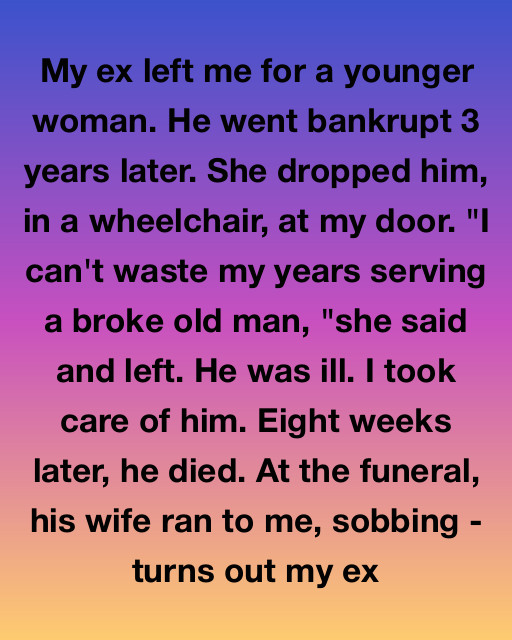
I remember the day Silas walked out of our cottage in Surrey like it was yesterday. We had been married for twenty-two years, a lifetime of shared tea, damp winters, and the quiet rhythm of a life built on solid ground. Then came Tanya, a woman who was closer in age to our youngest niece than she was to us. Silas told me he felt “reborn” and that he couldn’t spend the rest of his life watching the grass grow with someone who knew his every habit. He left me with the house, a broken heart, and a silence so loud it felt like a physical weight in the rooms.
For three years, I rebuilt myself from the rubble he left behind. I started a small garden design business, made new friends who didn’t know him, and stopped checking his social media to see their lavish holidays in Dubai. I heard whispers through the grapevine that things weren’t going well, that his investments had soured and the high life was draining his pension faster than he could replenish it. I felt a twinge of pity, but mostly I felt a cold, hard sense of detachment. He had made his bed in a five-star hotel, and he could sleep in it.
The doorbell rang on a Tuesday afternoon, a drizzly, gray October day that made everything look muted. I opened it expecting a delivery, but instead, I found a sight that drained the blood from my face. There was Silas, sitting in a manual wheelchair, looking thirty years older than the man I had once loved. His face was gaunt, his skin had a grayish pallor, and his hands were trembling in his lap. Behind him stood Tanya, dressed in a designer tracksuit, holding a small suitcase and looking utterly bored with the entire situation.
“I can’t waste my prime years serving a broke, dying old man,” she said, her voice as sharp and cold as a winter frost. She didn’t even look me in the eye as she pushed the wheelchair forward, crossing the threshold of my porch. “He’s got no money left, he’s got no health, and quite frankly, he’s your problem now.” Before I could even find my voice to protest, she turned on her heel, hopped into a waiting car, and sped away. I stood there in the doorway of the home we once shared, looking down at the man who had traded me for a dream that had turned into a nightmare.
Silas didn’t look up at me; he just stared at his own knees, his breath coming in shallow, wheezing rattles. My first instinct was to call an ambulance or a social worker, to scream that this wasn’t my responsibility. But then I looked at his hands, the ones that used to hold mine during the scary parts of movies, and I saw how frail they had become. The anger didn’t disappear, but it shifted into a heavy, somber sense of duty. I couldn’t leave a human being, even one who had betrayed me, to rot on my doorstep in the rain.
I wheeled him inside, back into the hallway where we used to hang our coats together. He was incredibly ill, suffering from a heart condition that had clearly been neglected in the chaos of his financial collapse. I set up a bed for him in the downstairs study, the room where he used to sit and plan the future he eventually threw away. For the first few days, we barely spoke; I simply performed the mechanical tasks of caregiving. I fed him soup, changed his linens, and administered the cocktails of medication the local doctor prescribed.
As the weeks crawled by, the silence between us began to soften into something more fragile. He started to regain a tiny bit of strength, enough to sit up and watch the birds in the garden through the window. One evening, as the sun was setting behind the oaks, he reached out and touched my sleeve with a shaking hand. “I’m sorry, Elena,” he whispered, his voice barely more than a rasping breath. I didn’t say it was okay, because it wasn’t, but I sat down beside him and stayed until he fell asleep.
I spent eight weeks as his nurse, his confidante, and his silent witness. We talked about the early years, the times before the greed and the ego took hold of his senses. He told me about the regret that had been eating him alive long before the heart disease took its turn. He confessed that the moment he moved into that glass apartment in London with Tanya, he realized he had made a catastrophic mistake. He was a man who belonged in a garden with a woman who knew his soul, not in a nightclub with a woman who only knew his bank balance.
In those final days, Silas became the man I had married again, stripped of the bravado and the expensive suits. We laughed about a camping trip we took in the Lake District where the tent blew away in the middle of the night. We cried about the years we had wasted being apart when we should have been growing old together. He told me he knew he didn’t deserve my kindness, but that it was the only thing keeping him from slipping into the dark. On a quiet Sunday morning, eight weeks after he arrived, Silas took his last breath while I was holding his hand.
The funeral was a small, somber affair at the local parish church, attended by a few old friends and distant cousins. I sat in the front row, feeling a strange mix of grief and a bizarre sense of closure. I had seen him through to the end, and the debt of our history felt paid in full. As the service ended and we began to file out toward the graveyard, I saw a familiar figure standing near the lychgate. It was Tanya, but she wasn’t wearing the designer tracksuit or the cold, arrogant expression she had worn on my doorstep.
She was dressed in simple black, her face tear-streaked and her eyes red with what looked like genuine, gut-wrenching grief. As I approached, she didn’t turn away or act indifferent; she literally collapsed toward me, sobbing into my shoulder. “I’m so sorry, Elena,” she wailed, her body shaking with the force of her emotions. “I’m so, so sorry for the way I spoke to you that day.” I stood there, stiff and confused, wondering why the woman who had dumped him like trash was now acting like a broken-hearted widow.
When she finally composed herself enough to speak, she led me to a quiet bench away from the other mourners. She reached into her handbag and pulled out a crumpled letter, written in Silas’s unmistakable, looping handwriting. She told me that Silas had known he was dying for months, and he had known he was bankrupt. But he had also known that I was a woman of immense pride and that I would never have taken him back if he had simply asked for forgiveness. He was too ashamed to crawl back, and he knew I was too hurt to open the door.
“He begged me to do it,” Tanya whispered, wiping her eyes with a damp tissue. “He told me the only way you would let him in was if you thought he was being abandoned and had nowhere else to go.” She explained that they hadn’t actually broken up and he hadn’t spent all his money—he had actually set aside a significant life insurance policy for me. The “broke old man” act was a charade they had choreographed together so he could spend his dying days in the only place he ever felt at home.
Tanya had faked the cruelty, the abandonment, and the insults because she loved him enough to let him go back to the woman he truly belonged with. She had spent those eight weeks in a cheap motel nearby, calling him every night when I was asleep to check on his progress. She had sacrificed her own reputation in my eyes and his final weeks of company just so he could find peace with me. It was a twist I never saw coming—a conspiracy of love between the wife and the mistress to give a dying man his final wish.
I realized then that Silas hadn’t just come home to be cared for; he had orchestrated a final act of redemption. He wanted me to have the house, the insurance money, and the knowledge that he had returned to me, even if it took a lie to get him through the door. Tanya kissed me on the cheek, handed me the legal documents for the policy, and walked away, leaving me alone in the churchyard. I looked down at the fresh earth of his grave, feeling a warmth I hadn’t expected.
The lesson I learned is that love and forgiveness often travel in very strange vehicles. Sometimes, the truth is too heavy to carry, and a lie is the only thing that can bridge the gap between two broken people. We spend so much of our lives holding onto our dignity and our grudges, forgetting that at the end of the road, the only thing that matters is where you lay your head. Silas found his way back to the start, and in doing so, he taught me that grace is often found in the most unlikely of places.
If this story touched your heart or reminded you that it’s never too late to find your way home, please share and like this post. We all deserve a little bit of grace, even when we think we’ve wandered too far away to be found. Would you like me to help you write a letter to someone you’ve lost touch with, or perhaps find a way to start a conversation about forgiveness in your own life?