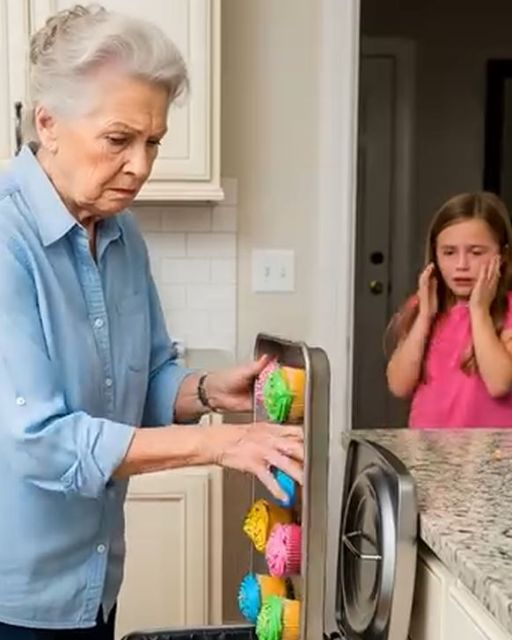
My 8-year-old spent five hours baking cupcakes for our family dinner. My mother tossed them into the trash, and my sister laughed, “Try again when you’re older.” I didn’t laugh. I stood up… and what I said next left the entire table silent…..
The first thing I saw was the frosting.
A bright white smear against the black plastic of the trash bag.
Then, the crushed paper cups. Six of them. The ones my daughter Lily had spent five hours baking, frosting, and arranging on a plate just so.
My feet stopped moving.
My breath caught somewhere in my throat.
And that’s when I saw her. Lily. Standing silently in the kitchen doorway.
Her eyes were fixed on the bin. Her face was perfectly blank. She didn’t cry. She didn’t make a sound. She just… deflated. Like a balloon losing its air.
That was so much worse than tears.
I walked back to the dining room. The sound of my family’s laughter felt like glass in my ears.
Lily was already in her chair, her hands hidden in her lap. My sister, Karen, was holding court.
“You have to hold them to a higher standard,” she was saying, gesturing with her fork. “It builds character.”
My mother nodded in agreement, dabbing her lips with a napkin.
I looked at Lily. Her little shoulders were trembling.
Something hot and sharp bloomed in my chest.
My hand found my wine glass. The stem was cool against my skin.
My voice came out low. Even.
“Karen, sure you don’t want one of Lily’s cupcakes?”
She let out a short, tight laugh. “I think not. Maybe when she’s a little older and knows what she’s doing.”
The table chuckled.
And I saw it all with perfect, horrifying clarity. This wasn’t about cupcakes. It was a lesson. A cruel one.
I stood up.
The chatter died. Every eye turned to me.
“I’d like to make a toast,” I said.
My mother’s smile was a thin line.
“To the last time,” I said, my voice cutting through the silence, “that you will ever see us again.”
A fork clattered onto a plate.
“Sarah, that’s enough,” my mother snapped. “This family has standards.”
I looked right at her. For the first time, there was no fear. Just a strange, cold calm.
“You’re right,” I said softly. “You do.”
I let that hang in the air for a second.
“And now you get to find out just how much those standards cost.”
I took Lily’s small, trembling hand in mine.
We walked out. We didn’t run.
The front door didn’t slam. It just clicked shut behind us.
The quietest, loudest sound I had ever heard.
The car ride home was a vacuum.
No radio. No words. Just the rhythmic thump of the tires on the pavement.
I glanced over at Lily in her booster seat. She was staring out the window, watching the streetlights streak by like fallen stars.
Her face was still a careful, fragile mask.
When we pulled into our driveway, I turned off the engine, but I didn’t move to get out.
“Lily-bug,” I whispered into the quiet.
She didn’t turn.
“It wasn’t about your cupcakes,” I said, my own voice thick with unshed tears. “They were perfect.”
A single, tiny tear finally escaped and traced a path down her cheek.
“They weren’t,” she whispered back, her voice impossibly small. “Grandma said the frosting was lumpy.”
I unbuckled my seatbelt and twisted around to face her.
“Your grandma is wrong,” I said with a firmness that surprised even me. “And we are never going to listen to her again.”
Inside, the house felt big and empty.
I helped Lily get into her pajamas and tucked her into bed. She curled into a tight ball, her back to me.
I sat on the edge of her bed for a long time, just watching the gentle rise and fall of her shoulders.
I felt like I had failed a test I didn’t even know I was taking.
My phone buzzed on the nightstand. It was my mother. I ignored it.
It buzzed again. Karen. A text message.
“You’re being hysterical. You owe Mom an apology.”
I stared at the words. Hysterical. Owe. Apology.
A lifetime of those words, a lifetime of bending and shrinking to fit their mold, flashed through my mind.
With a deep breath, I blocked both of their numbers.
It felt like cutting a rope that had been around my neck for thirty-four years. I could finally breathe.
I went downstairs.
The silence of my own kitchen was a comfort.
I pulled out the flour. The sugar. The eggs.
I found the bowl Lily and I had used earlier that day, still with a faint dusting of flour on the rim.
When I heard a soft shuffle behind me, I turned.
Lily stood there, her favorite stuffed rabbit clutched in her hand.
“What are you doing, Mommy?”
“I’m not sure,” I admitted. “I just felt like we needed to make something.”
She watched me for a moment, then padded over to the counter.
“Not cupcakes,” she said quietly.
“No,” I agreed. “Definitely not cupcakes.”
We made chocolate chip cookies.
There was no recipe. We just added things that felt right. Extra brown sugar for chewiness. Too many chocolate chips. A dash of cinnamon just because.
We got flour on our noses and batter on our pajamas.
Lily laughed. A real, genuine laugh that healed a crack in my heart.
We sat on the kitchen floor at one in the morning, eating warm, gooey, imperfect cookies straight from the baking sheet.
They were the most delicious thing I had ever tasted.
The next few weeks were a strange kind of quiet.
No Sunday dinner obligations. No passive-aggressive phone calls.
It was liberating and terrifying all at once. I kept waiting for the other shoe to drop, for them to show up on my doorstep.
But they never did. Their silence was its own kind of judgment.
Lily, however, started to change.
She started her own little notebook, covered in stickers. She called it her “Book of Flavors.”
In it, she didn’t just write down recipes. She drew pictures of her ideas. A cake that looked like a planet. A cookie shaped like a dragon.
The shame my mother had tried to pour into her had, instead, sparked something creative and fierce.
She asked for a piping bag set for her birthday. For a subscription to a baking magazine for Christmas.
Her passion, which had been so brutally crushed that night, was slowly, carefully, being rebuilt. And this time, it was built on a foundation of her own joy, not a desire for anyone’s approval.
I became her official taste-tester, her head of photography for the creations she wanted to share online, her ingredient runner.
Our weekends were filled with the smell of vanilla and melting chocolate. Our kitchen was perpetually dusted with flour.
It was our sanctuary.
Years passed. Five of them. Then seven.
Lily was fifteen now, a whirlwind of teenage energy and artistic talent.
Her “Book of Flavors” had turned into a popular baking blog and an Instagram account with a surprisingly large following.
People loved her whimsical designs and her down-to-earth writing. She wrote about her successes and, more importantly, her failures. The collapsed souffle, the burnt caramel. She showed them all.
She taught her followers that baking wasn’t about perfection. It was about love.
I hadn’t spoken to my mother or Karen in all that time. I heard through the grapevine of distant relatives that my mother’s health was declining, and that Karen was running the family’s bakery.
“Heirloom Bakes,” it was called. A place built on my grandmother’s recipes and my mother’s rigid standards.
I tried not to think about them. They were part of a different life. A life before cookies on the kitchen floor.
One afternoon, Lily came home from school, her eyes shining.
“They announced the theme for the County Fair Bake-Off,” she said, practically vibrating with excitement.
“Oh yeah?” I asked, looking up from my laptop.
“It’s ‘A Taste of the Future.’ The grand prize is ten thousand dollars in seed money to start a business.”
Her unspoken question hung in the air between us.
This wasn’t just some local contest. It was a huge event, sponsored by culinary magazines and big food brands.
“You should do it,” I said, my heart swelling with a fierce pride that almost hurt.
“Really? But… it’s a huge deal. The judges are professionals.”
“Lily,” I said, walking over and putting my hands on her shoulders. “You are a baker. A real one. You’ve got this.”
For the next month, our lives became a flurry of sketches, test batches, and flavor experiments.
Lily was designing a multi-layered cake. Each layer told a story of a different baking technique she’d mastered. It was ambitious and beautiful.
The day of the fair was bright and sunny, filled with the noise of carnival rides and the smell of popcorn.
We found our station in the big exhibition hall. Lily carefully began setting up her display.
And then I saw them.
Across the hall, setting up their own pristine, sterile display, were my mother and my sister.
My mother looked older, frailer, seated in a high stool, but her expression was as hard as ever. Karen was all sharp angles and a forced, professional smile.
Their sign read “Heirloom Bakes: Honoring Tradition.”
My blood ran cold.
Karen saw me first. Her smile tightened. She nudged my mother.
They both looked over at Lily, who was now carefully placing a spun-sugar sculpture on top of her cake.
They didn’t come over. They just watched. Judged. Dismissed.
I saw the flicker of doubt in Lily’s eyes. The old wound, I knew, was still tender.
I stepped up beside her.
“Hey,” I said softly, pretending to adjust a piece of her display. “Look at me.”
She met my gaze.
“Who are you baking for?” I asked.
A small smile touched her lips. “For me,” she whispered.
“That’s right,” I said. “No one else matters.”
Her shoulders straightened. The doubt vanished, replaced by the quiet confidence I had watched her build for seven years.
The judging began.
The judges, a panel of three renowned pastry chefs, moved from table to table.
They stopped at Heirloom Bakes. They tasted my sister’s offering—a technically perfect, but utterly predictable, Victoria sponge.
“Classic,” one judge said with a polite nod. “Well executed.”
Then they came to Lily’s station.
She explained her creation. She called it “The Storyteller.”
She spoke about how the bottom layer, a dense, rich chocolate stout cake, represented a strong foundation. The middle, a light and airy lemon sponge with raspberry filling, represented creativity and joy. The top, a delicate lavender and honey cake, represented looking towards a sweet future.
She spoke with a passion that filled the space around her.
The judges were silent as they took their first bites.
I held my breath.
One of them, a stern-looking woman, closed her eyes. A slow, genuine smile spread across her face.
“Astonishing,” she said. “This isn’t just a cake. It’s a piece of art. It has heart.”
The rest of the judging was a blur.
When they announced the winner, I was already crying.
“The grand prize… goes to Lily Miller for ‘The Storyteller’!”
The hall erupted in applause. Lily stood, stunned for a second, before a huge grin broke out across her face. She threw her arms around me, and we just held on.
Over her shoulder, I saw my mother and Karen. Their faces were masks of disbelief and fury.
They had been so sure that their standards, their tradition, were the only things that mattered. They never understood that passion was the one ingredient they were missing.
Later, as we were packing up, they approached us.
Karen’s smile was back, but it was all teeth. My mother stood behind her, leaning on a cane.
“Well, well,” Karen began. “Quite the surprise.”
“We’re very proud of you, Lily,” I said, stepping slightly in front of my daughter.
“She has talent,” my mother conceded, her voice raspy. “Raw, of course. Untrained. But there’s potential.”
I waited for the other shoe. It didn’t take long to drop.
“Our bakery,” Karen said, getting to the point. “Sales have been… slow. People want new things. Things like… that.” She gestured at Lily’s prize-winning cake.
“We want to make you an offer,” she continued. “Come work for us. We’ll give you a proper platform. The family name. We can teach you our standards.”
I almost laughed. It was so perfectly them. It wasn’t an apology. It was a business transaction. They didn’t see a granddaughter, a niece. They saw an asset. A way to save themselves.
I was about to tell them exactly where they could put their offer, but a soft voice spoke up from behind me.
“No, thank you.”
It was Lily. She stepped out from behind me, her chin held high. She was no longer that deflated eight-year-old girl. She was a young woman who knew her own worth.
“I don’t need your platform,” she said, her voice clear and steady. “And I don’t want your standards.”
She looked directly at my mother.
“The only ingredient my baking needs is love. It’s something you threw in the trash a long time ago.”
My mother flinched as if she’d been struck. Karen’s jaw tightened in anger.
But there was nothing left for them to say. They had no power here anymore.
Without another word, they turned and walked away, disappearing into the thinning crowd.
As I watched them go, I felt not anger, but a profound sense of peace. The rope I had cut seven years ago was well and truly gone.
We had built our own family. Our own traditions.
That night, back in our flour-dusted kitchen, Lily and I sketched out a logo for our new business. It was a simple drawing of two people, a mother and a daughter, rolling out dough together.
We decided to call it “The Second Chance Bakery.”
Because that’s what we had given each other. A second chance to build a life not on rigid, heartless standards, but on the sweet, messy, and infinitely rewarding foundation of love. And that was a recipe that could never fail.