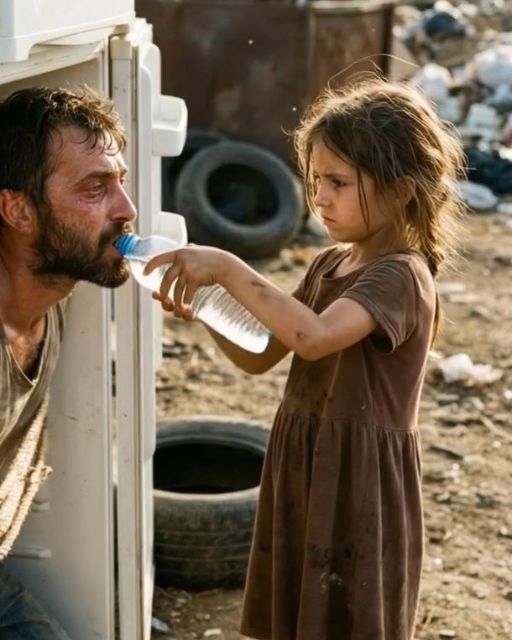
Mary knew the rules of the dump: Don’t touch the medical bags, don’t sleep near the compactor, and never open the locked boxes. But she heard the crying coming from the rusted Kenmore unit near the tire stack. She pried the door open with a steel pipe.
A man in a torn silk suit was curled inside, his wrists bound tight with silver duct tape. He looked up, sweat dripping down a face that cost more to maintain than Mary made in a year.
“Help,” he wheezed. “Robert… my name is Robert. My brother locked me in. He wants the trust fund. Please.”
Mary didn’t hesitate. She didn’t have a knife, so she used her teeth. She gnawed at the thick tape binding his wrists. It tasted like glue and dirt. It took twenty minutes. Her gums bled. Finally, the tape snapped.
Mary fell back, panting, waiting for a hug. A reward. A “thank you.”
Robert stood up. He didn’t stumble. He didn’t stretch his cramped legs. He brushed a speck of dust off his lapel. He took a deep breath – not a gasp of relief, but a sigh of boredom. He reached into his inner jacket pocket and pulled out a fresh, cold bottle of water. He took a sip.
Mary stared. He had water the whole time.
He looked at the open fridge, then at Mary’s bloody mouth. “You ruined the tape,” he said coldly. “That was the primary evidence.”
He pulled a phone from his sock. It had full signal. “Plan B,” he said into the receiver, his eyes locking onto Mary. “The witness contaminated the scene. She’s holding the weapon. We have to make it look like…”
Mary’s blood ran cold. The weapon? She looked down at the steel pipe in her hand. The pipe she used to save him.
The world seemed to slow down. The distant hum of the highway, the rustle of rats in the trash heaps, all of it faded. All she could hear was the man’s calm, cruel voice.
“She attacked me for my wallet,” Robert continued into the phone. “Struck me, tried to lock me in here to die. A real psycho.”
His eyes, which had pleaded for help moments ago, were now sharp and pitiless. They were the eyes of a predator.
Mary dropped the pipe. It clanged against a metal drum, the sound echoing in the sudden silence.
She wasn’t a hero. She was a prop.
Headlights cut through the darkness at the edge of the dump, a sleek black car pulling up near the entrance. Robert didn’t even look. He knew it was coming.
Mary did the only thing she could. She ran.
She didn’t run towards the street. She ran deeper into the maze of junk she called home. Her bare feet knew every dip in the terrain, every pile of broken glass to avoid.
“Get her!” Robert’s voice boomed behind her, no longer wheezing, but full of authority.
She scrambled over a mountain of discarded tires, the rubber slick with evening dew. She dove behind a stack of crushed cars, their metal skeletons groaning in the wind. She could hear two sets of footsteps now, heavy and purposeful. They didn’t know this place.
She slithered through a gap in a chain-link fence that separated the dump from the industrial backlots. The sharp wire snagged her thin jacket, tearing it, but she didn’t stop.
Adrenaline was a fire in her veins. Her bleeding mouth was a dull throb compared to the terror pounding in her chest.
She ran for what felt like miles, through darkened alleys that smelled of stale grease and rain. She didn’t stop until the sirens started in the distance, their wails growing closer to the dump she had just fled.
They were looking for her. For the woman with the “weapon.”
Exhausted, she finally collapsed in the recessed doorway of a silent, glass-walled office building. The city’s glow reflected off the polished marble floor inside.
She curled into a ball, trying to make herself invisible. The cold from the concrete seeped into her bones.
A homeless girl saving a CEO. It sounded like a fairy tale. But her fairy tale had turned into a nightmare orchestrated by the man she had tried to save.
The door beside her clicked open. A sliver of warm light fell across her face.
Mary flinched, ready to bolt.
An old man in a security guard’s uniform stood there, holding a steaming styrofoam cup. He had kind, tired eyes and a face etched with the lines of a long life.
“You’re going to freeze out here,” he said, his voice a low rumble. He didn’t sound angry or disgusted. Just weary.
He held out the cup. “It’s just coffee. I make a terrible pot, but it’s hot.”
Mary stared at him, then at the cup. She hadn’t been offered something warm without a price in years. Suspicion warred with the desperate need for a simple human kindness.
Slowly, she reached out and took it. The heat was a shock to her numb fingers.
“My name’s Arthur,” he said, leaning against the doorframe. “I’m on the night watch. Saw you on the cameras.”
Mary tensed, expecting him to tell her to leave, or worse, to call the police.
“Relax, kid,” he sighed. “I’m not going to do anything. But you look like you’ve seen a ghost. And your mouth… it’s bleeding.”
The unexpected gentleness in his voice was her undoing. A single tear traced a path through the grime on her cheek. Then another. Soon, she was sobbing, her whole body shaking with the release of fear and betrayal.
Arthur just stood there, patient and silent. He waited until her sobs subsided into ragged breaths.
“Alright,” he said softly. “Come on inside. Just for a bit. My boss is in the Bahamas, and his boss is probably asleep in a mansion. No one’s going to know.”
He led her not into the gleaming lobby, but down a side corridor to a small, cluttered break room. It was warm. It smelled like burnt coffee and lemon-scented cleaner. It was the safest place she’d been in a decade.
She drank the coffee while Arthur sat opposite her, reading a worn paperback novel. He didn’t press her for details. He just gave her a space to be.
After a long silence, she found her voice. “He was in a fridge,” she whispered.
Arthur looked up from his book.
Hesitantly, piece by piece, the whole story tumbled out. The crying man, the silk suit, the duct tape, her bleeding gums. The water bottle. The phone. The coldness in his eyes.
Arthur listened intently, his brow furrowed. When she finished, he didn’t call her crazy. He just nodded slowly.
“Robert Sterling,” he said, the name tasting like something sour.
Mary looked at him, surprised. “You know him?”
“I know of him,” Arthur said, his gaze drifting to the glass towers outside. “He owns half this block. Sterling Innovations. He comes in here for meetings sometimes. Walks around like he’s a king and the rest of us are just dirt on his shoes.”
He looked back at Mary. “What you’re saying… it sounds exactly like something he would do.”
He stood up and walked over to a small computer in the corner. He typed for a few minutes, the clicking of the keys filling the quiet room.
“It’s already on the news,” he said grimly, turning the monitor so she could see.
The headline read: “CEO Robert Sterling Survives Vicious Kidnapping Attempt.” The article detailed his “harrowing escape” and mentioned that police were searching for an “unidentified homeless woman, considered armed and dangerous,” who was the primary suspect in the assault. Her description was vague, but it was her.
Mary felt sick. The whole world was being told she was a monster.
“He’s framing you,” Arthur said, stating the obvious. “But why? What’s the point?”
“He mentioned a brother,” Mary recalled. “And a trust fund. He said his brother locked him in there.”
Arthur’s fingers flew across the keyboard again. He pulled up another series of articles. These were from business journals, detailing a hostile power struggle at Sterling Innovations between Robert and his younger brother, David Sterling.
David was known for his philanthropy and ethical business practices, while Robert was a ruthless corporate raider. The board was divided. The trust fund, left by their father, was the deciding factor.
“It’s not just about the money,” Arthur mused, piecing it together. “It’s about control. And character.”
He looked at Mary. “If Robert is the victim of a violent crime, he gets the sympathy vote. If he can somehow implicate his brother… or make it look like his brother’s ‘softer’ approach to life makes the company vulnerable… he wins.”
“But how does framing me help him?” Mary asked, her voice trembling.
“You’re the perfect pawn,” Arthur said, his voice laced with bitterness. “You have no one. No resources. No credibility. Who is a jury going to believe? A celebrated billionaire CEO or a homeless girl from a dump?”
The hopelessness of her situation crashed down on her. Robert had thought of everything.
“No,” Arthur said, as if reading her mind. “Not everything. People like him… they’re arrogant. They always make a mistake. We just have to find it.”
He thought for a moment, his eyes narrowed. “The tape,” he said suddenly. “You told me you chewed it off.”
Mary nodded, touching her sore mouth.
“That’s it,” Arthur whispered, a spark of excitement in his tired eyes. “That’s the mistake.”
“What do you mean? He said I ruined the evidence.”
“You didn’t ruin it, kid. You created new evidence,” Arthur explained, leaning forward. “Think about it. The police have that duct tape. When they test it, they’ll find your saliva, your DNA, all over the outside of it from where you chewed.”
“That just proves I was there,” Mary said, defeated.
“Exactly! But what will they find on the inside of the tape? The sticky side?” Arthur pressed. “If someone else, a kidnapper, had wrapped it around his wrists, you’d expect to find their skin cells, their hair, maybe fabric from their gloves. But if Robert wrapped it around his own wrists…”
Mary’s eyes widened as she understood.
“…then the only DNA on the sticky side will be his own,” she finished. “There would be no sign of a struggle. No proof anyone else put it on him.”
It was a brilliant, simple truth. Robert, in his arrogance, had focused on framing her with the pipe, but he had overlooked the very thing that bound him.
The problem remained. How could they, a night watchman and a homeless fugitive, get the police to listen? To run that specific, detailed forensic test?
“We can’t go to the cops,” Arthur said, already thinking ahead. “Robert’s lawyers would have them tied in knots. They’d bury us in paperwork and dismiss you as an unreliable witness.”
“So, what do we do?”
Arthur looked at the screen, at the picture of the two brothers. Robert, smiling a cold, polished smile. And David, who looked more reserved, with a hint of sadness in his eyes.
“We go to the one person who has as much to lose as you do,” Arthur said. “We go to his brother.”
Finding David Sterling wasn’t easy. He was surrounded by the same walls of wealth and security as his brother. But Arthur was resourceful. He’d been a security guard for thirty years. He knew how systems worked. He knew who delivered the papers, who catered the lunches, who fixed the elevators. He made a few calls to old friends.
Two days later, they had a location. David Sterling had a weekly, private breakfast at a small, unassuming diner far from the financial district. It was his one ritual that wasn’t surrounded by assistants and bodyguards.
Arthur bought Mary a simple, clean set of clothes from a thrift store. A plain grey hoodie and jeans. He gave her a hot meal and let her sleep on the cot in the back room. For the first time in years, she felt like a person again.
Standing outside the diner, her heart hammered against her ribs. Arthur stood beside her, a steady, calming presence.
“Just tell him the truth, Mary,” he said. “All of it. Don’t leave anything out. Especially the water bottle. That’s the kind of detail a liar wouldn’t invent.”
David Sterling walked in, looking tired and stressed. He sat in a booth in the back, ordering his usual black coffee.
Mary took a deep breath and walked over.
“Mr. Sterling?” she said, her voice barely a whisper.
He looked up, his eyes immediately wary. “I’m not interested in whatever you’re selling.”
“I’m not selling anything,” Mary said, her courage returning. “I’m the woman your brother said attacked him.”
David’s face hardened. He was about to call for the manager, for security.
“Before you do,” Mary said quickly, “let me ask you one thing. Did he tell you how thirsty he was? How he was dehydrated and weak?”
David paused, a flicker of confusion on his face. “Yes. He said he hadn’t had a drop of water for hours.”
“He was lying,” Mary said, looking him straight in the eye. “The moment I got the tape off, he pulled a fresh bottle of water from his jacket pocket and took a sip. He was never in danger.”
She told him everything. The details poured out of her, raw and honest. The sound of his fake crying. The taste of the tape. The way he sighed with boredom, not relief. The coldness in his eyes as he made the phone call.
David listened, his expression shifting from anger to doubt, and finally, to a dawning, horrified recognition. The story, as monstrous as it was, fit the brother he knew. It was a classic Robert maneuver: elaborate, cruel, and designed for maximum impact.
“The duct tape,” Mary finished, echoing Arthur’s words. “Tell your lawyers. The proof is on the sticky side.”
David Sterling was silent for a full minute. He stared into his coffee cup, his world clearly tilting on its axis. He had known his brother was ruthless, but this was a new level of depravity.
He finally looked up at Mary. “Thank you,” he said, his voice thick with emotion. “I believe you.”
What happened next happened fast. David Sterling’s legal team was one of the best in the country. They filed an emergency petition with the District Attorney’s office, presenting Mary’s testimony as a confidential tip. They didn’t just request a new DNA test on the tape; they demanded it, alongside a full audit of Robert’s personal and corporate finances.
The results of the forensic test came back a week later. They were exactly as Arthur had predicted. Robert’s DNA was on the sticky side of the tape. Mary’s was on the outside. And there was no trace of any third party. The kidnapping was a complete fabrication.
The financial audit was even more damning. It revealed Robert had been embezzling millions from the company for months, funneling it into untraceable offshore accounts. The “kidnapping” was meant to be the final act. He planned to frame his brother, seize control of the trust, liquidate the remaining assets, and disappear.
Robert Sterling was arrested not in a dramatic showdown, but quietly, in his penthouse apartment. He didn’t seem surprised. He just looked annoyed, as if his travel plans had been inconveniently delayed.
A few weeks later, Mary was sitting in a clean, bright coffee shop with Arthur. A check for a staggering amount of money lay on the table between them, offered by a grateful David Sterling as a reward.
Mary pushed it back towards him.
“I can’t take this,” she said.
“What are you talking about, kid?” Arthur exclaimed. “You’ve earned it!”
“No,” Mary said, a quiet confidence in her voice she hadn’t possessed before. “All I did was what anyone should have done. I tried to help someone.”
She took out a pen and wrote a number on a napkin – a fraction of the amount on the check – and pushed it across the table. “This is enough for a small apartment and some art supplies. It’s enough for a start.”
David looked at the napkin, then at her. For the first time, he smiled a genuine smile. “Alright,” he said. “A start.”
He also insisted on giving Arthur a “consulting fee” that allowed the old security guard to retire and buy the small fishing boat he’d always dreamed of.
Mary got her small apartment. It had a window that looked out over a park. She bought a new sketchbook and a set of charcoal pencils. As she drew the faces of the people walking by, she realized her hands were no longer just for survival. They were for creating.
She had been invisible for so long, a ghost in the alleys of the city. But by showing compassion, even when it was thrown back in her face, she had found her voice. She had torn apart a web of lies not with a weapon, but with the simple, undeniable truth of her actions.
True value is not measured by the contents of a wallet or the name on a building. It’s measured in small acts of courage and kindness. It’s found in the simple, profound choice to help someone in need, even if you have nothing yourself. Because sometimes, the person with nothing is the only one who has what it truly takes to make things right.