
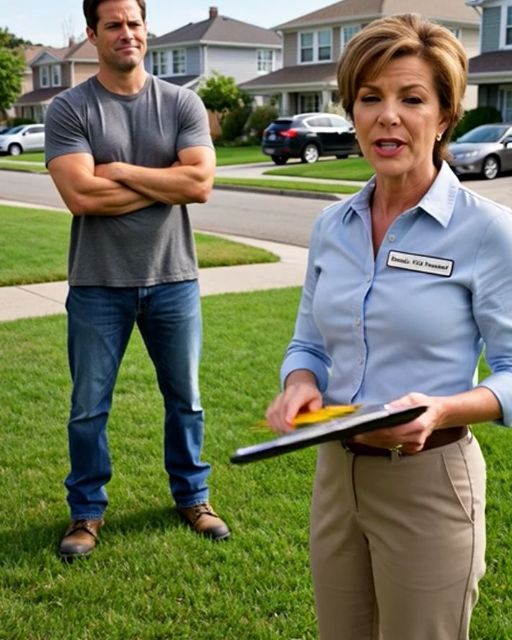
Brenda, the head of the Oak Creek board, measured my lawn with a plastic ruler. “Three inches,” she said, tapping her clipboard. “The limit is two. That’s a hundred-dollar fine, Mike.”
I tried to explain that my mower had died that morning. She didn’t care.
She smiled that tight, thin smile and pointed to the bylaws. “Rules are rules. Pay by Friday or we place a lien on your home.”
She loved the power. She lived to evict families over paint swatches and trash cans.
I didn’t pay. Instead, I drove to the county clerk’s office.
I spent four days in the basement, digging through dust and microfiche, looking at the original subdivision surveys from 1980. I traced the property lines.
Then I checked them again. My hands started shaking.
The developers had messed up the grading. They had shifted the entire block south by twelve feet.
On Saturday, Brenda was hosting the annual “Board Appreciation” party in her driveway. She had a bouncy castle, a caterer, and fifty guests.
She saw me walking up the street with a roll of orange construction fencing and a sledgehammer.
“Get out!” she screamed, marching down her driveway. “This is private property! I’m calling the police!”
“Please do,” I said. I pulled the certified survey map out of my back pocket.
I pointed to the stake in the ground right next to her husband’s BMW. “You’re right about the rules, Brenda. But you’re wrong about the land.”
“You see, your driveway, your porch, and that bouncy castle aren’t on your lot. They’re sitting in my front yard.”
A hush fell over the party. The music from the speakers seemed to die down.
Brenda’s face went from crimson red to a pale, chalky white. Her husband, a quiet man named Carl who usually just nodded along to her tirades, stepped forward.
“What is the meaning of this, Mike? This is a prank. A sick joke.”
“It’s no joke, Carl,” I said, my voice steady despite the adrenaline pumping through me. I held up the map. “This is a certified copy from the county recorder’s office. Your house is on your lot. Barely.”
“But your entire front yard, from that big oak tree to the sidewalk, was supposed to be part of my property.”
Brenda snatched the map from my hand, her eyes scanning it wildly. She was looking for a flaw, a loophole.
“This is forged!” she shrieked, waving the paper in the air. “You can’t just print things off the internet and claim they’re real!”
“It has the county seal embossed on the corner, Brenda. Feel it.”
She ran her thumb over the raised seal. Her hand dropped to her side.
I took a deep breath. “I’m not trying to cause a scene. I just want what’s fair.”
“I’m giving you twenty-four hours to remove your personal property from my land,” I said, gesturing to the bouncy castle, the tables of food, and the shiny black BMW. “After that, I’ll have it all towed.”
I didn’t wait for a response. I turned around and walked back to my house, the eyes of fifty people boring into my back.
I spent the rest of the day looking out my window, waiting. Sure enough, about an hour later, two police cruisers pulled up.
Brenda, now composed and looking every bit the victim, met them at the curb. She pointed dramatically at me, then at her driveway.
I saw the officers sigh. They knew Brenda. They’d been called to our neighborhood for dozens of her petty complaints over the years.
I walked outside to meet them, my own copy of the map in hand.
“He’s trespassing and threatening me!” Brenda cried.
Officer Miller, a man with a tired face and kind eyes, looked at me. “Mike, what’s this all about?”
I explained the situation calmly. I showed him the certified map and the property markers I had found, nearly buried under years of dirt and mulch.
He looked at the map, then at Brenda’s house, then back at the map. He handed it to his partner, who whistled under his breath.
“Ma’am,” Officer Miller said, turning to Brenda. “This appears to be a civil dispute. A property line disagreement.”
“He can’t just take my driveway!” she protested.
“We can’t determine who owns what,” the officer continued patiently. “But he has a legally certified document. You’ll need to take this up with a lawyer and the courts.”
“Until then,” he finished, giving me a slight nod, “it’s probably best if you move the party.”
The look of pure, unadulterated fury on Brenda’s face was something I would never forget. It was the face of a queen watching her castle crumble.
The party ended abruptly. The guests, whispering amongst themselves, made hasty exits. The caterers packed up their chafing dishes.
By nightfall, the bouncy castle was deflated, and Carl had parked the BMW on the street. My twelve-foot strip of land was empty.
The next morning, I started putting up the orange construction fence. I hammered the posts in, one by one, right along the new, correct property line.
It cut straight through her prize-winning rose bushes. It ran inches from her front porch steps.
Several neighbors came out to watch. Some smirked. Others looked worried.
My next-door neighbor, an elderly man named Arthur, shuffled over. He had lived in Oak Creek since the houses were first built.
“You’ve stirred the hornet’s nest, son,” he said, a twinkle in his eye.
“She fined me for tall grass, Arthur. I had to do something.”
He nodded, leaning on my new fence. “She’s a piece of work, that one. But this mess… it goes deeper than you think.”
“What do you mean?” I asked.
Arthur looked around, then lowered his voice. “The developer who built this place, a fella named Morrison, he was a crook. Cut corners everywhere.”
“He knew about the survey error,” Arthur whispered. “Knew it before the first foundation was poured.”
My blood ran cold. “He knew? Why didn’t he fix it?”
“Cost too much. It was cheaper to bribe the county inspector and push the paperwork through. He figured no one would ever notice.”
It was all starting to make sense. This wasn’t just a mistake. It was fraud.
“How do you know all this?” I asked.
“I was on his framing crew back in ’80,” Arthur said with a grim smile. “I heard the arguments. I saw the checks change hands. I quit right after.”
That week, I received a letter from a high-powered law firm. Brenda was suing me for damages, emotional distress, and slander of title.
She was demanding I take the fence down and publicly apologize. It was a classic bully tactic, meant to scare me into submission with the threat of crippling legal fees.
But now I had Arthur’s story. This was bigger than my lawn. It was about the whole neighborhood.
I started knocking on doors. I showed my neighbors the map. I told them what Arthur had told me.
At first, they were skeptical. But then they started looking at their own property surveys, the ones they got when they bought their homes.
Every single one was based on the original, fraudulent map. Everyone’s property line was shifted by twelve feet.
Mr. Henderson two doors down discovered his prized vegetable garden was technically on his neighbor’s lot. The community pool, it turned out, was partially built on land that belonged to the four houses that backed up to it.
The entire subdivision was a legal house of cards, and Brenda’s hundred-dollar fine had just pulled out the bottom one.
We formed a homeowners’ committee, not to be confused with Brenda’s HOA. We were a group dedicated to finding a real solution.
We all chipped in and hired our own lawyer, a sharp woman named Sarah who specialized in real estate fraud.
Sarah’s investigation uncovered something even more shocking. Brenda wasn’t just an ignorant tyrant.
She had known about the property line issue all along.
Sarah found that Brenda had worked as a paralegal for the very same developer, Morrison, back in the early 90s. She had access to the real files.
When her house came up for sale, a foreclosure, she bought it for a fraction of its value. She knew the property had a fatal flaw, but she also knew how to exploit it.
Her plan, Sarah explained, was likely based on a legal principle called “adverse possession.” If you openly use and maintain a piece of land that isn’t yours for a certain number of years, you can legally claim it.
Brenda’s meticulously manicured lawn, her driveway, her porch – it was all part of a long con. She was positioning herself to legally seize my twelve-foot strip of land.
The HOA fines, the constant harassment, the liens – it was all designed to make my life miserable. She hoped I would get fed up and sell, preferably to her, so she could combine the lots and erase the problem for good, increasing her property value immensely.
She wasn’t just a power-hungry president. She was a predator.
When we presented this evidence at the next HOA meeting, the room was electric. It was held in the community clubhouse, and it was standing room only.
Brenda and Carl sat at the front table, stone-faced, with their lawyer between them.
Our lawyer, Sarah, laid out the entire history of the fraud, complete with affidavits from Arthur and copies of Brenda’s employment records.
She explained how Brenda had systematically used her position on the board to intimidate residents, all while secretly plotting to claim land that wasn’t hers.
The fine for my grass wasn’t a random act of tyranny. It was a calculated move.
When Sarah was done, the room was silent for a moment. Then, people started talking.
Mrs. Gable stood up. “She threatened to fine me two hundred dollars because my son’s basketball hoop was touching the sidewalk!”
Mr. Henderson stood. “She made me tear out a garden shed that had been in my family for twenty years, saying it was an inch too close to the fence line!”
Story after story poured out. A decade of petty grievances suddenly clicked into place, re-framed as pieces of a larger, more sinister puzzle.
Brenda’s lawyer tried to object, but the tide had turned. Her power, built on fear and arcane rules, evaporated under the bright light of the truth.
An immediate vote was called. Brenda was removed from the board unanimously. A motion was then passed to recall the entire existing board, her silent enablers.
The aftermath was swift. Faced with a class-action lawsuit from the entire neighborhood, Brenda’s legal case against me collapsed.
The county, exposed for its role in the original fraud, was forced to step in. They funded a complete, top-to-bottom resurvey of the entire Oak Creek subdivision.
It was a massive undertaking, but when it was done, every homeowner had a correct and legal deed to their property. Lines were redrawn, fences were moved, and for the first time in forty years, we all knew exactly what we owned.
For Brenda, the consequences were devastating. The new survey confirmed that her driveway and porch were entirely on my land.
The city building inspector condemned her porch as an illegal structure, as it was now attached to a home on a different property. She was ordered to tear it down.
Without a driveway, her home’s value plummeted. The public humiliation was too much for her.
A few months later, a “For Sale” sign went up in her yard. It was a short sale. The bank was taking a loss.
She and Carl moved away without a word. I never saw them again.
The new HOA, led by a group of reasonable, community-minded people, immediately went to work. They overhauled the bylaws, removing all the ridiculous, punitive rules.
The focus shifted from enforcement and fines to community events and mutual support. Oak Creek started to feel less like a prison camp and more like a neighborhood.
One afternoon, I was out mowing my lawn. My new, much larger lawn.
Arthur came by, holding two cold bottles of lemonade. He handed one to me.
We stood there for a moment, looking at the orange construction fence, which was still standing. I hadn’t had the heart to take it down yet. It felt like a monument.
“You know,” Arthur said, “sometimes you have to let the grass grow a little too tall.”
I smiled. “What do you mean?”
“Sometimes,” he said, taking a sip of his lemonade, “it’s the small injustices you ignore that allow the big ones to fester. You stood up over a hundred-dollar fine, and you ended up saving the whole neighborhood.”
He was right. I hadn’t set out to be a hero. I was just a guy who was tired of being pushed around.
But in fighting for my small piece of ground, I had helped everyone find theirs. It taught me that bullies only have the power you give them, and that the truth, no matter how deep it’s buried, always finds its way to the surface.
The foundation of a home, I realized, isn’t just concrete and wood. It’s the fairness, respect, and community it’s built upon.
And ours was finally solid.