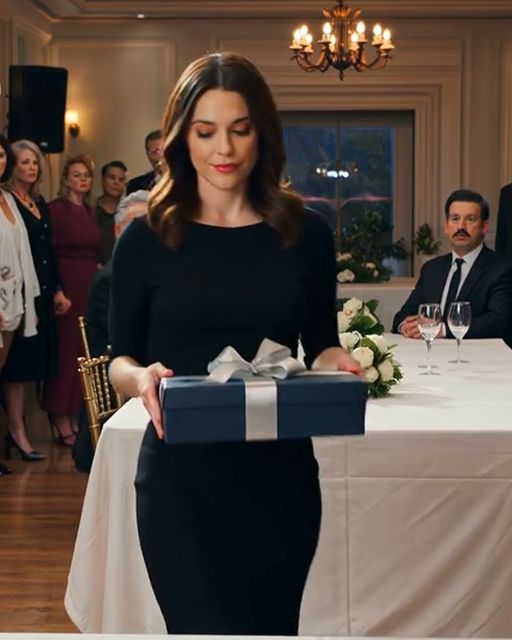
The night my mother called me a freeloader in front of fifty people, I set my gift box on the table and realized I was finally done being quiet.
The box made a soft, final sound on the white linen.
“Happy anniversary, Mom.”
She didn’t look at me. She looked at the women on her left and right, a small, practiced smile on her face. A performance.
She joked that I’d probably found it on a clearance rack. She told them I hadn’t called in years, couldn’t keep a job. Then her voice got louder.
“This is my daughter,” she announced to the room. “The one I told you about.”
My stepfather, Mark, stood up. He grabbed the navy blue box and shoved it back into my arms.
“We don’t need your cheap gift,” he said. “Take it and get out.”
The string quartet stopped playing.
Fifty pairs of eyes landed on me. Some amused. Some pitying. My hands started to shake, and for a second, I wasn’t in a country club.
I was seventeen again, standing in a stranger’s house with one suitcase.
That house belonged to Mark. My mother had remarried so fast. She didn’t pack up my dad’s things so much as erase them. She called it starting over. For her.
Mark’s son, Kyle, got the big guest room and a new car.
I got the converted storage closet with a window the size of a shoebox.
I remember asking for help with college tuition. My mother cut me off before I could finish. She said my dad’s money was for “rebuilding the family.” Mark was more direct.
“This house doesn’t support freeloaders,” he told me. “You want a degree? Earn it.”
He made it clear the door was open for me the day I turned eighteen.
So I lay on that narrow bed in that tiny room, staring at a water stain on the ceiling. I had nothing. No savings, no support. Just a scholarship that wasn’t enough.
Maybe they were right. Maybe I was nothing.
Then my phone buzzed. A number from another city. I almost didn’t answer.
“Anna? This is Sarah. Your Aunt Sarah. Your dad’s sister.”
My mother had cut off that entire side of the family after the funeral. I hadn’t heard my aunt’s voice in years. She told me to come see her. She said my dad had left something for me.
So I lied about a study group and took a bus.
Her apartment was small and warm and covered in old photos of my father smiling. She pulled out a small wooden box he’d given her. He hadn’t trusted my mother with my future.
Inside was proof he’d been putting money away for me since I was three. There was a letter, too. His handwriting. He told me he believed in me. He said it wasn’t my fault if my mother didn’t put me first.
Use this money, he wrote. Build a life you deserve.
That’s how I ended up in a cramped studio in the city. Rent barely covered, but it was a start. A real one. I worked in a coffee shop. I slept in four-hour shifts. I never missed an assignment.
I interned at a small design firm. Then I took on tiny projects. People started asking for me by name.
I became a lead designer. Then I opened my own studio. I never announced it. I never posted about it. My mother had no idea who I had become.
Ten years passed without a single call.
Then the invitation arrived. Cream card stock. Silver letters. An anniversary party.
I called my aunt. She’d heard whispers. Mark’s business was struggling. They needed to keep up appearances.
“She never does anything without a reason,” Aunt Sarah said.
I decided to go. Not for her. For me. To close the door myself. And I brought a gift. One small object in a navy blue box that could change a life.
A test.
Now, standing in the silent ballroom, Kyle found me. Same smirk.
“The prodigal daughter returns,” he said. “Here to ask for help?”
I walked right past him. Past the whispers. Past the stares. Right back to the main table.
The shame was a ghost trying to crawl back under my skin. But something else was there now. Something solid.
I actually laughed. It was quiet. Steady.
“You have no idea what you just refused,” I said.
My hands were perfectly still as I set the box back on the table.
“You want to know what’s inside?” I looked from my mother, to Mark, to the guests leaning in to listen. “Fine.”
Slowly, I untied the silver ribbon.
I lifted the lid.
The entire room seemed to lean forward, a collective, silent gasp of anticipation. Inside the box, nestled on a bed of dark blue velvet, was a single, old-fashioned key.
It wasn’t shiny or new. It was ornate, made of dark, heavy metal, with a simple leather cord tied through the top.
A confused murmur rippled through the guests. It was just a key.
Mark scoffed, his face red with a mix of anger and relief. He thought it was a joke.
“A key?” he boomed, forcing a laugh for the crowd. “What’s that for? The storage closet you used to live in?”
Some of the guests tittered nervously.
My mother stared at the key, her mask of polite indifference finally cracking. A flicker of something I couldn’t read crossed her face.
“Mark, stop,” she whispered, her voice tight.
“No, let him,” I said, my voice clear and carrying in the silence. I picked up the key, letting it rest in the palm of my hand.
“This is the key to the house on 24th and Elm.”
My mother’s breath hitched. She knew the address. Everyone from our old town knew that address.
It was my father’s childhood home. The one my grandparents had built. The one my mother had sold for a fraction of its worth a month after she met Mark, claiming it had too many memories.
“I heard you were having some financial difficulties,” I continued, my gaze fixed on Mark. “I heard you were about to lose this house. This country club membership. Everything.”
Mark’s face went from red to a pale, blotchy white. The whispers in the room grew louder, more urgent.
“So I bought you a gift,” I said, my voice softening just a little. “A way out.”
“I bought back my father’s house. I spent the last year having it restored. New roof, new plumbing, updated everything. It’s beautiful.”
I looked at my mother. “It’s all paid for. No mortgage. The property taxes are covered for the next five years. It’s smaller than this place, of course. But it’s safe. It’s secure. It’s yours.”
I held the key out.
“It was a genuine gift. A new start. A chance for you to live without debt, without the constant pressure of keeping up this illusion.”
The room was utterly silent. The pity in the guests’ eyes was no longer for me. It was for the couple at the head table, their perfect life suddenly exposed as a fragile lie.
My mother reached for the key, her hand trembling. Her eyes were wide with a desperate, hungry light.
Mark was faster. He lunged for it, his social grace gone, replaced by raw greed. “Give me that.”
I closed my hand around the key just as his fingers brushed mine.
I pulled my hand back to my chest.
“No,” I said.
The word was quiet, but it echoed in the cavernous room.
Mark froze. “What did you say?”
“I said no,” I repeated, looking him directly in the eye. “You see, this gift came with one condition. An unspoken one.”
“It was a test to see if, after ten years, either of you had developed an ounce of kindness. An ounce of grace. To see if the mother who abandoned me had any part of her left that could just be a mother.”
I looked at her, at the tears welling in her eyes. But they weren’t tears of remorse. They were tears of loss. She was crying for the house, not for me.
“You said you didn’t need my cheap gift,” I said to Mark, my voice cold and even. “You told me to get out.”
“So I will.”
I slipped the leather cord over my head, and the heavy key settled against my heart.
“The offer is withdrawn.”
A collective gasp went through the room.
“You can’t do that!” my mother shrieked, standing up so fast her chair screeched against the floor. “It’s ours! You said it was a gift!”
“A gift has to be accepted,” I replied calmly. “And you rejected it. You rejected me. In front of fifty of your closest friends.”
Mark’s face contorted with fury. He was a cornered animal.
“You think you’re so clever, don’t you?” he snarled, jabbing a finger at me. “Playing games with your little art projects. I’m about to close the biggest deal of my career. A partnership with an investment group that will make your little studio look like a child’s lemonade stand. We don’t need your charity!”
He puffed out his chest, trying to reclaim his dominance in the room.
“A deal with the Phoenix Development Group?” I asked, my voice dangerously soft.
He faltered, his bravado draining away, replaced by confusion. “How… how did you know that?”
I gave him a small, sad smile.
“Because I am the Phoenix Development Group.”
If the silence before had been profound, this was something else entirely. It was a vacuum. A complete absence of sound.
Mark’s jaw hung open. He looked at me, then at the guests, then back at me, as if his brain couldn’t process the words.
My mother simply sank back into her chair, her face a blank sheet of paper.
“Phoenix was the name of my first major project,” I explained to the room, my voice conversational now. “It was an old, burned-out building that everyone said was a lost cause. I rebuilt it. I thought the name was fitting.”
“My studio, my team… we don’t just design spaces, Mark. We invest in them. We redevelop them. We partner with firms we believe in.”
I took a slow step towards him.
“We’ve been vetting your company for six months. Your proposal for the waterfront project was… adequate. But it was your reputation that was the problem. We kept hearing whispers about your debts, your ethics.”
“I wanted to believe they were just rumors. I wanted to believe that the man my mother married had some good in him.”
I let that hang in the air.
“So I arranged this final test. The anniversary party was my idea, funneled through your event planner. I wanted to see you in your natural habitat. I wanted to see how you would treat the ‘freeloader’ daughter when she showed up with nothing.”
I shook my head slowly.
“You didn’t just fail the test, Mark. You set it on fire.”
I looked around the room, at all the shocked faces.
“The partnership is dissolved. The offer is rescinded. Phoenix Development will be moving forward with another firm.”
That was it. The final blow. It wasn’t just about losing a house anymore. It was about losing everything. The deal that was meant to be his salvation was now the instrument of his complete and public ruin.
Kyle, who had been frozen by the door, just stared at me, his usual smirk gone, replaced by a look of dawning horror.
I turned to leave. I had said everything I needed to say. The door I had come to close was now sealed shut, locked, and barricaded.
I walked through the silent, parted crowd. No one met my eye. The air was thick with the death of an illusion.
As I reached the grand doors of the ballroom, I paused. I looked back one last time.
Mark was staring into space, a broken man. My mother had her head in her hands, her shoulders shaking with quiet, desperate sobs.
For a fleeting second, I felt a pang of something. Not pity, but a deep, aching sadness for the mother I never had, for the family that could never be.
But then I felt the weight of the key against my chest. It was a reminder. A promise.
I walked out into the cool night air and didn’t look back.
The next day, I drove to the house on 24th and Elm. The sun was shining on the new gray paint and the bright white trim of the porch. The garden was full of my dad’s favorite flowers, planted by a local landscaper I’d hired.
Aunt Sarah was waiting for me on the porch swing. She stood up and wrapped me in a hug that smelled like cinnamon and safety.
“I’m so proud of you,” she said, her voice thick with emotion.
“It’s over,” I whispered into her shoulder. “It’s finally over.”
We sat on the swing for a long time, not saying much. We didn’t need to.
A few weeks later, the news of Mark’s bankruptcy was all over the local business journal. They sold everything. The big house, the cars, the jewelry. They disappeared from the social scene they had so desperately clung to.
I never heard from them again.
The house, my father’s house, sat waiting. It was a beautiful, empty vessel of memories and second chances. I didn’t need to live there. My life was in the city. My studio was thriving.
I knew exactly what I had to do.
I called a lawyer and started a foundation in my father’s name.
The house on 24th and Elm became The Harrison Project. It was a transitional home for young adults, aged eighteen to twenty-one, who had aged out of the foster system or had been kicked out of their homes.
A safe place for the “freeloaders.”
We offered them a room, job training, counseling, and help with college applications. We gave them the support that I had so desperately needed.
The first resident was a quiet girl with haunted eyes who wanted to be a veterinarian. The second was a boy who carried a sketchbook everywhere he went.
Slowly, the house filled with the sounds of tentative laughter, late-night study sessions, and the quiet hum of healing.
I visited every weekend, not as a benefactor, but as a friend. A mentor. I saw myself in each of them. I saw their strength, their resilience.
One afternoon, sitting on the porch swing with the girl who wanted to be a vet, I watched as she paged through a thick textbook.
“Thank you,” she said suddenly, looking up at me. “For all of this. For believing in us.”
I touched the old key, which I still wore around my neck.
It was no longer a symbol of a painful past. It was the key to a future. Not the one I had planned to give away, but a much better one.
I realized that night at the party, I wasn’t just closing a door on my past. I was opening a new one for so many others.
True wealth isn’t about what you own or the image you project. It’s about what you build, who you lift up, and the legacy of kindness you leave behind. My mother and Mark had taught me everything about what family shouldn’t be. It was my father, and now these kids, who were teaching me what it truly was: a home you build yourself, full of people you choose to love. And that was a gift no one could ever take away.