Sgt. Kowalski was a brute. He had knuckles like walnuts and a stare that could strip paint.
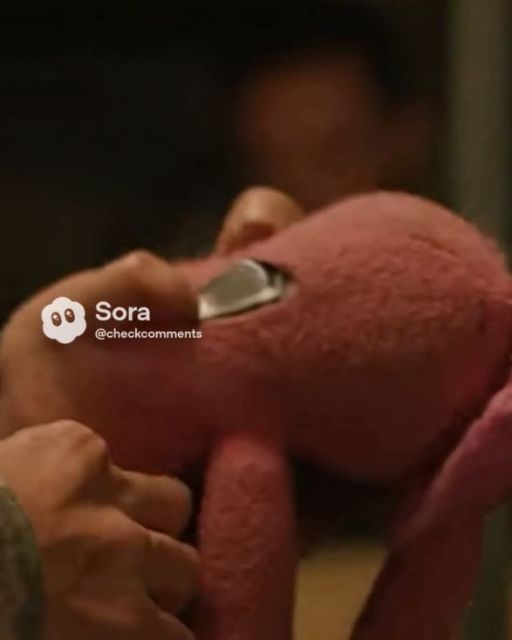
He made grown men cry during rucks. But every night, he placed a dirty, pink stuffed rabbit on his pillow.
The platoon laughed about it when he wasn’t looking. We called him “soft.”
One night, while Kowalski was on duty at the perimeter, I decided to be the funny guy.
“Watch this,” I whispered to the squad. I crept to his bunk to grab the rabbit.
I was going to hide it in the latrine. I picked it up by the ears.
My arm dropped. The thing was heavy. Dead heavy.
It felt like a brick wrapped in fur. The guys went silent.
I squeezed the rabbit’s stomach. There was no cotton inside. Just a hard, rectangular mass.
I pulled out my pocket knife and sliced the stitching on the back. I reached inside and pulled out a tightly taped package.
It wasn’t drugs. I peeled back the duct tape.
It was a stack of polaroids. The first photo showed the General’s missing wife, tied to a chair in a basement, holding a newspaper.
My breath hitched in my throat. The date on the newspaper was from three days ago.
The official story was that Eleanor Abernathy, the General’s wife, had vanished a year back. She was presumed dead after her car was found abandoned by a river.
But this photo told a different story. She was alive. And she looked terrified.
Harris, a lanky private from Ohio, grabbed my arm. “What is that, Carter?”
His voice was a ghost in the quiet barracks. I flipped to the next photo.
It was another one, same basement, different newspaper. This one was from two weeks ago.
There were a dozen of them, a chronological record of a nightmare. Proof of life.
“Kowalski…” Davis whispered from his bunk, his eyes wide. “He’s the one. He’s the kidnapper.”
The thought was like ice in my veins. It made a sick kind of sense.
Who else could operate so close to the General, carrying a secret this massive?
We heard the crunch of boots on the gravel outside. Kowalski was coming back.
Panic seized us. “Put it back!” Harris hissed.
My hands fumbled with the photos and the tape. There was no time.
I shoved the package back into the rabbit’s gut, the jagged cut gaping open.
I threw the heavy rabbit back on his pillow just as the barracks door creaked open.
Sgt. Kowalski strode in, his shadow stretching long and menacing in the dim light.
He didn’t even look at us. He just walked to his bunk.
He picked up the rabbit. His movements, usually so sharp and aggressive, were gentle with it.
He ran a thumb over the ripped seam. His whole body went still.
Slowly, very slowly, he turned his head and looked right at me.
His eyes weren’t angry. They were something far worse. They were full of a cold, profound disappointment. And fear.
He knew. He knew someone had been inside his secret.
The next morning, the world was different. The sun rose, but everything felt gray.
PT was hell. Kowalski ran us until our lungs burned and our legs turned to jelly.
But it wasn’t punishment. It was a distraction. His eyes kept flicking towards me, Harris, and Davis.
He was watching us, trying to figure out what we knew, what we were going to do.
We were just as scared of him. A man who could kidnap the General’s wife was capable of anything.
We huddled up by the mess hall later, our food untouched.
“We have to go to the MPs,” Davis said, his voice trembling. “We have to report him.”
“And say what?” Harris shot back. “That we broke into our sergeant’s personal property? That we found photos? They’ll think we’re in on it. Or they’ll bury us for insubordination.”
He was right. We were just privates. Our word against a decorated Drill Sergeant.
It was my fault. “I have to talk to him,” I said.
They looked at me like I’d just volunteered to juggle grenades.
“Are you insane, Carter?” Davis asked. “He’ll kill you.”
“Maybe,” I said. “But we can’t just sit on this. A woman’s life is at stake.”
I felt a weight of responsibility heavier than any rucksack. I had started this. I had to finish it.
That night, I waited until everyone was asleep. The barracks was filled with the sound of soft breathing.
I walked to Kowalski’s bunk. He wasn’t sleeping. He was sitting on the edge, staring at the floor, the pink rabbit in his lap.
“Sarge,” I whispered.
He didn’t look up. “You had no right, Carter.”
His voice was quiet, stripped of its usual bark. It was the voice of a tired man.
“I know, Sarge. I’m sorry. I was being an idiot,” I said. “But we saw the pictures.”
I braced myself for the explosion. For him to stand up and break me in half.
Instead, he just sighed. A deep, weary sound.
“What do you think you saw?” he asked, still not looking at me.
“We think… we think you have her,” I stammered.
He finally looked up. There were no paint-stripping glares now. Just a deep, aching sadness.
He shook his head. “I don’t have her, Private. I’m trying to find her.”
The words hung in the air between us, completely upending my world.
He patted the bunk next to him. I sat down, my heart pounding against my ribs.
“Eleanor Abernathy… she was my sister’s best friend,” he began, his voice low. “I grew up with her. She was like family.”
He told me that when she disappeared, he never believed she was dead. He knew her. She was a fighter.
“The official investigation was a joke,” he said, his knuckles white as he clutched the rabbit. “They closed the case in three months. Declared her dead. The General was devastated.”
But Kowalski didn’t give up. He started his own, secret investigation.
He used his leave to chase down leads the police had ignored. He talked to her friends, her colleagues.
He discovered she’d been looking into something before she vanished. Something to do with supply contracts on the base.
She suspected someone high up was selling military equipment on the black market.
“She got too close,” Kowalski said. “So they took her. They made it look like she ran away and had an accident.”
The story was so much bigger and darker than a simple kidnapping.
“So, the photos?” I asked.
“One of the kidnappers grew a conscience,” he explained. “But he’s in too deep. He’s terrified.”
The man had managed to get a message to Kowalski. He wanted to help, but he couldn’t go to the authorities. The conspiracy was too high up.
“So he sends me proof that she’s still alive. A new photo every week or so. It’s how he lets me know he’s still on the inside, still trying to get her out.”
My mind reeled. The teddy bear. The rabbit.
“It’s a dead drop,” Kowalski said, reading my thoughts. “His sister works as a cleaner on base. She switches out the old rabbit for a new one with the latest photo whenever I’m on duty. No one looks twice at a tough sergeant’s weird lucky charm.”
It was brilliant. Hiding in plain sight.
“It’s heavy because I filled the old ones with sand and dumped them,” he said. “The weight had to be consistent so no one would notice the swap.”
My stupid prank. I had almost destroyed his entire operation. I had put Eleanor Abernathy’s life in even more danger.
“Sarge, who is it?” I asked. “Who’s behind it?”
He looked me straight in the eye. “Colonel Vance. The General’s right-hand man.”
Colonel Vance. The man who was always smiling, patting soldiers on the back. The man who was set to take over when General Abernathy retired.
The pieces clicked into place. With the General distraught and distracted by his wife’s “death,” Vance had free rein.
“We have to tell the General,” I said.
“With what?” Kowalski countered. “A stack of anonymous polaroids found inside a stuffed animal? Vance would bury us. He’d say I was obsessed, that I was forging evidence. He’d have his man on the inside silenced. And Eleanor would be gone for good.”
He was right. We were trapped.
“What do we do now, Sarge?” I asked. It was the first time I’d asked him a question out of genuine respect, not fear.
He looked at me, then over at Harris and Davis, who were pretending to be asleep but were wide awake, listening to every word.
“Now, Private,” Kowalski said, a flicker of the old steel returning to his voice. “You and your friends are going to help me finish this.”
For the next week, we lived a double life. By day, we were grunts, getting screamed at by Kowalski for having dust on our boots.
By night, we were his secret unit.
He told us everything. The man on the inside was named Corporal Miller. He was Vance’s driver.
Miller had been feeding Kowalski information, but he was getting spooked. Vance was getting paranoid.
We needed more than just photos. We needed a location.
Our job was simple, but dangerous. We had to watch Colonel Vance.
Harris, who was a whiz with computers before he enlisted, was tasked with monitoring any digital chatter he could intercept from Vance’s office.
Davis and I took turns on surveillance, tracking Vance’s movements on base, noting every meeting, every phone call.
It was nerve-wracking work. We were kids playing a deadly game against a powerful man.
One evening, Davis came back from his surveillance shift, his face pale.
“Vance left base,” he said. “But he didn’t take his usual car. He took an unmarked civilian vehicle from the motor pool.”
Kowalski went rigid. “Miller isn’t answering his burner phone. This is wrong.”
Just then, Harris burst in. “Sarge, I got something. It’s not from Vance, it’s from Miller. It’s a single, encrypted image file sent from a public library terminal off-base.”
He pulled it up on his laptop. It was a map. A blurry, hand-drawn map of an abandoned farm complex about twenty miles from the base.
There was one building circled in red ink. And a message at the bottom.
“Tonight. He’s moving her. Or ending it.”
There was no time to think. No time to go through channels.
Kowalski looked at the three of us. “I’m going. This is my fight. You three have done enough. I’m not ordering you to do this.”
He was giving us an out. A chance to walk away, no questions asked.
Davis squared his shoulders. “We saw the pictures, Sarge. We’re in.”
Harris nodded. “All the way.”
I looked at the man I had once mocked. The man who had carried this impossible burden in silence, hidden inside a child’s toy.
“Let’s go get her, Sarge,” I said.
We moved out under the cover of darkness, four soldiers on an unsanctioned mission.
Kowalski drove a beat-up truck he kept off-base. The ride was silent, each of us lost in our own thoughts.
We weren’t acting on orders. We were acting on faith. Faith in a sergeant we’d misunderstood, and faith in a corporal we’d never even met.
When we arrived, the farm was even more desolate than the map suggested. A decaying house and a crumbling barn stood silhouetted against the moon.
“Vance will have men here,” Kowalski said, his voice a low growl. “We go in quiet. We use our training. Surprise and speed are our only advantages.”
He laid out the plan. Simple. Brutal. Effective.
We moved like ghosts through the tall grass. Two guards were posted outside the barn.
Kowalski and I took them out without a sound. It was terrifyingly clean. All our training, all the drills, suddenly became real.
We slipped inside the barn. It smelled of hay and decay.
In the center of the dusty floor, illuminated by a single bare bulb, was a small, locked room. We could hear a faint noise from within.
Colonel Vance was there, standing with his back to us, talking to two other men.
“The General is getting sentimental,” Vance was saying. “Starting to ask questions again. We can’t risk it anymore. Get rid of her. Make it look like an accident.”
And then we saw her. Eleanor Abernathy. She was tied to the same chair from the photos. She was thinner, paler, but her eyes held a spark of defiance.
My blood ran cold. Miller was right. We had minutes to spare.
Kowalski gave the signal.
We moved. I had never seen Kowalski in action before. He wasn’t a drill sergeant anymore; he was a force of nature.
The firefight was short and violent. We were outnumbered, but we had the element of surprise.
Harris laid down covering fire while I worked on the door to the room. Kowalski and Davis moved with a lethal grace that left me breathless.
When the dust settled, Vance’s men were down. Vance himself was cornered, his smug expression replaced with shock and rage.
He looked at Kowalski. “You. The grunt with the stuffed rabbit. How?”
Kowalski didn’t answer. He just walked past him, knelt beside Eleanor, and cut her ropes.
“Mikey,” she whispered, her voice hoarse. “You came.”
“Always, El,” he said softly.
The return to base was a blur. We brought a bound Colonel Vance and a weak but very much alive Eleanor Abernathy directly to the General’s quarters.
The look on General Abernathy’s face when he saw his wife… it’s something I’ll never forget. It was a mixture of disbelief, joy, and a grief so deep it was like watching a man come back to life.
The story came out. All of it. Vance’s arms trafficking, the kidnapping, Corporal Miller’s bravery, Kowalski’s secret year-long investigation.
Vance and his network were dismantled. They were tried, and they were sent away for a very long time.
Corporal Miller was given protection and a medal for his courage.
And us? The four of us stood before the General a week later, expecting anything from a court-martial for going off-book to a quiet dismissal.
He didn’t yell. He just looked at us, his eyes filled with a gratitude that was more powerful than any commendation.
“You broke dozens of regulations,” he said, his voice thick with emotion. “You went against protocol. You put yourselves at incredible risk.”
He paused, and a small smile touched his lips. “And you did the right thing. You are the kind of soldiers I am proud to command.”
We weren’t punished. We were commended for valor.
Things changed in the platoon after that. No one ever called Kowalski “soft” again.
The story got out, in hushed whispers and awed tones. The story of the pink rabbit and the secret it held.
He was still the same brute on the training field. He still made grown men want to cry. But we understood him now.
We saw the strength behind the toughness. We saw the loyalty that ran deeper than any order.
One afternoon, a few weeks later, I saw him by his bunk. He was holding a new stuffed animal.
It was a small, simple teddy bear. Not pink, but a plain brown.
He tossed it to me. I caught it. It was light as a feather. Just cotton and thread.
“A gift,” he said gruffly. “From Eleanor.”
I looked at him, at this man I had so completely misjudged. I had stolen his secret to mock him, and in doing so, I had stumbled upon the truest definition of strength.
It’s not about how loud you can shout, or how hard you can be. It’s about the burdens you are willing to carry for others, especially when no one is watching. It’s about the quiet, heavy things you hide in plain sight, protecting them until the job is done.