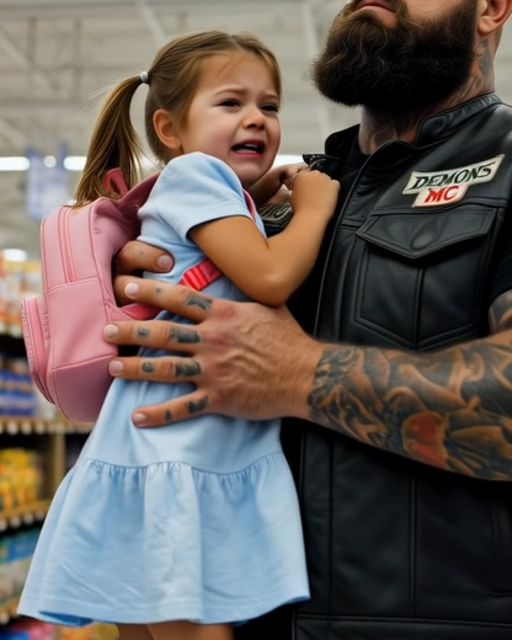
The mute six-year-old girl ran straight into the giant biker’s arms at Walmart, frantically signing something while tears poured down her face.
I watched this massive, tattooed man in a Demons MC vest suddenly start signing back to her fluently, his hands moving with surprising grace as other shoppers backed away in fear.
The little girl – couldn’t weigh more than forty pounds – was clinging to this scary-looking biker like he was her lifeline, her small hands flying through signs I couldn’t understand.
Then the biker’s expression changed from concern to pure rage, and he stood up, scanning the store with eyes that promised violence, still holding the child protectively against his chest.
“Who brought this child here?” he roared, his voice echoing through the aisles. “WHERE ARE HER PARENTS?”
The girl tugged on his vest, signing frantically again. He looked down at her, signed something back, and his face went darker than I’d ever seen a human face go.
That’s when I realized this little girl hadn’t run to him randomly. She’d seen his vest, seen the patches, one of them with a deaf sign awareness.
He pulled out his phone with one hand – still holding her with the other—and dialed 911.
“I have a child. Deaf. She’s been taken from her school. She just found me.”
His voice was steady, but I could hear the barely controlled fury underneath.
“And the people who took her didn’t know she could read lips. She just told me everything.”
He looked down at the girl, who was nodding vigorously as she signed more details.
“She heard them in the van talking about selling girls,” he continued, his jaw clenching. “Fifty thousand dollars. Tonight. At the warehouse on Fifth and Morrison.”
A store manager, a nervous young man named Kevin, scurried over, his eyes wide with a mix of fear and duty.
“Sir, is everything okay?” he stammered, keeping a safe distance.
The biker didn’t even look at him. “Call your security. Lock the front doors. The people who took her might still be in the store.”
His command was so absolute that Kevin just nodded and fumbled for his radio. Within moments, the calm afternoon shopping trip was over. The sliding glass doors hissed shut, and a low murmur of confusion and panic spread through the checkout lines.
I stayed where I was, frozen in the canned goods aisle, unable to look away. The little girl, whose name I later learned was Lily, was still signing to the biker. He’d crouch down to her level, his huge, calloused finger gently tracing a sign back to her, his face a mask of concentration.
Two police officers arrived first, their hands resting on their hips as they assessed the scene. Their eyes immediately locked onto the biggest threat in the room: the six-foot-four biker covered in leather and ink.
“Sir, I need you to step away from the child,” the older officer said, his voice firm.
The biker, who I now knew as Bear from the patch on his vest, slowly stood up to his full height, making the officers look small.
“Not a chance,” he growled. “She stays with me.”
Lily hid behind his leg, peeking out at the uniforms with wide, frightened eyes.
The officer’s hand moved closer to his sidearm. “Sir, I’m not going to ask you again.”
That’s when I found my voice. “He’s helping her,” I said, stepping out from behind a pyramid of tomato soup cans. “She ran to him. He’s the one who called you.”
Both officers looked at me, then back at Bear, their expressions softening just a fraction.
“He knows sign language,” I added. “She’s been telling him what happened.”
The lead officer, a man with tired eyes and a name tag that read “Miller,” nodded slowly. “Okay. Let’s all just take a breath. Can you tell us what she told you, sir?”
Bear never took his eyes off the store’s entrance. “I already told dispatch. Two men, a gray van, took her from her school playground this morning. They were talking about a deal tonight. Fifth and Morrison. Other girls were mentioned.”
He looked down at Lily and signed a question. She signed back, her little fingers a blur.
“She says one man had a spider tattoo on his neck,” Bear translated, his voice low and guttural. “The other one smelled like stale cigarettes and called her ‘cash’.”
Detective Miller’s face hardened. He knew this wasn’t some custody dispute. This was real.
A female officer with a kind face arrived and knelt down a few feet away from Lily. She didn’t speak, just offered a small, sad smile. Lily eventually peeked out from behind Bear’s leg, her fear giving way to curiosity.
Paramedics checked Lily over while her frantic parents were located and rushed to the scene. The reunion was a tidal wave of tears and relieved sobs. Lily’s mother couldn’t stop thanking Bear, hugging his leather-clad waist while her father shook his hand with a grip tight with emotion.
As they led Lily away, she turned and signed three words to Bear. He signed back with a gentle smile, a sight so incongruous with his appearance that it nearly made me cry.
I approached him after they were gone. “What did she say?”
He looked down at his hands, then at me. His eyes weren’t filled with rage anymore, just a deep, profound sadness.
“She signed, ‘You are my brother now’.”
He turned and walked away before I could respond, pushing through the now-open doors and disappearing into the parking lot. I stood there, realizing the story was far from over.
Bear didn’t go home. He went to a quiet, unassuming house on the edge of town, the one with the meticulously kept garden. He let himself in and walked into the living room, where a young man sat hunched over a bank of computer monitors.
The young man looked up, his bright, intelligent eyes meeting Bear’s. He didn’t speak. He didn’t have to. This was Caleb, Bear’s actual brother. His silent brother.
Caleb had been born profoundly deaf and had been non-verbal his entire life. When they were kids, Bear, whose real name was Arthur, had learned to sign before he could even properly read. He’d become Caleb’s voice, his protector, his fiercest advocate. The deaf awareness patch on his vest wasn’t a fashion statement; it was a testament to the most important person in his life.
Bear began to sign, his movements sharp and angry, recounting the events at Walmart. Caleb watched, his expression growing more and more serious. When Bear was finished, Caleb turned to his keyboard.
Words appeared on the main screen. ‘Gray van. Spider tattoo on neck. Fifth and Morrison.’
Caleb’s fingers flew across the keyboard. He was a genius with computers, a white-hat hacker who consulted for security firms. It was a skill he’d developed in a world that often overlooked him, a way to be heard without ever making a sound.
Bear pulled up a chair. “The cops will be slow, Cal. They need warrants, surveillance. These scum are selling kids tonight.”
Caleb typed again. ‘Police have rules. We don’t.’
He pulled up traffic camera footage from near Lily’s school. He cross-referenced it with DMV records for gray vans. For two hours, the only sound in the room was the clicking of keys and Bear’s heavy breathing.
Then, Caleb pointed to the screen. He’d isolated a van. It was blurry, but it matched the description. He enhanced the image of the driver getting out at a gas station.
There, on the man’s neck, was the unmistakable, spindly shape of a black widow spider.
Caleb kept digging, pulling data from cell towers, social media, and the dark corners of the web. He found a name: Marcus Thorne, a low-level criminal with a history of petty offenses but nothing this serious.
He then tracked Thorne’s known associates. One of them, a man named Rick, had just posted a picture of a stack of cash on a private social media account with the caption, “Payday.” The photo’s location data was still attached. It pinged to a rundown motel on the other side of town.
Caleb looked at Bear and typed. ‘They aren’t waiting for tonight. The picture was posted 20 minutes ago. The deal is happening now. Or soon.’
The warehouse was a decoy. A place to send the cops while the real transaction happened somewhere else entirely.
Bear stood up, his fists clenched. He pulled out his phone, not to call the police, but the president of his club.
“Prez, it’s Bear. I’ve got a situation. It’s real, and it’s bad. I need every brother who can ride.”
Detective Miller was frustrated. The warehouse on Fifth and Morrison was a ghost town. It was a classic misdirect, and they had fallen for it. His team was scrambling, trying to get a new lead, but he knew they were losing precious time.
His phone buzzed. It was an anonymous text.
‘Wrong location. Try the old Sun-Glo Motel. Room 112. You have maybe thirty minutes. A friend.’
Miller stared at the text. He knew, instinctively, who it was from. The biker. How had he found them? It didn’t matter. It was the only lead he had.
“Everyone, saddle up!” he yelled to his team. “We’re going to the Sun-Glo Motel! Now!”
At the motel, Bear and a dozen other members of the Demons MC rolled in, not with a roar of engines, but as quietly as a ton of steel and chrome could manage. They didn’t park out front. They circled the block, taking up positions in the shadows, their faces grim.
They weren’t there to be vigilantes. Bear had been clear. They were there to be a wall.
“No one gets in or out until the cops arrive,” he’d said. “We don’t engage. We just contain. For Lily. And for the others.”
From a car across the street, Bear watched Room 112. The curtains were drawn, but a faint light seeped through. A second car, a black sedan with tinted windows, pulled into the spot in front of the room. The buyers.
Time was up. The deal was happening. The police were still five minutes out.
Bear made a decision. He gave a signal, a single flash of his headlights.
In an instant, the night erupted. Twelve Harley-Davidson motorcycles roared to life, their engines a synchronized thunderclap that shook the cheap motel windows. They flooded the parking lot, their headlights pinning the black sedan and the door to Room 112 in a blinding glare.
They formed a perfect, intimidating semi-circle, revving their engines, creating a cacophony of sound and fury.
The door to Room 112 burst open. Marcus Thorne, the man with the spider tattoo, stood there, his face a mixture of confusion and terror. The men from the sedan were frozen, caught in the brilliant light.
There was nowhere for them to run.
Just as Thorne raised a weapon, the first police cars screamed into the parking lot, their sirens wailing. Detective Miller jumped out, his gun drawn.
“Police! Drop your weapons! Hands in the air!”
Outnumbered, outmaneuvered, and completely surrounded, the criminals gave up without a fight. When the officers breached the room, they found two other little girls, huddled together on the bed, terrified but unharmed.
The bikers sat on their idling bikes, a silent, menacing jury, as the men were cuffed and put into patrol cars.
Miller walked over to Bear, the roar of the engines finally dying down to a low rumble. He looked at the circle of leather-clad men, then back at Bear.
“A friend, huh?” Miller said, a small, tired smile on his face.
“Just some concerned citizens,” Bear replied, his expression unreadable.
“Your ‘concern’ just saved three kids’ lives,” Miller said, his voice full of a respect that hadn’t been there a few hours ago. “I owe you one. But if I ever see you take the law into your own hands like this again…”
“You won’t,” Bear cut him off. “There won’t be a next time.”
A week later, I saw a story on the local news. They called it the “Motel Miracle.” The human trafficking ring had been dismantled, thanks to a tip from a brave little girl and what the report called an “anonymous source.”
The families of the three rescued girls had pooled their resources, offering a fifty-thousand-dollar reward for the information that led to the rescue. The reward had been claimed by a local motorcycle club: The Demons MC.
I’ll admit, a part of me felt a little disappointed. I imagined them using the money for a wild party.
Then came the twist that changed everything.
A month later, I was driving through a part of town I rarely visited and saw a crowd gathered outside an old, previously neglected community center. There was a brand-new sign out front.
“The Lily & Caleb Center for Deaf and Hard of Hearing Youth.”
I pulled over and got out of my car. There, in the middle of the celebration, was Bear. He wasn’t wearing his MC vest, just a simple t-shirt. He was standing next to a smiling Caleb, who was showing Lily how to use a new piece of technology on a computer.
Lily’s parents were there, along with the families of the other two girls. Members of the Demons MC, looking much less intimidating in the bright sunshine, were serving hot dogs and sodas to a crowd of happy children.
I saw Detective Miller in the crowd, off-duty, sharing a laugh with the club’s President.
Bear saw me and walked over, a genuine smile on his face.
“You came,” he said.
“I had to,” I replied, looking at the brand-new sign. “The reward money?”
He nodded. “Caleb never had a place like this growing up. We wanted to make sure other kids did.”
He explained that this was the real payday. It wasn’t about the cash, but about building something that would last. It was about creating a safe space, a community, a place where kids who felt unheard could finally have a voice.
I looked at Lily, who was now laughing, her hands moving with the easy confidence of a child who knows she is safe and loved. She wasn’t silent because she was broken. She was silent because that was her language, and she had finally found people who were willing to listen.
That day, I learned that heroes don’t always wear capes. Sometimes they wear leather and ride motorcycles. And I learned that family isn’t just about the blood you share, but about the people who show up when you need them the most. True strength isn’t about how loud you can shout, but about how closely you are willing to listen to the silence.