His voice cut through the wind.
“Whoever wrote this, see me after.”
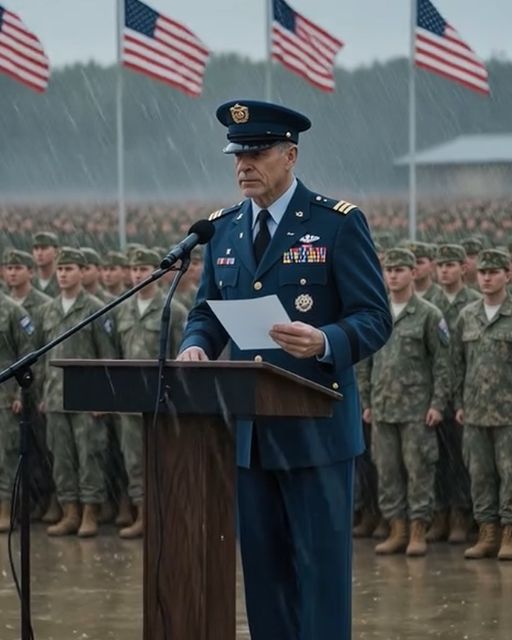
Rain hammered the parade ground. The whole unit stood locked in formation, boots sinking into wet mud.
A three-star general was at the podium.
He was holding a single sheet of paper.
My letter.
For twelve years, I’d been invisible. A logistics NCO. My job was clipboards and supply chains, not saving people. Keep your head down, do the work, go home. The system works if you let it.
But that was before Private Miller.
He couldn’t have been more than nineteen. Fresh out of some small town, with a “sir” and “ma’am” for everyone. His bunk was two down from mine.
Some nights I heard it. A muffled laugh. A hard thump against a metal locker. Low voices. Then quiet.
I told myself it was just training. The kind of thing that makes you tough.
Then I saw it.
It was late. I was heading back from the gym and cut through the showers. Two corporals had him in a corner. The water was running ice cold, plastering his uniform to his skin. They were laughing.
One of them called him a name I won’t repeat.
I was a Staff Sergeant. They were corporals. All I had to do was walk in there and say two words.
I didn’t.
I turned around and walked back to my room, my heart pounding against my ribs. Pinned to my wall was the Code of Conduct. The words felt like they were burning a hole through the plaster. I am responsible for my actions.
That night, the words felt personal.
So I did the thing you’re never supposed to do.
I sat down and wrote. No emotion. Just facts. Dates. Times. Names. What I saw in the showers. What I heard through the thin walls of the barracks.
I didn’t sign it.
I folded the paper, walked the dark, silent hall to the duty officer’s door, and slid it underneath.
The next morning, the air on the base had changed.
The usual noise in the chow hall was gone. Replaced by whispers. The two corporals were pulled into an office for hours. When they came out, their faces were pale and their jaws were set like stone.
People looked at me differently. Or maybe I just thought they did.
Our senior drill instructor gathered us for morning brief. He mentioned an “internal review” into hazing allegations. His eyes scanned the platoon. The message was clear: the problem wasn’t the hazing, it was whoever broke the silence.
Later that day, Miller found me by the vending machines.
He wouldn’t look at me. Just stared at his boots. “Ma’am,” he said, his voice barely audible. “Whoever it was… who tried to help… tell them thank you.”
I just nodded. “Keep your head up, Private.”
A few days later, I was cleaning my rifle in the armory. I heard two other NCOs talking.
“They’ll tear the place apart to find who wrote it,” one said.
The other just laughed. A short, sharp sound. “Doesn’t matter. Career’s over either way.”
My hands didn’t shake. I just kept cleaning.
Then the order came down.
Full formation. Dress uniforms. Now.
We stood on the parade ground as the sky opened up. A black sedan cut through the rain and pulled up to the podium.
The general got out. He didn’t have an umbrella. He just walked straight to the microphone, his face like granite.
He unfolded a single piece of paper.
And then he started to read.
My words. Every single one. Ringing out over the loudspeakers for the entire unit to hear. My private thoughts, my secret shame, broadcast across the field. My spine felt like it had been pulled from my body.
He finished reading. The silence that followed was heavier than the rain.
He scanned the formation. His eyes felt like they were looking right at me.
“Whoever wrote this, see me after.”
He folded the letter. Tucked it into his jacket. Turned, and walked away.
The formation was dismissed. Everyone left. I was the only one who didn’t move. My boots felt like they were anchored to the center of the earth.
Every instinct screamed at me. Disappear. Blend in. Let it go.
I turned and started walking toward headquarters.
The hallway floors were so polished I could see my own tired reflection. I stopped at his door. Took a breath.
And knocked.
“Enter.”
I stepped inside. The room was immaculate. I saluted. My eyes went straight to the photo on his desk.
It was a picture of him, standing next to a smiling, younger Private Miller.
My stomach dropped through the floor.
“Close the door, Staff Sergeant.”
And I knew.
This was never about a letter. It was about his son.
I closed the door. The latch clicked with a sound like a jail cell locking. I stood at attention, my eyes fixed on a point on the wall just over his shoulder.
He didn’t return my salute. He just sat there, looking at me. His face wasn’t angry. It was something far worse. It was weary.
“At ease,” he said, his voice quiet now, all the parade ground thunder gone.
I relaxed my stance, but every muscle in my body was still coiled tight.
He gestured to the chair in front of his desk. “Sit down.”
I sat. The leather was cold.
He leaned forward, his hands clasped on the polished wood. “My son, Thomas, he wanted to do this on his own.”
Thomas. Private Miller had a first name.
“He told me he didn’t want to be ‘the general’s kid.’ He wanted to earn it. The name, the uniform, the respect.” The general looked at the photo, a flicker of pain in his eyes. “I respected that. It’s what I would have wanted at his age.”
He paused. “But a father worries.”
He told me how Thomas had been calling home less and less. How his voice changed. The spark was gone.
“Last week, he called me at three in the morning,” the general said, his gaze back on me. “He was broken. He told me everything. What those corporals were doing. How it was a game to them.”
I felt a fresh wave of shame. I had waited. I had hesitated.
“I was on the next transport here,” he continued. “I was going to burn this place to the ground. Quietly. But then your letter showed up on my desk this morning.”
He tapped the breast pocket of his uniform where my letter was tucked away.
“My son’s story was a father’s nightmare. Your letter… it was evidence. It was the truth from someone with nothing to gain and everything to lose.”
My throat felt tight. “Sir, I… I saw it. The incident in the showers. I didn’t do anything.”
The confession hung in the air between us.
He nodded slowly. Not in judgment, but in understanding. “I know. You mentioned it in your letter. You said you were ashamed you walked away. Why did you include that part?”
It was a fair question. I could have just been a heroic whistleblower.
“Because it was part of the truth, sir,” I said, my voice barely a whisper. “The problem wasn’t just them. It was me, too. It was everyone who saw and stayed quiet.”
The general leaned back in his chair, studying me. The silence stretched on. I could hear the clock on the wall ticking, counting down the seconds of my career.
“The hardest thing to do in this uniform, Staff Sergeant,” he finally said, “is to choose the harder right over the easier wrong. Especially when the easier wrong is just… doing nothing.”
He stood up and walked to the window, looking out at the rain-swept base.
“This problem is bigger than Corporals Dawkins and Russo. They’re just symptoms of the disease. The sickness is in the bones of this unit. It’s in the NCOs who look the other way, who call it ‘character building.’”
His eyes found mine in the reflection on the glass. “It’s in your senior drill instructor, Master Sergeant Finch.”
The name sent a chill down my spine. Finch was a legend. Thirty years in. Feared and respected. He set the tone for everything.
“Finch fosters this,” the general stated. “He calls it ‘weeding out the weak.’ But he’s not making soldiers. He’s making bullies and victims. I’ve seen reports before. Vague complaints. Nothing that would stick. Until now.”
He turned back to face me. “The official investigation will run its course. But they’ll close ranks. Finch will protect his own. They’ll all have stories. Alibis.”
I knew he was right. I’d seen it happen before.
“I need to know what’s really happening on the ground,” he said. “I need to know who is part of the problem. And who might be part of the solution.”
It wasn’t an order. It was a request. A far more dangerous thing.
“Sir, what are you asking me to do?”
“Nothing,” he said. “Just keep your eyes open. And your head on a swivel. You painted a target on your back the moment you knocked on this door.”
He was right. My career wasn’t over. It was worse. I was now a ghost, caught between the command I was supposed to trust and the soldiers I lived with. An outcast.
The next few weeks were the longest of my life.
The whispers followed me everywhere. In the chow hall, conversations would stop the second I walked in. People would get up and move to another table.
My gear would go missing from my locker, only to turn up in the trash. Small things, meant to send a message.
Master Sergeant Finch started singling me out during PT. Extra reps. Impossible standards. He’d stand over me, his voice a low growl. “Think you’re special, Staff Sergeant? Think you’re better than us?”
I’d just keep my eyes forward and count the pushups.
Dawkins and Russo, the two corporals, were back on duty pending the investigation. They’d walk past me and shoulder-check me, just hard enough to be deniable. They’d smirk, a confident, ugly look on their faces. They knew the system would protect them.
I was completely alone. The invisible NCO had become the most visible pariah on the base.
There were nights I’d lie in my bunk and wonder if it was worth it. I could have kept walking that night. I could have stayed silent. My life would be simple. Easy.
Then one day, I saw Private Miller.
He was on the rifle range, focused, his movements crisp and sure. The timid, scared kid was gone. In his place was a soldier.
He finished his round and saw me watching. He walked over, his posture straight, his head held high.
“Ma’am,” he said, with a nod.
“Private,” I replied. “You’re looking sharp.”
He almost smiled. “I’m trying. I decided I’m not running. I’m going to earn this. The right way.”
He didn’t thank me. He didn’t mention the letter. He didn’t have to. We both knew. In his eyes, I saw the reason I was enduring all of this. It wasn’t about him, not really. It was about what was right.
That brief exchange was the fuel I needed.
A week later, the general called me back to his office.
“The investigation is being stonewalled,” he said, just as he’d predicted. “Dawkins and Russo have a dozen buddies who swear they were playing cards all night. Master Sergeant Finch submitted a glowing report on their character. He’s recommending the case be closed.”
My heart sank. They were going to get away with it.
“They think they’ve won,” the general said, a cold fire in his eyes.
Then he laid a thin file on the desk. “But Finch made a mistake. He underestimated you. And he underestimated me.”
He opened the file. Inside were two other anonymous letters, both years old. One described a recruit getting a broken arm during an “unsanctioned training exercise.” The other detailed how a soldier was driven to request a discharge after relentless harassment.
Both were signed, “A Concerned NCO.”
“These were useless at the time,” the general explained. “No names, no dates. No proof. But your letter, Staff Sergeant, provided the pattern. It gave these old stories context. It gave them power.”
He looked at me. “It’s not enough to get rid of Finch. But it’s a start. We need one more thing. We need someone else to speak up. On the record.”
I knew what he was asking. “You want me to testify at the hearing.”
“Yes,” he said. “But it will mean the end of your quiet life. They will try to tear you apart on the stand. They will dig into every fitness report, every mistake you’ve ever made. They will try to paint you as a disgruntled soldier with an axe to grind.”
This was it. The point of no return. I could back out. He was giving me an out. But I thought of Miller. I thought of the kid with the broken arm. I thought of the Code of Conduct pinned to my wall.
“When is the hearing, sir?”
The hearing was held in a sterile, windowless room. On one side sat Dawkins, Russo, and Master Sergeant Finch, flanked by their legal counsel. They looked smug. Confident.
On the other side was me, the general, and an investigating officer who looked bored before we even started.
I gave my testimony. I told them everything I wrote in the letter. I described the incident in the showers. I talked about the culture of fear Finch cultivated.
Their lawyer went to work. He picked apart my record. A minor infraction from six years ago. An average mark on a single performance review. He made it sound like I was incompetent, a liar.
Finch and the corporals just smirked. They were winning. The system was working for them.
The investigating officer looked at his watch. He was ready to wrap this up.
“Does anyone else wish to add anything to the record?” he asked, his tone flat.
The room was silent. My heart pounded. This was it. I had failed.
Then, a chair scraped against the floor.
From the back of the room, a voice said, “I do.”
It was Sergeant Wallace. A quiet, respected NCO from another platoon. A man I’d always seen as part of the old guard, one of Finch’s guys.
He walked to the front of the room. He didn’t look at me. He looked straight at Master Sergeant Finch.
“My name is Sergeant First Class Wallace,” he began, his voice steady. “And I was the NCO on duty the night Private Jessup broke his arm three years ago. It wasn’t an accident. Master Sergeant Finch ordered two corporals to ‘toughen him up.’ I was told to write it up as a training mishap.”
The smirks vanished from their faces. Finch went pale.
Wallace continued. “I wrote an anonymous letter about it. I was a coward. I was afraid of what Finch would do to my career. I’ve lived with that shame every day since.”
He finally turned and looked at me. “But when I heard that Staff Sergeant hadn’t just seen something, but was willing to put her name and her career on the line for what was right… I knew my silence was no longer an option.”
He looked at the investigating officer. “I’m ready to give my official statement.”
That was the moment everything broke open. Wallace’s testimony gave the old letters teeth. It proved a pattern of abuse, sanctioned from the top down. It was no longer my word against theirs.
It was the truth, undeniable and unforgiving.
Dawkins and Russo were dishonorably discharged.
Master Sergeant Finch was forced into retirement to avoid a court-martial, his thirty-year career ending in disgrace.
The day the final orders came down, I found an envelope on my bunk. Inside were my new orders. A promotion to Sergeant First Class, and an assignment as an instructor at the NCO Academy.
Tucked in with the official papers was a small, handwritten note from the general.
It had only seven words. “This is what leadership looks like. Thank you.”
A few months later, I was walking across the grounds of the academy, preparing for my first class. I saw a group of new soldiers marching, and at their head, calling cadence, was Corporal Thomas Miller.
He was no longer a victim. He was a leader.
He saw me, and for a brief moment, our eyes met across the field. He gave a sharp, almost imperceptible nod. A nod of respect. Of a shared understanding.
I nodded back.
For twelve years, I thought the way to survive was to be invisible, to keep your head down. I was wrong. The system doesn’t just work if you let it; it works if you have the courage to fix it when it’s broken. Courage isn’t about being the loudest person in the room. Sometimes, it’s a quiet, anonymous letter. Sometimes, it’s a single voice in a silent room. And sometimes, it’s just choosing the harder right, no matter the cost.