The kid on the bench stood up.
That’s all it took. The air changed.
My whole life is reading a room before it turns. This one was turning.
Six years. That’s how long my little girl had lived with the volume off.
Six years of watching Anna’s lips form the word “Daddy” and knowing she couldn’t hear her own voice.
We saw the specialists. We drove to the city hospitals. We sat in cold rooms while machines hummed and men in white coats told us what they couldn’t find.
They all said the same thing.
Her ear canal looks clear.
Clear.
So why did my daughter still tilt her head, still rub her right ear like something was trapped inside, buzzing and angry?
They had no answers. Just more appointments. More bills.
So I broke the rules today. No club business. No phone calls.
Just me and Anna and this beat-up park.
I just wanted one good afternoon. One day she could fly on the swings and I could forget the silence that followed her.
She was laughing, a flash of red dress and tangled hair, and then I saw it.
Her hand drifted to her right ear. A little tap. A wince.
The same motion every doctor had shrugged off.
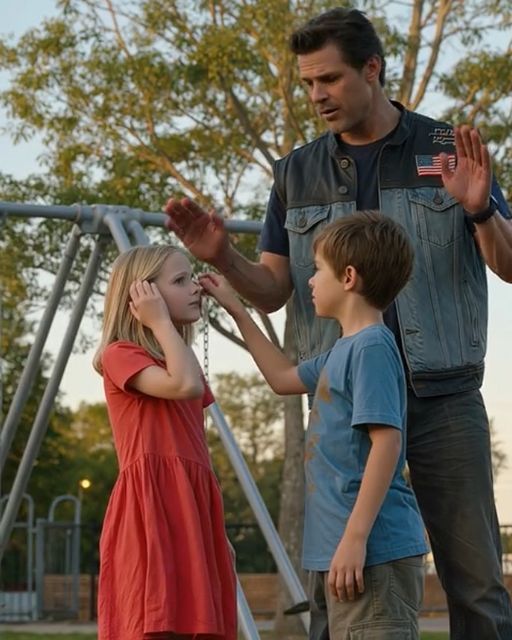
That’s when the barefoot kid moved.
He started walking toward her. Not fast, but with purpose.
My blood went cold.
I was between them before he took a third step. My shadow fell over him. My hand came up, palm out. A wall.
Hey, I said. Back up.
He stopped. His own hands came up, empty. He was skinny, drowning in a t-shirt, but his eyes were glued to my daughter.
I’m sorry, he said, his voice a wire. Please, sir, I just –
I said back up.
Any other kid would have been gone. A man in a leather vest with my tone doesn’t usually ask twice.
But he didn’t move.
He wasn’t looking at me. He wasn’t looking at my jacket.
He was looking at Anna’s ear.
Sir, he said, his voice shaking but dead certain. There’s something in her ear. I can see it when the light hits. It’s deep.
I heard the words, but my mind was screaming. Another story. Another angle.
Then he said the thing that changed everything.
That’s why she keeps touching it. I’ve seen it before. I know how to help.
My hand shot out and clamped around his wrist. Not enough to break it. Just enough to make sure he understood.
You have five seconds, I said, my voice low and quiet.
He met my eyes. He didn’t flinch.
It’s like a plug, he said, talking fast. If you let me try… I think she could hear.
Anna was standing behind me now, her eyes wide, her own hand still resting against the side of her head.
My grip tightened. My heart hammered against my ribs.
I was a breath away from throwing him backward and walking out of that park for good.
Instead, I did the scariest thing a father can do.
I let go.
The kid knelt in the dirt in front of my daughter. A barefoot stranger reaching for the one part of her the whole world had given up on.
And in the half-second before his fingers met her skin, one thought hit me so hard it stole my breath.
If this kid was right, then every single person I had trusted was wrong.
And my little girl’s silence was a lie we’d all been told.
His name was Finn. He told us that later.
Right then, he was just a pair of steady hands and eyes that saw what no one else had.
He gently tilted Anna’s head toward the afternoon sun. She didn’t pull away. She looked at me, her expression a question I couldn’t answer.
I gave her a tiny nod. A nod that felt like jumping off a cliff.
Finn’s fingers were surprisingly gentle. He wasn’t poking or prodding.
He placed one thumb just below her earlobe and a forefinger just above, on the cartilage.
It’s about the angle, he whispered, more to himself than to me.
He applied a soft, specific pressure. A kind of gentle pull, stretching the skin around her ear canal ever so slightly.
It wasn’t a doctor’s move. It was something else. Something learned from feel, not a textbook.
Anna flinched for a second, a tiny gasp. My whole body tensed, ready to rip him away.
But then she relaxed. Her own hand, which had been pressed to her ear, dropped to her side.
Wait for it, Finn breathed.
He held the pressure for a few long seconds. The world seemed to stop. The sound of other kids playing, the distant traffic, it all faded into a hum.
Then, with a final, careful wiggle, he released her.
Nothing happened.
The silence that I knew so well just… stayed.
My shoulders slumped. A fool. I was a fool for listening to a kid in a park.
I opened my mouth to tell him to get lost, to thank him for trying, to say something, anything to end this embarrassment.
Before I could speak, a dog barked from across the field. A sharp, happy yelp.
Anna jumped.
It wasn’t a big jump. It was a full-body jolt, a lightning strike of surprise.
Her head whipped around, eyes wide as saucers, searching for the source of the noise.
My breath hitched in my throat.
She had never, not once, reacted to a sound she couldn’t see.
Finn stayed kneeling, his gaze fixed on her face. A small, knowing smile touched his lips.
Daddy? Anna whispered. Her own voice sounded strange to her. She touched her throat.
Her eyes were locked on mine, but I could see they were processing something new. Something enormous.
I couldn’t form words. My throat was a desert.
I knelt down in front of her, my knees cracking on the hard-packed dirt.
Anna, baby? Can… can you hear me?
Tears were already blurring my vision. My voice was a wreck.
She stared at me, her little brow furrowed in concentration. Then her eyes filled with tears of her own. Not of sadness, but of pure, terrifying wonder.
Your voice is… loud, she said.
And then she started to cry. A real, sound-filled cry that broke my heart and put it back together all at once.
I pulled her into my arms, burying my face in her hair. She was shaking. The whole world, with all its noises, was crashing into her at once.
I looked over her shoulder at the barefoot boy, who was now standing quietly, watching us.
How? I mouthed the word.
He just shrugged a little, his eyes kind.
We went for ice cream. It seemed like the only logical thing to do.
I sat at a sticky metal table, watching Anna’s head swivel with every new sound. The ding of the bell on the door, the whir of the blenders, the low chatter of other customers.
It was overwhelming for her. I could see it. But it was also magic.
Finn sat across from us, working on a scoop of vanilla, his bare feet tucked under his chair.
I pushed a twenty-dollar bill across the table. It wasn’t enough. A million dollars wouldn’t have been enough.
He pushed it back.
You don’t have to do that, sir.
I’m Marcus. And yes, I do. Tell me how you knew.
He licked his spoon, thinking.
My little sister, he started. It was the same with her.
He told me they lived with their grandmother. A few years back, his sister started having trouble hearing. Same thing as Anna. Tapping her ear, crying at night from a pain no one could see.
The doctors said it was an infection. Then they said it was nothing. They gave her drops that did nothing.
My grandma, she’s a cleaner at the big hospital downtown. She sees things. Hears things.
He explained that his grandmother had noticed a pattern. Kids coming in with the same problem, getting the same non-answers.
She said the doctors only look straight in, with their little lights. They don’t see how the canal can get… stuck.
It wasn’t an object. It was a tiny flap of skin and hardened wax, almost invisible, that acted like a one-way valve. It would let a little pressure out, but it would seal shut against sound waves coming in.
His grandma figured out that if you stretched the skin just right, you could unstick it. It was a trick she’d learned from her own mother back home. An old remedy for what they used to call “wind in the ear.”
So you did this for your sister? I asked, amazed.
Yeah. It took a few tries. But it worked. She can hear perfectly now.
And the doctors?
They don’t listen to the cleaners, he said, with a sadness that was too old for his years.
I looked at this skinny kid, who had more practical wisdom in his little finger than a whole team of specialists. He had given me back my daughter’s world.
I had to do more than buy him an ice cream.
The next Monday, I was back at the hospital. Not in the waiting room this time.
I walked straight to the office of Dr. Albright, the head of pediatric otolaryngology. The man who had told me, on three separate occasions, to “accept the situation.”
His secretary tried to stop me. I didn’t slow down.
I walked into his plush office and shut the door behind me.
He looked up from his desk, annoyed. Marcus, you need an appointment.
I’ve had enough of your appointments, I said, my voice dangerously calm.
I told him everything. The park. The boy. The simple, unbelievable truth.
He listened with a look of smug disbelief, steepling his fingers under his chin.
Mr. Cole, he said, his voice dripping with condescension. I understand you’re desperate for a miracle. But these old wives’ tales… it’s most likely a temporary remission. A coincidence.
He didn’t believe a word. He thought I was a grieving, uneducated biker making up fantasies.
The rage I’d been holding back started to boil. I took a step toward his desk.
My daughter can hear the birds sing for the first time in her life because of an old wives’ tale, I growled.
He actually chuckled. A small, dismissive sound.
If you’d like, we can run the same tests again. I’m sure you’ll find the results are unchanged. He was already turning back to his paperwork.
I was about to lose it. I was about to show him exactly what an uneducated biker does when his family is insulted.
Just then, the door opened. A woman in a cleaner’s uniform came in, pushing a small cart. She was older, with tired eyes and kind hands.
She froze when she saw me, her eyes darting between me and the doctor.
I’m sorry, Doctor. I can come back later.
It’s fine, Maria, he said, not even looking up. Just empty the trash.
The woman nodded and moved to the bin beside his desk. As she bent down, her eyes met mine. There was a flicker of recognition. A flash of understanding.
I knew, even before she spoke.
Her name tag read Maria. Finn’s grandmother.
She straightened up, holding the small, full trash bag in her hand. She looked at the doctor.
Doctor Albright, she said, her voice soft but firm. My grandson, Finn. He told me he met your daughter, sir.
She was talking to me.
He helped her? she asked.
I just nodded, my throat tight.
The doctor finally looked up, irritated by the interruption. Maria, this is a private consultation.
She ignored him. She looked at me.
It’s the little fold, she said. Just inside. God made us all different. For some children, it gets stuck. You just have to know how to open it.
Dr. Albright stood up, his face turning red.
That is quite enough! You are a cleaner, not a physician. You have no idea what you’re talking about.
Maria didn’t back down. She stood there, a small, proud woman in a blue uniform, holding a bag of trash.
I know what I see, Doctor. I see the children who leave here crying. And I see you, in the waiting room with your own granddaughter.
The doctor froze. His mouth opened and closed, but no sound came out.
I see her rubbing her ear, just like the others, he said. And I hear your daughter telling you that little Beatrice keeps saying there’s a bee buzzing in her head.
The color drained from Albright’s face. He looked like he’d been struck by lightning.
It was true. I’d seen the little girl in the waiting room myself. A pretty kid with her hair in pigtails, always touching her ear. His granddaughter.
He sank back into his expensive leather chair, the arrogance gone, replaced by a raw, naked fear that I knew all too well. The fear of a family member in pain.
He looked at Maria. Truly looked at her, for the first time.
What… what do I do? he whispered.
Maria put the trash bag down.
You listen, she said simply. You just have to listen.
Things changed after that day.
Dr. Albright, humbled and horrified, brought his granddaughter to Maria’s small apartment that evening. An hour later, little Beatrice was staring in wonder at a ticking clock on the wall.
The next day, Albright started a formal inquiry. He called it the “Maria Method.” He brought her in not as a cleaner, but as a paid consultant.
He fought the hospital board. He risked his reputation. But he won.
They developed a new, simple, non-invasive screening technique based on what Maria knew. It didn’t require expensive machines, just trained hands and open minds.
I did my part, too. The guys in the club, they’re family. When I told them the story, they didn’t just slap me on the back.
We passed the helmet. We organized a charity ride, bigger than any we’d ever done before.
We raised enough money to start a small foundation. We called it “Anna’s Echo.”
It’s for families who get lost in the system. The ones who are told there are no answers. We help them get second opinions, travel to see specialists, or just pay the bills so they can focus on their kids.
Maria runs it. She quit her cleaning job. She sits in a real office now, and people listen to every word she says. Finn helps out after school.
I bought him a new pair of shoes. The best I could find.
He thanked me, but I still see him in the park sometimes, his shoes sitting neatly on the bench while he runs through the grass with Anna, feeling the earth beneath his feet.
We’re there a lot, me and Anna. I push her on the swings, and I don’t have to watch her lips to know she’s laughing.
I can hear it. A sound that is so loud, so clear, so beautiful.
The other day, she stopped the swing and looked at me.
Daddy, she said. What’s that little whistling sound?
I listened. It was just the wind, moving through the leaves of the big oak tree.
It was nothing. And it was everything.
I learned something that day in the park, something more important than anything a doctor in a white coat ever told me.
Wisdom isn’t always loud. Sometimes it’s a quiet whisper from a place you’d never expect.
And strength isn’t about the leather you wear or the noise your engine makes. It’s about being brave enough to let go, to trust a stranger, and to listen to the people that the rest of the world has learned to ignore.