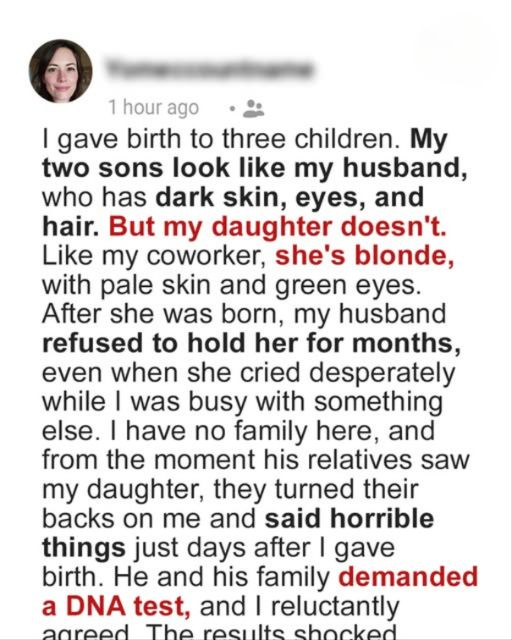
I gave birth to three children. My two sons look like my husband, who has dark skin, eyes, and hair. But my daughter doesn’t. Like my coworker, she’s blonde, with pale skin and green eyes. After she was born, my husband refused to hold her for months, even when she cried desperately while I was busy with something else. I have no family here, and from the moment his relatives saw my daughter, they turned their backs on me and said horrible things just days after I gave birth. He and his family demanded a DNA test, and I reluctantly agreed.
The results shocked everyone, including me. The test confirmed it: my daughter wasn’t biologically his. But there was no explanation for it—no affair, no infidelity on my part. I was as stunned as anyone. I had never cheated on him, nor could I explain why she didn’t share his features, why she was so different from our two boys.
The look in my husband’s eyes after the test came back was something I’ll never forget. It wasn’t anger, nor was it confusion. It was a kind of relief. He finally had an answer to the question he’d been harboring since she was born. He didn’t say much, but I could tell from his silence that everything had changed.
For the first time in our marriage, I saw him act as if I was a stranger. He no longer seemed to care about me, nor did he make any effort to care for his daughter. He spent more time away from home, working late, going out with friends, or claiming to be busy with something else. His silence spoke louder than words.
My daughter, however, was completely unaware. She was only a toddler, and she was a happy child—always smiling, laughing, reaching for hugs. I was the one who had to endure the guilt and confusion. I was the one who had to answer her innocent questions about why her father didn’t want to play with her.
Then, the worst part happened. His family—the ones who had once embraced me with open arms—began to criticize me. They questioned my character, insinuating that I must have cheated on him for her to not look like him. My sister-in-law even suggested I get a “paternity test” for the boys, implying I wasn’t trustworthy enough to raise children that looked like my husband.
I was devastated. I had always felt like an outsider in this family, but never like this. It was as if I were being stripped of my dignity, my motherhood, and everything I had once held dear.
A few weeks passed, and the situation didn’t improve. My husband would come home late, barely speak to me, and ignore our daughter. There was a tension in the house that felt suffocating. One evening, after another long day of his silence, I snapped.
“Why don’t you just leave if you can’t handle it?” I said, tears welling up in my eyes. “Why are you still here if you don’t want to be a part of this family? If you hate her so much, why even stay?”
My words hit like a slap. He didn’t even flinch. He just looked at me, a blank expression on his face, and said the words I had been dreading: “I’m thinking about it.”
That night, I couldn’t sleep. I lay awake, staring at the ceiling, replaying everything. The memories of how we once were—a happy family—felt like they belonged to someone else. I had hoped that time would heal this wound, that somehow things would return to normal, but I was wrong. The damage was too deep.
The following days were filled with more arguments and silence. My daughter’s smiles grew rarer, and she began asking why Daddy didn’t want to play with her anymore. That broke me in ways I hadn’t anticipated. The love I had for my children—especially her—was something I could never explain, something so profound that no one, not even my husband, could take it away from me.
I began to search for answers. Was there something I was missing? What if she wasn’t my husband’s daughter? What if the DNA test had somehow been wrong? I went to a therapist, hoping to find some clarity, but all I found were more questions. How had we gotten here? Why hadn’t he believed in me?
Then, something strange happened. My coworker, the one I had confided in, pulled me aside one afternoon. She had known about the situation and had been quietly observing from a distance. She had a theory—a wild one, but one that made sense when she explained it.
“What if…” she started carefully, “What if your husband is more than just angry about the test? What if he’s angry at something else?”
I stared at her, confused.
“I think he might be scared,” she continued. “Scared that this isn’t just about genetics. Scared that he doesn’t know who you are anymore. Scared that, maybe, he’s not the man you fell in love with.”
Her words caught me off guard. I had never considered that. But the more I thought about it, the more I realized that my husband had always been insecure. He had grown up in a family that judged everything by appearances. He had always prided himself on the fact that his children looked like him. But now, with our daughter—who was so different—he was facing a challenge to his identity.
A part of me wanted to confront him, to tell him what I now knew about his fears. But the truth was, I was too hurt to even speak. I didn’t want to be the one to make the first move anymore. I was tired. Tired of defending myself, tired of trying to fix everything, tired of being the only one who cared.
Weeks passed, and I started to focus on my daughter. I threw myself into motherhood, spending time with her every day, teaching her, watching her grow into a brilliant, funny, and strong little girl. I couldn’t let her see the sadness I was feeling, couldn’t let her know that her father’s rejection was taking a toll on me. She deserved better.
One day, while I was picking up my son from school, I bumped into an old friend. He was someone I had known before I got married, someone I had lost touch with over the years. He looked different—older, more mature—but the connection between us was instant.
We started talking, and before I knew it, we were meeting regularly. He was a good listener, and slowly, I began to open up to him. I told him everything—the marriage, the rejection, the pain I was feeling. And while he was understanding, he didn’t offer the sympathy I expected. Instead, he offered something more valuable: perspective.
“You deserve to be happy,” he said one day, after we had been talking for hours. “You’re doing everything for everyone else, but what about you? What about your happiness? You’ve given up so much of yourself already. It’s time to take care of you.”
It wasn’t what I wanted to hear, but it was what I needed. I had spent years putting my family first, but somewhere along the way, I had forgotten about myself. I had lost sight of who I was, of what made me happy. And as much as I loved my children, I knew I had to learn to love myself again.
After that conversation, I made a decision. I wasn’t going to wait for my husband to come around. I wasn’t going to live in a home filled with tension and rejection. I wasn’t going to let his insecurities define me anymore.
I packed my bags and took my children on a trip. It was a small vacation—just the three of us—but it was everything I needed. It was a chance to reconnect with my kids, to remind them how much they meant to me, and to show them that family didn’t have to mean being confined to a single definition. Family was about love, trust, and support. And that was something I could give them, even without their father.
When we returned, my husband was waiting. But this time, there was something different about him. He didn’t say anything at first. He just stood there, watching me, as if seeing me for the first time in a long while.
“I’m sorry,” he said quietly. “I’ve been selfish. I’ve been scared. I didn’t know how to handle this, and I took it out on you.”
It wasn’t the apology I had been hoping for, but it was a start. We talked. Really talked. And for the first time in months, I felt like we were speaking the same language. He admitted that his fear wasn’t about the DNA test, but about the possibility that our family was no longer what he thought it was. He had been afraid of losing his place in the world, of being overshadowed by something he couldn’t control.
In the end, we didn’t have all the answers. But we were both willing to try again. To rebuild. It wasn’t perfect, and it wasn’t easy, but it was real.
Sometimes, it takes losing yourself to find the strength to move forward. Sometimes, it takes a little bit of distance to realize how much you’ve grown. And sometimes, it takes letting go of the expectations to find the love you’ve been looking for all along.
I hope that whoever reads this knows that no matter what life throws your way, there is always a way forward. You deserve love. You deserve peace. And you deserve to be seen for who you are.
If you’ve ever felt lost or rejected, just remember that it’s never too late to take back your happiness. And remember, it’s never too late to start over.