His fingers were dry and cool when they brushed against my hand.
The train lurched, a crush of bodies, but his eyes were fixed on my neck.
Take it off, he whispered, his voice a crackle under the screech of the rails. There’s something inside.
He was gone before the doors slid shut, leaving only a small, stiff card in my palm. Elias Vance. Jeweler.
For two months, my day had started on the bathroom floor. A cold sweat, a nausea so deep it felt like it was clawing its way up from my bones.
Every doctor said the same thing. You’re healthy. It’s just stress.
Mark would hold me, his hands firm on my shoulders. He’d kiss my forehead and tell me his mother knew another specialist. He was so kind. His kindness felt like a blanket, heavy and suffocating.
I wanted to believe him. Believing him was easier than admitting the price of our peace was my silence.
At work, the pills I counted felt like a joke. Little cures for things with names, while mine remained a ghost in my own body.
My friend Sarah, a nurse, looked at the growing hollows under my eyes. What if the problem isn’t in you? What if it’s on you?
The jeweler’s card burned in my pocket.
That night, the pendant felt heavy. A silver oval, engraved with a delicate vine. A first anniversary gift. Mark had fastened the clasp himself, his knuckles grazing my skin. So you always feel my love, he’d said.
I ran my thumbnail along the edge.
And there it was. Not a scratch. A seam. A line so fine it was almost invisible, a secret hiding in plain sight.
The next morning was the worst yet. The world tilted, the room swam. I fumbled with the clasp, my fingers shaking, and dropped the necklace on my nightstand.
An hour later, I could breathe.
The nausea hadn’t vanished. It had receded, like a tide pulling away from the shore, and the silence it left behind was terrifying.
So I started to lie.
The necklace went on five minutes before he came home. It came off the second he was in the shower. I smiled. I made dinner. I played the part of a woman who was simply stressed.
I called the number on the card.
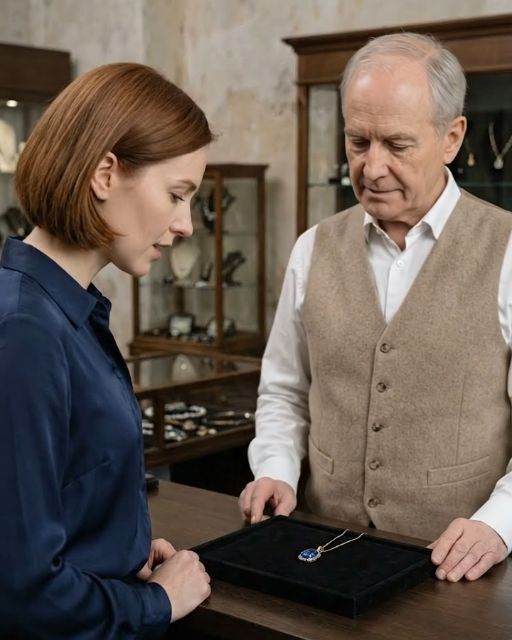
Mr. Vance’s shop smelled of old wood and solvent. He didn’t speak, just motioned for the pendant, his hands covered in thin leather gloves.
He held it under a bright lamp, turning it slowly.
The doctors were looking for a poison in your blood, he said, his voice quiet. They were looking in the wrong container.
He pointed a thin, metal tool at the hairline seam.
Then he looked at me, his eyes holding no pity, only a question.
Are you ready to see what he’s been keeping so close to your heart?
My own heart was a frantic drum against my ribs. I could only nod, my throat tight.
He worked with a surgeon’s precision. A click, a soft whirring sound. He used a pair of fine-tipped tweezers to carefully pry the two silver halves apart.
The oval shell opened like a locket.
But there was no space for a picture inside. There was only a small, hollowed-out compartment.
Nestled within it was a tiny, greyish pellet, no bigger than a grain of rice. It was dull, almost porous, absorbing the light from his lamp.
What is that? I whispered, the words barely audible.
He leaned back, gesturing for me to look closer. It’s not something you’d find in a textbook. Not easily, anyway.
He explained that the silver casing wasn’t just silver. It was alloyed with lead, a thin layer, just enough to prevent a normal x-ray from seeing the cavity inside.
But the pellet, he said, his voice dropping lower. That’s the real work of art.
It was designed for slow, transdermal absorption. Skin-to-skin. A steady, microscopic dose that would never show up on a standard toxicology screen.
It wouldn’t kill you, he said, meeting my gaze. It would just make you sick enough to need someone. It mimics the symptoms of a severe anxiety disorder, chronic fatigue, vertigo. It makes the world feel unsafe.
It makes you feel like you need a savior.
The room seemed to shrink. Mark’s face swam in my vision. His gentle hands. His worried frown. His constant, suffocating care.
It was all a script. And I was the star, unknowingly playing my part.
Why? The word was a breath, a plea.
Mr. Vance sighed, a sound of profound weariness. He’d seen this before. I knew it in that moment. He wasn’t just a jeweler.
Some people don’t want a partner, he said softly. They want a patient. A project. Someone they can fix, over and over, so they never have to look at how broken they are themselves.
He carefully placed the pellet into a tiny glass vial and sealed it. He handed me the empty silver shell.
He’ll notice it’s lighter, he warned. Or he’ll notice it’s gone. You need to be careful. You need a plan.
I drove home in a daze, the empty pendant cold in my fist. Every memory of the past year was replaying in my mind, but now tinted with a sickening, horrifying clarity.
The time I was too dizzy to go to Sarah’s birthday party, and he’d stayed home to make me soup. The promotion I’d turned down because I didn’t have the energy, and he’d praised me for prioritizing my health.
He hadn’t been supporting me. He had been curating my weakness.
I walked into our home, a place that now felt like a cage designed by a monster. I had to pretend. I had to keep the mask on a little longer.
That night, I put the empty necklace on before he got home. I held my breath when he kissed me, his hand going to the back of my neck, his thumb brushing against the silver oval.
It’s hollow, my mind screamed. Just like you.
He didn’t notice. Or if he did, he said nothing. He just smiled his kind, gentle smile.
I called Sarah the next day, my voice shaking. I met her on her lunch break, in a noisy cafe where we couldn’t be overheard.
I slid the vial across the table. Her eyes widened as I told her everything. Her nurse’s mind immediately started working, connecting dots I hadn’t seen.
His mother, she said, her voice sharp. You said she works for that boutique pharmaceutical research firm. The one that specializes in rare elemental compounds.
My blood ran cold.
They’re not just a research firm, Sarah continued, pulling out her phone. They’ve been investigated for unethical human trials. Nothing ever stuck, but the rumors have been around for years.
This isn’t just about him wanting you dependent, she said, looking at me with a new, fierce light in her eyes. This is bigger. He might be using you.
She told me what we needed. Proof. Something that connected the pellet to him and his mother. Something more than my word against the word of a kind, devoted husband.
The plan was terrifyingly simple. I had to get into his home office.
Mark kept it locked. He said it was for work, sensitive client files. Now I knew it was a vault for his secrets.
The next day, he had an all-day conference downtown. He kissed me goodbye, reminding me to take it easy.
Don’t push yourself, angel, he said.
The term of endearment felt like acid.
I waited an hour after he left, my heart pounding a frantic rhythm. I found the spare key to his office exactly where I knew he’d hide it – in the book on his bedside table. A biography of Marie Curie. A pioneer in poison. The irony was suffocating.
The office was neat, sterile. A large desk, a powerful computer, and a wall of filing cabinets. The cabinets were locked.
I went for the computer. It was password-protected, of course. I tried my birthday. His birthday. Our anniversary. Nothing.
Then I remembered Mr. Vance’s words. They want a patient.
I typed in my medical record number. The one he’d memorized when he was handling all my doctor’s appointments.
The screen flickered and opened to his desktop.
It didn’t take long to find it. A folder, cryptically labeled “Project Nightingale.”
Inside were files. Research notes. Chemical compositions. And a log.
It was a daily journal of my symptoms, cross-referenced with dosage levels and notes on my mood and compliance. Words like ‘lethargic,’ ‘receptive,’ ‘anxious,’ and ‘dependent’ were used to describe me, as if I were a lab rat.
And then I saw the emails.
They were between Mark and his mother. They talked about me, but they called me ‘the subject.’ They discussed the compound’s efficacy, its subtlety. His mother praised him for his meticulous data collection.
This one is much more stable than the last trial, she’d written in one email. The effect on cognitive function is exactly what we were hoping for. Minimal, but creates enough fog to foster reliance.
The last trial.
My breath hitched. My mind flew to Mark’s previous girlfriend. The one he never talked about. She’d moved away suddenly, he’d said. To a wellness retreat upstate. She’d just needed to get her head straight.
Had she been a Nightingale, too?
I copied everything onto a small USB drive Sarah had given me. My hands were shaking so hard I could barely guide it into the port.
I locked the office, put the key back, and erased my footprints. I sat on the sofa, waiting for him, the USB drive feeling like a tiny bomb in my pocket.
When he came home, I played my part one last time. I let him hold me. I let him tell me how much he worried.
I looked into his kind eyes and saw the chilling emptiness behind them. There was no love there. There was only the quiet satisfaction of a scientist observing his successful experiment.
The next day, I told him I was going to visit my parents for the weekend. I needed a change of scenery.
He was thrilled. He packed my bag for me, fussing over which sweaters I should take. He fastened the empty necklace around my neck.
So you always feel my love, he said, the words the same as they were a year ago.
I will, I said, my voice steady for the first time in months. I promise.
I didn’t go to my parents’ house. I went to Sarah’s. We sat with Mr. Vance and a lawyer he knew, a woman with eyes as sharp as cut glass.
She looked through the files on the USB drive. She looked at the vial containing the grey pellet.
This is monstrous, she said, her voice devoid of emotion. But it’s also airtight.
We had everything. The compound, the research, the emails detailing the conspiracy between Mark and his mother. We even had a name for a potential prior victim.
The plan was set in motion. It wasn’t just about me anymore. It was about his mother’s company. It was about the other Nightingales.
A week later, I went back home. Mark was surprised to see me.
I came back early, I told him. I missed you.
His face lit up with that practiced, gentle smile. He pulled me into a hug.
And that’s when the doorbell rang.
He opened it to find two stern-faced detectives and our lawyer. His smile faltered, confusion clouding his features.
The confusion turned to ice as they presented him with a warrant. They went straight to his office. They didn’t need the key.
He looked at me. The mask didn’t just drop. It shattered.
The kindness in his eyes was replaced by a cold, reptilian fury.
You, he hissed, his voice a stranger’s.
I just stood there, my hands steady, the space on my neck where the necklace used to be feeling wonderfully, liberatingly light.
It turned out his mother’s company had been developing a new kind of “compliance” drug. Something to be used in residential care homes or psychiatric facilities to make patients more manageable. It was illegal, of course. The human trials were completely off the books.
I was the final, perfect test subject. A healthy woman, slowly, methodically broken down in her own home, the safest place in the world.
The evidence was overwhelming. Mark and his mother were arrested. Their assets were frozen. The company was ruined, its dark secrets laid bare for the world to see.
I found out later about the first woman. Her name was Clara. With our evidence, the police were able to track her down. She was still in a private “wellness” facility, heavily medicated and diagnosed with a host of stress-related disorders. Our testimony set her free.
Months later, I visited Mr. Vance in his shop. It smelled the same, of old wood and quiet purpose.
He was polishing a silver bracelet, his hands moving with practiced grace.
He didn’t ask how I was. He seemed to already know.
I wanted to thank you, I said. You gave me my life back.
He shook his head, placing the bracelet down.
I only showed you the door, he said. You were the one who had to walk through it.
He reached under his counter and brought out a small, velvet box. Inside was my pendant. The two silver halves had been soldered shut. The vine engraving had been polished until it shone.
There are no secrets inside anymore, he said. It’s just a piece of silver. Its story is up to you now.
I took it from him, its weight familiar but no longer threatening. It was just an object, stripped of its terrible power.
We often accept the containers people build for us. A role, a relationship, a diagnosis. We live inside the walls they create, sometimes without even realizing a lock has been turned. But the most important truths are like seams, hiding in plain sight. You just have to be brave enough to look for them, to pry them open, and to see what’s really been kept inside. True freedom isn’t about never being caged. It’s about realizing you were always the one with the key.