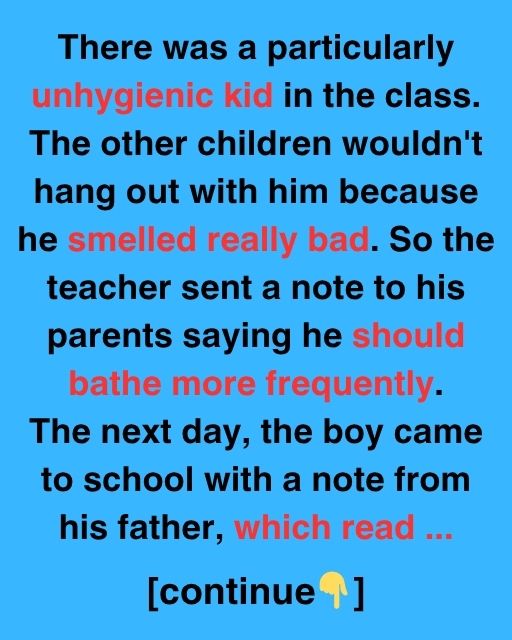
There was a particularly unhygienic kid in the class. The other children wouldn’t hang out with him because he smelled really bad. So the teacher sent a note to his parents saying he should bathe more frequently. The next day, the boy came to school with a note from his father, which read: “My son tries his best, but we don’t have hot water at home, and we can’t afford soap right now. I’m sorry.”
The teacher read the note twice before folding it carefully and slipping it into her desk drawer. She looked at the boy, his hair matted and his shirt stained, and her heart ached. That day, she couldn’t focus on the lesson. She kept glancing at him, noticing how he tried to keep to himself, how he avoided raising his hand so no one would get close enough to smell him.
At recess, the boy sat alone under the big oak tree. A couple of boys from his class were kicking a ball nearby, but every time the ball rolled towards him, they’d run over quickly, grab it, and hurry away without saying a word. The teacher watched from her window and sighed.
She remembered her own childhood, how her family had struggled, how she’d once been the kid with holes in her shoes. After school, she called the boy over and knelt to his level. She asked if he’d like to come by her house sometime, saying she had some extra soap and maybe some clothes that would fit him. His eyes widened, but he just nodded quietly.
That weekend, the teacher, Ms. Patel, drove her small red car to the address listed on the note. The neighborhood was worn down, with cracked sidewalks and stray cats darting between trash cans. She parked in front of a pale yellow house with peeling paint. The boy’s father opened the door.
He looked tired, with dark circles under his eyes and hands that seemed too big for his thin frame. He greeted her politely, apologizing for the smell drifting from inside the house. She waved it off, stepping inside. The smell was a mix of mildew and old cooking oil. Clothes were piled in corners, and a single electric heater buzzed loudly in the living room.
The boy, whose name was Arjun, was sitting on the floor playing with a broken toy truck. He looked up, surprised to see his teacher. Ms. Patel sat on the couch, explaining that she wanted to help. She offered to bring over soap, shampoo, and clothes.
The father hesitated, pride flickering across his face, but finally agreed. He admitted he’d lost his job months ago and was struggling to keep the lights on. They talked for nearly an hour, sharing tea brewed over a camping stove in the kitchen.
Over the next week, Ms. Patel brought boxes of donated clothes from the school’s lost and found. She slipped a few packets of instant soup and rice into the boxes, hoping they’d help. Arjun started coming to school cleaner, his hair combed and his shirt free of stains.
The kids noticed. Some of them started talking to him, asking about his toy truck or inviting him to join their games at recess. He still kept to himself at first, but soon he began smiling, even laughing when someone told a joke.
One afternoon, as the kids lined up for lunch, a girl named Rina offered to share her homemade samosas with him. He was hesitant, but she insisted. From that day, the two became inseparable. They’d sit under the oak tree, eating lunch and giggling. The other kids slowly joined them, drawn by their laughter. By the end of the month, Arjun wasn’t the lonely kid anymore. He was part of the group.
But things weren’t perfect. One day, a boy named Vikram, who’d always liked to stir trouble, pushed Arjun into the mud during recess. He sneered, calling him “dirty boy” even though Arjun’s clothes were clean that day.
The teacher rushed over, scolding Vikram and sending him to the principal’s office. That night, Arjun cried quietly to his father, asking why people hated him just because they’d been poor. His father hugged him tightly, promising things would get better.
Ms. Patel decided to take things further. She organized a school fundraiser, explaining to the principal that several families in the community needed help. The principal agreed, and soon parents and teachers came together to host a cultural night with food stalls, dance performances, and raffles.
The event was a huge success, raising enough money to buy school supplies, clothes, and even pay a plumber to fix the hot water in Arjun’s home and others in the same street.
The day the plumber arrived, Arjun’s father cried openly, hugging Ms. Patel when she came to check in. He said it wasn’t just about hot water—it was about feeling human again. That night, Arjun took his first warm bath in months.
He wrapped himself in a towel that smelled of fresh laundry and fell asleep smiling. The next morning, he wore a new shirt to school, one that fit him properly and didn’t smell of mildew. He walked taller that day, greeting his classmates with a shy but proud smile.
One day, as the class was doing a group project, Arjun spoke up, sharing an idea about building a model of the solar system with recycled materials. The other kids loved the idea. Rina suggested they all bring items from home—bottle caps for planets, old CDs for rings.
They worked together after school, laughing and teasing each other. By the end of the week, they had a beautiful model that hung from the ceiling of their classroom, each piece a symbol of teamwork.
A week later, Ms. Patel was called into the principal’s office. She worried something was wrong, but instead, the principal praised her. Parents had been calling, saying how much their children had learned about kindness, empathy, and community. The school decided to make the fundraiser an annual event, naming it the Arjun Fund, to help any student in need.
Meanwhile, Vikram, the boy who’d bullied Arjun, started noticing how his classmates looked at him disapprovingly. His friends began to drift away. One afternoon, he found himself sitting alone under the oak tree.
Arjun noticed him, hesitating for a moment before walking over. He offered Vikram half of his sandwich. Vikram stared at it, then at Arjun’s face, expecting anger or mockery. But Arjun just smiled. “You don’t have to sit alone,” he said quietly.
Vikram’s eyes filled with tears. He whispered, “I’m sorry.” Arjun nodded, sitting down next to him. The two sat in silence for a while, sharing lunch. Slowly, the others came over, including Rina, who handed Vikram a juice box. That moment changed everything.
Vikram stopped making mean comments. He even started helping Arjun with math problems, discovering they both liked building things. They began working together on projects, often staying late after school with Ms. Patel supervising them.
One rainy afternoon, Arjun invited Vikram over to his house. Vikram was surprised to see how small it was, how the couch had holes covered with old blankets. He realized how lucky he was to have his own room and toys. That night, he asked his mom if they could donate some of his clothes and books to Arjun’s family. His mom hugged him, proud of the boy he was becoming.
As months passed, Arjun’s father found a part-time job at a repair shop. With the help of Ms. Patel and the school community, he was able to save enough to buy second-hand tools and start fixing appliances from home.
Word spread, and soon neighbors came to him with broken toasters, fans, and radios. He worked late into the night, teaching Arjun how to tinker with wires and screws. Arjun loved these evenings, sitting with his father under the dim light, feeling useful and connected.
One evening, the school called Ms. Patel to tell her Arjun was selected to represent the school in an inter-school science competition. He’d built a working model of a wind turbine from scrap metal and old bicycle parts.
The project impressed the judges so much they wanted him to present it at the district level. Arjun was nervous, but his father and Ms. Patel stood by him, practicing his speech late into the night.
The day of the competition arrived. Arjun wore his best shirt and stood on stage, voice shaking at first but growing stronger as he explained how wind energy could help families like his reduce electricity costs.
His model spun beautifully under the breeze from a small fan. When he finished, the crowd erupted in applause. He won first prize, a scholarship to a science camp that summer.
The local newspaper ran a story about him, calling him “The Boy Who Built a Future from Junk.” People from all over the town sent letters and small donations to the Arjun Fund.
The school used the money to set up a permanent assistance program for students in need, offering free meals, clothes, and tutoring. Ms. Patel became known as the teacher who changed the school’s heart.
Years passed, and Arjun continued to excel. He became known for helping anyone who needed it, tutoring younger students, fixing broken bikes, and organizing weekend clean-up drives in the neighborhood. His father’s small repair business grew, enough to move them to a better apartment. They never forgot the kindness that started it all.
One sunny afternoon, Arjun and Vikram were sitting on the same oak tree bench where they’d first shared lunch years ago. They talked about their plans—Arjun wanted to study engineering, and Vikram dreamed of becoming a teacher like Ms. Patel.
They laughed, remembering their fights and how far they’d come. Rina joined them, bringing homemade sweets to celebrate their last day of school.
As they walked home together, they saw a little boy sitting alone near the swings. His clothes were worn, and his eyes looked downcast. Without thinking twice, Arjun approached him, kneeling to ask his name. The boy whispered he was new and didn’t know anyone.
Vikram offered him a piece of candy, and Rina invited him to join their game. The boy’s face lit up, and he ran off with them, his laughter ringing through the playground.
Ms. Patel watched from her classroom window, smiling with tears in her eyes. She realized the circle of kindness she’d started had grown beyond anything she’d imagined. It wasn’t just about soap or clean clothes—it was about seeing people, really seeing them, and making them feel they belonged.
Years later, after college, Arjun came back to his old school as an engineer volunteering to teach kids about renewable energy. Vikram returned too, now a teacher himself, helping kids find their voice. Rina, who’d always loved cooking, started a lunch program to make sure no child went hungry. Together, they kept the spirit of kindness alive.
The oak tree grew taller, its branches spreading wide over the playground. Kids still sat beneath it, but now it was a place of friendship, where no one was left out or pushed away. The school became known as a place where compassion thrived, where every child, no matter their background, felt safe and valued.
This story reminds us that small acts of kindness can ripple out in ways we can’t imagine. When we reach out to others with compassion, we don’t just change their lives—we change entire communities. So next time you see someone struggling, remember Arjun’s story, and choose kindness.
If this story touched your heart, please share it with someone who needs a little hope today. And don’t forget to like the post to spread the message of kindness further!