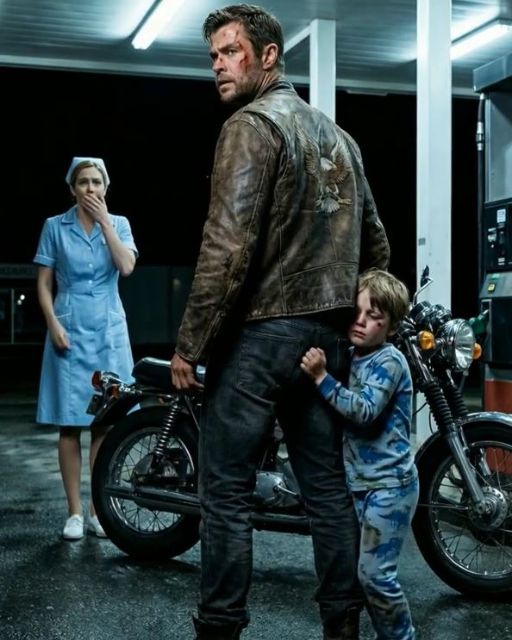
The pump clicked off. It was late, the kind of quiet that makes you feel like the last man on earth. I was on my way to see my sister, a ten-hour drive I did twice a year. I was tired. I just wanted a coffee and another hundred miles behind me.
That’s when I felt a small tug on my jeans.
A little boy, maybe six or seven, was staring up at me. His eyes were wide. “Dad?” he whispered.
I almost laughed. “Sorry, pal. Wrong guy.”
He shook his head, his grip tightening. “No. It’s you. You came back.” He buried his face in my leg and his small shoulders started to shake. I froze. What do you even do with that?
A woman came rushing out of the mini-mart. She looked wrecked. “Oh, God. Paul. Let go of him. I am so sorry, sir.” She tried to pull the boy away, but he clung to me like I was a life raft.
“He just misses his dad so much,” she said, her voice cracking. “You… you have the same build. The same jacket.”
I felt a pang of pity. “It’s okay,” I told her.
“I have a picture,” she said, fumbling with her phone. “You’ll see. The likeness is just crazy.”
She held the phone out. The screen was cracked. I leaned in to look at the picture she was showing me. My stomach dropped into my shoes.
It wasn’t a man who looked like me.
It was me.
The picture was of me, sitting in a booth at the diner I’d stopped at for lunch yesterday, three hundred miles north of here. I was wearing the exact same green work shirt. I remember that booth. I remember the waitress spilling coffee.
I was alone yesterday. I swear I was alone.
I looked from the phone back to the woman. Her eyes weren’t sad anymore. They were flat. Cold. The boy stopped crying. He let go of my leg and took a small step back, standing next to her. His expression was blank.
She saw the look on my face. She knew that I knew. She slowly put the phone back in her pocket, and from that same pocket, she started to pull out a set of car keys.
She held them up, dangling them between us in the cold, fluorescent light of the gas station canopy. They weren’t for my truck.
“Get in our car,” she said. Her voice was no longer cracking. It was steady. It was an order.
I shook my head, my own voice a dry whisper. “What is this? What do you want?”
“I want you to get in the car, Mr. Harris.”
She knew my name. My real name, Arthur Harris. It wasn’t on my jacket or my truck. A cold dread, colder than the night air, washed over me.
The boy, Paul, just watched me with those empty eyes. He wasn’t a grieving child. He was a sentry.
“How do you know my name?” I asked, taking a half-step back towards the relative safety of my truck’s cabin.
“I know a lot about you,” she said, taking a step forward, closing the distance. “I know you’re a sales rep for a paper company. I know you visit your sister in a different state every April and October. I know you like your coffee black.”
My mind raced. How could she know any of this? I wasn’t anyone special. I lived a quiet life.
She must have seen the panic in my face. Her expression softened, just a fraction. “I’m not going to hurt you, Arthur. But I need your help. Paul and I, we need your help.”
Her voice trembled on the last word, and for a second, I saw the wrecked woman from before. It felt more real this time.
“Help with what?” I stammered. “You have a picture of me. You know my name. This isn’t how you ask for help.”
“Sometimes it is,” she said softly. “When you have no other choice.” She gestured with the keys towards a beat-up sedan parked in the shadows at the edge of the lot. “Please. Just listen. If you don’t like what I have to say, you can walk away. I promise.”
I looked at the boy. He was just a kid, caught in the middle of… whatever this was. My gut screamed at me to get in my truck and drive away. But my heart, that stupid, bleeding thing, looked at his small face and couldn’t do it.
Against every instinct, I nodded. “Okay. I’ll listen.”
We didn’t get in her car. I insisted we talk in my truck. It was my space. I felt safer there. She agreed, and the three of us piled into the cab. It smelled like stale coffee and road maps.
Her name was Sarah. The boy, Paul, sat between us, silent, staring straight ahead at the dashboard.
“My husband’s name is David,” she began, her hands twisting in her lap. “And he looks exactly like you.”
I stared at her. A doppelgänger? It sounded like something out of a bad movie.
“I don’t mean a little bit like you,” she continued, her voice urgent. “I mean you could be twins. Same height, same build, same hair. Same face. It’s why I followed you.”
“Followed me?” My blood ran cold again. “From the diner?”
She nodded. “My cousin works there. She called me the second you walked in. I’ve been looking for someone like you for a year. A ghost. An escape hatch.”
She explained that she’d first seen me in a photo in a small-town newspaper online. I’d won a regional sales award. The picture was grainy, but it was enough. She had hired a private investigator with the last of her secret savings to find out who I was and what my routines were.
That’s how she knew about my trips to see my sister. That’s how she knew I’d be on this road, at this time.
“My husband… David,” she said, and her voice dropped so low I had to lean in to hear. “He’s not a good man. He’s controlling. He’s dangerous.”
She didn’t need to elaborate. I could see the story in the faint, old bruise hidden near her hairline and the way she flinched when a truck rumbled past on the highway.
“He has a business,” she said. “Not a legal one. He moves things for people. Bad people. And he keeps records of everything. Insurance. A little black book with names, dates, accounts. Leverage to make sure his partners never turn on him.”
She took a deep breath. “Tonight, I’m supposed to meet one of his associates. To give them the book.”
I was completely lost. “You’re giving them his leverage? Why?”
“It’s a trade,” she said, finally looking at me. “The book, for my freedom. This man, he wants the book to protect himself. In exchange, he’s promised to make David disappear. A new life, a new identity, far away. He’ll be gone, and Paul and I will be free.”
It sounded insane. Complicated and messy and dangerous.
“What does this have to do with me?” I asked, my voice barely a whisper.
“David can’t know I’m doing this. He thinks I’m taking Paul to my mother’s. If he suspected anything, he would… he would kill me.” Her voice was chillingly matter-of-fact. “The man I’m meeting has never seen David in person. Only pictures. Old ones.”
The puzzle pieces clicked into place with a horrifying sound.
“You want me to go?” I asked, incredulous. “You want me to pretend to be him?”
“Just for ten minutes,” she pleaded. “It’s at a motel, twenty miles from here. You walk in, hand him a briefcase, and you walk out. That’s it. David thinks I’m hours away. He’ll never know.”
This was a nightmare. I was a paper salesman. My biggest professional risk was getting a paper cut.
“No,” I said, shaking my head. “Absolutely not. This is police business. I can’t…”
“The police can’t help me!” she cut in, her voice sharp with desperation. “David owns half the local department. They won’t touch him. This is the only way. For me and for my son.”
She put a hand on Paul’s shoulder. The boy finally turned his head and looked at me. The blankness was gone. In its place was a quiet, soul-crushing plea. He didn’t say a word, but his eyes begged me. They were the same eyes as his mother’s.
I thought about my own sister, waiting for me. I thought about my safe, boring life. How could I say no? How could I drive away and leave this child in that man’s world? If something happened to them, it would be on my conscience for the rest of my life.
My shoulders slumped in defeat. “What do I need to do?”
A wave of relief so powerful it was almost tangible washed over Sarah’s face. She looked like she might cry, but she held it together.
The next ten minutes were a blur. She had a bag with a different jacket for me, a dark leather one that she said was David’s favorite. It smelled faintly of unfamiliar cologne. She handed me a heavy, old-fashioned watch. “He never takes this off.”
She gave me instructions. “Don’t smile. David never smiles. Keep your answers short. His name is Mr. Corbin. You meet him in room 112 at the Starlight Motel. The briefcase is on the back seat of my car. Just walk in, put it on the table, and walk out. Don’t take anything from him. Don’t say anything more than you have to.”
We drove in our separate vehicles. I followed her beat-up sedan, my headlights illuminating the peeling bumper sticker that read ‘My Child is an Honor Student.’ The irony was a punch to the gut.
The Starlight Motel was one of those places you see on the side of the highway and wonder who on earth would ever stay there. The sign was flickering, half the letters dark. It felt like the perfect place for a crime to happen. My crime.
Sarah pulled over on the dirt road just before the entrance. She got out and came to my window.
“Are you ready?” she asked, her eyes searching mine.
I wasn’t. My heart was a drum solo against my ribs. But I nodded. I was doing this for the kid. I kept telling myself that.
She handed me the briefcase. It was heavier than I expected. “I’ll be waiting right here. The second you’re out, we leave. We just disappear.”
I got out of my truck and walked toward the motel. Each step felt like I was walking on a tightrope over a canyon. The gravel crunched under my boots. The air was thick with the smell of damp pine and dread.
Room 112 was at the far end. The light was on. I could see the silhouette of a man through the thin curtains.
I took a deep breath, wiped my sweaty palms on my jeans, and knocked. I tried to channel whatever energy a man like David would have. Anger. Impatience.
The door opened. The man, Mr. Corbin, was large and imposing. He had a face like a collapsed building. He grunted and stepped aside to let me in.
The room was sparse and smelled of stale smoke. I did exactly as Sarah had told me. I walked to the small table, placed the briefcase on it, and clicked open the latches. Inside was a single black ledger.
Corbin stepped forward and looked inside, his eyes scanning the contents. He gave a slight, satisfied nod. “Good.”
My job was done. I turned to leave.
“Not so fast,” he grumbled.
I froze, my back to him. My heart hammered against my ribs. This wasn’t part of the plan.
“Heard you were leaving town,” Corbin said. His voice was casual, but it carried a threat. “Good for you. But my employer wanted me to give you a little severance package.”
I turned around slowly. He was holding a thick manila envelope. “Sarah said not to take anything.”
Corbin chuckled, a low, gravelly sound. “Sarah doesn’t know about this part. This is for you. For your silence. For your future.” He tossed the envelope onto the bed. “Take it. It’ll make your new life a lot more comfortable.”
My mind was screaming. This was a setup. I was in over my head. But refusing it might seem more suspicious than taking it. I hesitated for a second, then snatched the envelope from the bed and walked out of the room without another word.
I didn’t run, but it was close. Every shadow seemed to be reaching for me. I got back to my truck, my hands shaking so badly I could barely get the key in the ignition. Sarah was waiting, her car’s engine already running.
I flashed my headlights, the signal that it was done. She pulled out onto the highway, and I followed. We drove for five miles, then she took an exit onto a dark county road. She pulled over, and I pulled in behind her.
She ran to my window, her face pale in my dashboard lights. “Did it work? Did he take it?”
“He took it,” I said, my voice hoarse. “But he gave me this.” I held up the envelope.
She stared at it, her eyes wide with confusion. “What is it?”
“He called it a severance package.”
She snatched it from my hand and tore it open. It wasn’t full of cash. It was full of documents. IDs. A driver’s license, a social security card, a birth certificate. All with my picture on them.
But the name wasn’t Arthur Harris. The name on every single one was David Miller.
The truth hit me like a physical blow. I stumbled out of the truck, gasping for air.
“This wasn’t an escape, was it?” I looked at her, the pieces of her story shattering in my mind. The picture, my name, the setup – it was all too perfect. “You weren’t trading the book for your freedom. You were trading it for a new identity. For him.”
Sarah started to cry, real tears this time. “I’m so sorry. I didn’t have a choice.”
“He’s not disappearing,” I said, the horror dawning on me. “I am. You’ve set me up to take his place. Corbin thinks I’m David. When the real David shows up… they’ll think he’s me. An imposter. They’ll get rid of him.”
It was a brilliant, terrifying plan. She wasn’t just escaping her husband. She was erasing him, using me as the eraser. She had given Corbin’s employers the real David’s leverage, and in exchange, they had given her a patsy to take the fall. They would protect “David Miller” – a version of him now played by me – while eliminating the loose end, the original man who knew all their secrets.
“They’ll kill him,” I whispered.
“He deserves it,” she sobbed, clutching the documents. “You don’t know what he’s done.”
“And what about me?” I yelled, my voice echoing in the silent night. “What happens to Arthur Harris? I have a life! A sister!”
“You can start over,” she said weakly. “You can be anyone you want.”
Suddenly, the night was filled with flashing red and blue lights. Police cars swarmed the road from both directions, surrounding us. Officers were shouting, their weapons drawn.
My hands went up instantly. It was over. My life was over. I was going to prison, or worse, for being a man I’d never even met.
An officer yanked my door open and pulled me out, shoving me onto the hood of my truck. I saw them do the same to Sarah. Paul was in the back of her car, his face a small, white smudge against the dark window.
But they didn’t cuff me. A woman in a detective’s suit walked calmly toward me, ignoring Sarah completely.
“Arthur Harris?” she asked. Her voice was calm.
I nodded, my face pressed against the cold metal.
“You can stand up,” she said. “You’re not under arrest.”
I slowly straightened up, my mind reeling. I watched as they put Sarah in the back of a squad car. She wasn’t fighting. She looked defeated.
“I don’t understand,” I said to the detective.
“We’ve been building a case against David Miller for two years,” the detective explained. “Racketeering, extortion, you name it. But he was always insulated. We could never get to him.”
She gestured toward Sarah’s car. “Then about six months ago, his wife contacted us. She was terrified, but she was willing to cooperate. She’s been our inside source.”
The pieces started to re-form in a new, unbelievable shape.
“The book?” I asked.
“The real ledger is already in our evidence locker. She swapped it out weeks ago. What you delivered tonight was a very convincing fake, filled with just enough information to make Corbin believe it was real. We recorded the entire transaction.”
The detective looked at me with something like sympathy. “Sarah’s plan to use a lookalike was… unorthodox. And highly illegal. We didn’t approve it. But she was desperate. She told us just enough, that an ‘unknown male’ would be making the drop. She was trying to protect you, in her own twisted way.”
“The new identity? The envelope?” I asked.
“That was her endgame,” the detective sighed. “Her one last lie. She was going to give you David’s new identity and disappear with Paul. She was convinced we wouldn’t be able to protect her. She didn’t trust anyone.”
It turned out Mr. Corbin was also an undercover federal agent. The entire meeting was a sting operation, designed to catch him trying to bribe and coerce who he thought was a fleeing felon. They had everybody. David was being arrested at his home at that very moment.
They took me to the station. I gave a statement that took hours. I told them everything, from the gas station to the motel. I was an unwilling participant, a victim of a bizarre and desperate scheme.
By dawn, I was free to go. The detective gave me her card. “Child Services has the boy for now,” she said. “Sarah will be facing charges for endangerment and obstruction, but her testimony against her husband will likely lead to a plea deal. She did a brave thing, even if she did it the wrong way.”
I drove the rest of the way to my sister’s house in a daze. The world felt thin, like I could poke a hole in it.
Months passed. Life went back to normal, or a new version of it. The quiet moments on the road felt different now. Less lonely, more thoughtful.
One day, a letter arrived, forwarded from my sister. There was no return address. The handwriting was neat, careful. It was from Sarah.
She had been placed in the witness protection program. She and Paul were safe, living somewhere with a lot of sunshine. She apologized for what she’d put me through, for the fear and the lies. She said she saw no other way out.
Tucked inside her letter was a piece of folded construction paper. I opened it. It was a child’s drawing, done in crayon. A wobbly drawing of two stick figures. One was small. The other was tall, wearing a green shirt.
Underneath it, in a child’s messy scrawl, were three words. “Thank you, Dad.”
I stared at that drawing for a long time. I wasn’t his father. I was just a stranger at a gas station. But for one terrifying night, I was the man who had stood in the gap for him. I had worn the monster’s jacket, walked in his shoes, and, in the end, helped lock his cage.
Life doesn’t always ask you to be a hero. Sometimes, it just asks you to be a person. To see someone who is drowning and, instead of driving away, offer them a hand, even if it pulls you into the cold, dark water for a little while. That one moment of connection, of choosing compassion over fear, can change the course of a life. It certainly changed mine.