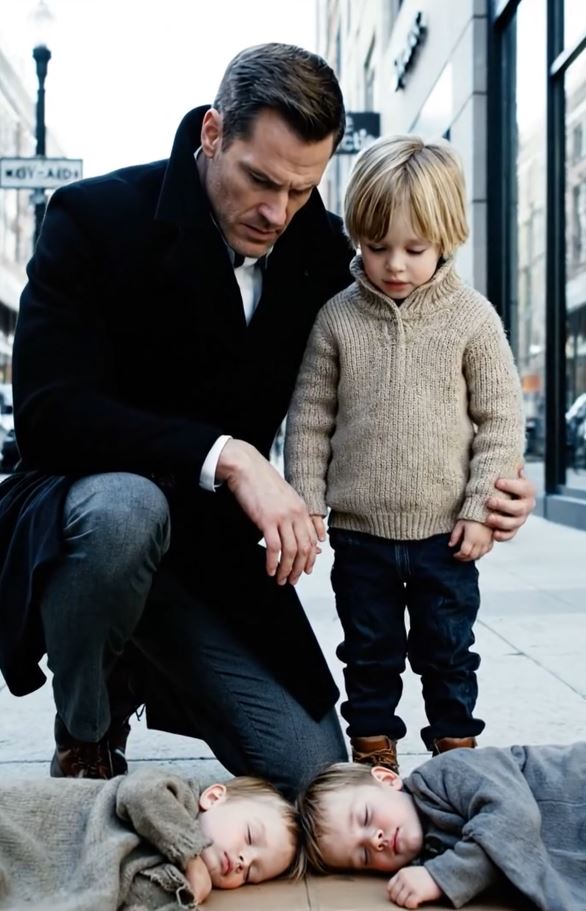
“Dad,” Leo whispered, his small finger pressing against the cold glass of the backseat window.
I glanced in the rearview mirror, annoyed. We were lost. A wrong turn had funneled us off the manicured boulevard and into a street of cracked pavement and shuttered storefronts.
“Those boys,” he said, his voice barely audible. “They look like me.”
I followed his gaze to an alley. Two kids were curled together on a stained mattress, their small forms barely visible in the long afternoon shadow. A trick of the light. A child’s imagination.
“Don’t be silly,” I said, looking for a place to turn the car around. “They don’t look anything like you.”
The click of his seatbelt buckle was like a gunshot in the quiet car.
Before I could react, he had the door open and was running. A flash of his blue jacket against the gray concrete, then he was gone, swallowed by the alley.
My heart seized in my chest. I threw the car in park, the engine still running, and sprinted after him. My expensive shoes scraped against the gritty asphalt.
I found him kneeling beside the mattress. He wasn’t touching the sleeping boys, just staring, his head tilted like he was trying to solve an impossible puzzle.
“Leo, we have to go. Now.” My hand was on his shoulder, ready to pull him away.
He didn’t move. He just looked up at me, his own face pale with confusion.
“But Dad,” he whispered, his eyes welling up. “Why do they have my nose?”
And then I saw it.
I knelt, the damp cold of the ground seeping through the knee of my slacks. The boy closest to us had the exact same nose. The same faint, almost invisible dimple in his chin. The same dark sweep of hair over his forehead.
It was my son’s face, just thinner. Hungrier.
A cold dread, heavy and metallic, settled in my stomach.
Then, the other boy stirred. He blinked, his eyelids fluttering open against the harsh light.
His eyes found mine.
They weren’t blue like Leo’s. They were a familiar, honey-brown.
They were my eyes.
And in their exhausted depths, I saw the ghost of a woman I hadn’t let myself think about in ten years. The bill for a debt I had convinced myself I’d never have to pay.
Her name was Sarah.
The world narrowed to the space between my hammering heart and the boy’s terrified face. The city noise, the hum of my car’s engine, it all faded into a distant roar.
The boy with my eyes, who couldn’t be more than nine, scrambled backward, pulling the younger one behind him. He was a protector.
“Stay back,” he rasped, his voice raw and thin.
Leo, my sweet, sheltered Leo, didn’t see the fear. He only saw the resemblance that had captivated him.
He reached into his jacket pocket and pulled out a half-eaten chocolate bar, still in its wrapper.
“Are you hungry?” he asked, holding it out. “We can share.”
The protective boy’s eyes flickered to the chocolate, then back to me, his gaze full of suspicion. He didn’t trust me, and he had no reason to.
“Leo, get back in the car,” I said, my voice strained.
But he didn’t listen. He just stayed there, a little boy offering a peace treaty of sugar and cocoa.
I had to do something. I couldn’t just leave them here. I couldn’t unsee my own features staring back at me from the dirt of an alley.
I raised my hands slowly, like I was approaching a frightened animal.
“I’m not going to hurt you,” I said, my voice softer than I intended.
The older boy flinched.
“My name is Arthur,” I said, realizing I’d never had to introduce myself to my own children. The absurdity of it was a physical blow. “This is my son, Leo.”
The boy with Leo’s face peeked out from behind his brother. His eyes were wide with a mix of fear and curiosity.
“I’m Finn,” the older one said, his chin held high despite the tremor in his voice. “This is Caleb.”
Finn and Caleb. My sons. The names were unfamiliar, yet they felt like they should have been on the tip of my tongue for a decade.
“Where is your… where is your mother?” I asked, the word catching in my throat.
Finn’s face hardened. “She’s gone.”
Gone where? Gone for the day? Or gone for good? The ambiguity was a special kind of torment.
“We can help,” I said, the words feeling hollow and inadequate. “You can come with us. We have food. A warm place to sleep.”
Finn shook his head fiercely. “We don’t go with strangers.”
He was smart. He’d been taught well. By Sarah.
My heart ached with a pain that was ten years old. Sarah, who loved art museums and laughed so hard she snorted. Sarah, who I’d left with a short, brutal letter and a check I thought would absolve me of everything.
“I’m not a stranger,” I said, the truth of it landing like a stone in the alley. “I knew your mother. Her name was Sarah.”
Finn’s tough exterior cracked. Just for a second. A flicker of disbelief, of a desperate, childish hope, crossed his face before he stamped it out.
“You’re lying,” he spat, but there was no venom in it. Only fear.
Leo, my beautiful, innocent boy, saved me. He walked right up to Caleb and gently placed the chocolate bar in his small, grimy hand.
Caleb looked at Finn for permission. Finn hesitated, then gave a tiny, almost imperceptible nod. Caleb unwrapped the bar and broke off a piece, handing it back to Leo before taking a bite himself.
That single act of sharing, of simple kindness, shattered the tension.
I looked at Finn. “Please,” I said, and the word was stripped of all my usual power and authority. It was just a plea. “Let me help you. For her.”
He stared at me for a long time, his brown eyes—my brown eyes—searching my face for the lie. Maybe he found something else instead. Maybe he found a truth he was too young to understand.
He finally nodded, a jerky, reluctant movement.
The walk back to the car was the longest of my life. Leo held Caleb’s hand. Finn walked close to me, but not too close, a wary satellite in my orbit.
I put them in the backseat, buckling them in myself. Their clothes were thin and smelled of damp earth and city grime. I could feel the sharp angles of their bones through the fabric.
I drove away from that alley, but I knew, with a certainty that chilled me to my core, that I could never truly leave it behind.
The drive home was a silent film of disbelief. I’d glance in the rearview mirror and see three boys where there was supposed to be one. Two of them were reflections of a past I had meticulously buried.
Leo, oblivious to the earthquake that had just ripped through my life, chattered away. He pointed out landmarks, asked Caleb if he liked video games, and told Finn the names of all his stuffed animals.
Finn and Caleb said nothing. They just stared out the window at the manicured lawns and towering houses of my neighborhood, their world expanding and contracting with every turn.
We pulled into the sweeping driveway of my home. It wasn’t a home, really. It was a monument to my success. A cold, glass-and-steel structure that my wife, Katherine, had decorated with minimalist precision.
It had never felt less like a home than it did right now.
Katherine was standing at the front door, arms crossed, a perfect silhouette against the floor-to-ceiling windows. Her expression was one of mild annoyance, which quickly morphed into confusion as I opened the back doors.
“Arthur? What’s going on? Who are these children?”
I had no script for this. No carefully prepared speech.
“Katherine,” I started, my voice failing me. “We need to talk.”
I led the three boys inside. Finn and Caleb froze in the cavernous entryway, their eyes wide as they took in the marble floors and the grand, floating staircase. Caleb instinctively reached for Finn’s hand.
Katherine’s gaze fell on Finn’s face, then on Caleb’s, then back to Leo, who was standing beside them. I saw the moment she understood. The same dawning horror I had felt in the alley bloomed on her face.
“Arthur,” she whispered, her voice tight with a pain that I had single-handedly caused. “Tell me this isn’t what it looks like.”
But it was. It was exactly what it looked like.
Later that night, after the boys had been given a hot bath, dressed in some of Leo’s clothes, and fed more food than they had probably seen in weeks, they fell asleep together in the guest room, huddled on one side of the king-sized bed as if it were a small mattress in an alley.
Katherine and I sat in the sterile living room, a chasm of silence between us.
“Ten years ago,” I began, the words tasting like ash. “Before I met you. Her name was Sarah.”
I told her everything. The passionate, whirlwind romance. The ambition that drove me to see her as a liability when my career started to take off. The brutal way I ended it. I’d given her money, told myself she’d be fine, and walked away to build my empire. To build this life with Katherine.
“Did you know?” she asked, her voice hollow. “Did you know she was pregnant?”
“No,” I said, the truth a pathetic defense. “I swear to you, Katherine, I never knew. I never would have left if I’d known.”
“Wouldn’t you?” she asked, and her question hung in the air, sharp and painful. A decade ago, maybe I would have. That younger version of myself was a stranger to me now, a ruthless ghost I didn’t want to recognize.
The days that followed were a fragile truce. Katherine was distant but not cruel. She made sure the boys had everything they needed, treating them with a gentle formality that kept them at arm’s length.
I hired a private investigator, a discreet man named Miller. His task was simple: find Sarah. I needed to know what happened. I needed to understand how her sons, my sons, ended up alone on the street.
While Miller searched, I tried to build a bridge to the children I never knew. It was clumsy work. I was used to mergers and acquisitions, not bedtime stories and scraped knees.
Finn remained wary, his eyes always on me, judging. He was the keeper of their story, and he wasn’t ready to share it.
Caleb was quieter, a little shadow who followed Leo around, mesmerized by a world of toys and limitless snacks.
One evening, I found Finn sitting alone by the pool, staring at his reflection in the water.
“She used to tell us about you,” he said, not looking at me.
I sat down, careful to leave space between us. “What did she say?”
“She said you were smart and worked hard,” he said, his voice flat. “She said you just didn’t know about us. She promised one day she’d find you and you’d make everything okay.”
The weight of that misplaced faith was crushing. “Why didn’t she?”
“She got sick,” he said simply. “Her head started to hurt. She forgot things. Then she couldn’t walk so good. We had to leave our apartment. A lady from the church helped us for a while, but then she moved.”
He finally turned to look at me, his brown eyes swimming with unshed tears. “I tried to take care of them. Of her and Caleb. But I’m just a kid.”
“You did a good job, Finn,” I said, my voice thick. “You did an amazing job.”
A week later, Miller called. “I found her, Mr. Sterling.”
My breath hitched. “Where is she? Is she okay?”
“She’s in a long-term care facility. St. Jude’s Hospice. Not far from where you found the boys.”
Hospice. The word was a death sentence.
“What’s wrong with her?” I asked, dreading the answer.
“Early-onset Huntington’s disease. It’s a degenerative neurological condition. According to their records, she’s been there for nearly two years. Non-verbal for the last six months.”
My world tilted on its axis. Two years. The boys had been on their own for two years.
“There’s something else,” Miller said. “Her care. It’s basic, state-funded, but someone has been making anonymous supplemental payments to the facility every month for the last two years. A small amount, wired from an untraceable account.”
“Who?” I demanded.
“I’m still working on it,” he said. “But I also found these.” He emailed me a file. It was a collection of scanned letters.
They were all addressed to my old office. They were all from Sarah.
The first was dated ten years ago. It had a picture of a baby with my eyes. Finn. Another one a year later, with a picture of a newborn. Caleb. They were filled with her beautiful, looping handwriting, telling me about our sons, asking me to please just call. She wasn’t asking for money, just for me to know them.
I never saw them. Not a single one.
“Someone at your company intercepted these, Mr. Sterling,” Miller said. “They never made it to you.”
My blood ran cold. There was only one person with the authority and the audacity to screen my mail like that ten years ago. One person who always believed Sarah was a distraction I couldn’t afford.
My father.
I drove to his estate, the unread letters from Sarah burning a hole in my mind. He was in his study, a cavern of mahogany and leather, nursing a glass of scotch.
I threw the printed-out letters on his desk. “What is this?” I asked, my voice shaking with a rage so profound it felt like it would split me in two.
He glanced at them without a flicker of surprise. “A mistake I rectified.”
“A mistake?” I roared. “They’re my sons! You knew. You knew all this time.”
He stood up, his face a mask of cold disappointment. “I did what was necessary. That woman would have ruined you. A scandal, a child… it would have cost you the merger, the marriage to Katherine, everything we worked for.”
“So you hid my children from me?” The betrayal was so immense I could barely breathe. “You let them and their mother struggle while I lived in this… this gilded cage you built for me?”
“I took care of it,” he said, his voice dangerously calm. “I sent her money. When she got sick, I made sure she had a place to go.”
The anonymous payments. The hospice. It was him.
“You call that taking care of it?” I yelled, my control snapping. “Her sons were living in an alley! Sleeping on a discarded mattress! She is dying, and they were alone!”
“Things became complicated,” he said with a dismissive wave of his hand. “The costs of her care exceeded the discreet budget I had allocated. It was an unfortunate but manageable loss.”
Manageable loss. He was talking about my children. He was talking about the woman I once loved.
In that moment, I didn’t see my father. I saw a monster who valued balance sheets more than human lives. I saw the man I was terrifyingly close to becoming.
“Get out of my life,” I said, my voice dropping to a low, chilling whisper. “You are no longer my father. You are nothing to me. Or to my sons.”
I walked out and never looked back.
The first thing I did was have Sarah moved to the best private neurological facility in the country. I sat by her bedside for hours, holding her hand, telling her about our sons. Telling her how sorry I was. She couldn’t respond, but sometimes, I thought I saw a flicker of recognition in her eyes.
The second thing I did was go home to my wife. I told Katherine everything. About the letters, about my father’s monstrous betrayal.
She listened, and when I was done, she did something I never expected. She closed the distance between us and took my hand.
“They are your sons, Arthur,” she said, her voice firm. “Which means they are my sons now, too. We will do this together.”
And we did.
Healing was not a straight line. It was a messy, painful, beautiful process. Finn had nightmares. Caleb was terrified of being left alone. Leo, in his innocence, became their anchor, teaching them how to be kids again.
I learned to be a father three times over. I learned the specific cadence of Finn’s sarcasm when he was scared, the way Caleb’s hand fit perfectly in mine, the exact pitch of Leo’s laughter.
I sold the cold, glass house and bought a home with a sprawling backyard and a tire swing. I stepped down as CEO of my company, taking a less demanding role that allowed me to be home for dinner every night.
Sarah passed away six months later, peacefully. We were all with her. I held her hand and thanked her for our beautiful boys.
One perfect autumn afternoon, a year after that wrong turn changed everything, I was watching them from the porch. Leo was teaching Caleb how to throw a football, while Finn sat on the steps, sketching in a notepad I’d bought him. He had his mother’s artistic talent.
He looked up and caught my eye, and for the first time, he gave me a smile that wasn’t shadowed by the past. It was bright and full of hope.
I had spent my life building an empire of glass and steel, a legacy I thought would be measured in stock prices and market shares. But I was wrong. My real legacy was there in the yard, in the sound of three boys laughing. It was built not on success, but on the ruins of a terrible mistake.
The past is never as far behind us as we think. It has a way of finding us, not to punish us, but to give us a chance to finally get things right. My greatest failure had led me to my most profound purpose, proving that a life isn’t defined by the turns you miss, but by the courage you find to go back and embrace who you were always meant to be.