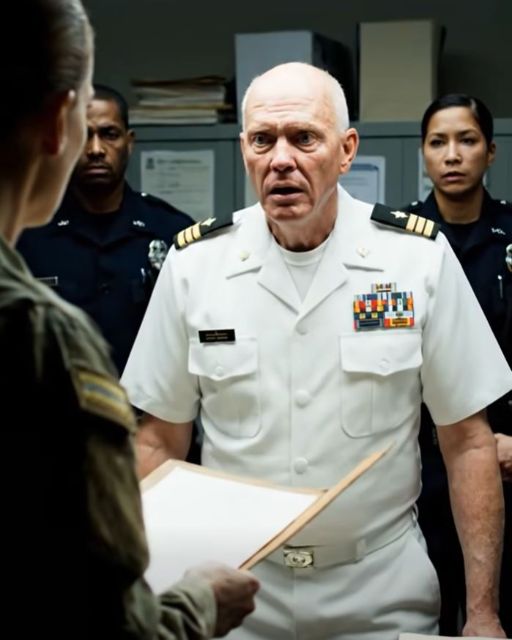
I stood by the door of the war room, holding a single manila folder. I wore plain fatigues, no rank, no medals. Just a tired face and a firm jaw. Admiral Hayes didn’t even look up from his map.
“Coffee. Black. Now,” he barked, pointing a finger at me but looking at a junior officer. “And get this woman out of my briefing. I don’t know how she got in here.”
I didn’t move. “Sir, I have orders for you.”
He finally looked at me. A slow, demeaning smile spread across his face. “Honey, the only orders you need to worry about are on the menu at the mess hall. Get out.” Two big security guys started walking toward me.
I held the folder out. “Admiral, you need to read this.”
He laughed, a loud, ugly sound that filled the room. “I don’t read anything from the secretarial pool.” He turned his back on me. “Get her out.”
The security guards each took one of my arms. I didn’t fight them. As they pulled me toward the door, I twisted my wrist and dropped the folder. It landed flat on the floor, open. Hayes glanced down, annoyed. His eyes caught the header: TOP SECRET // EYES ONLY. He froze. He bent down, snatched the paper, and his face went from red to white as he read the first line. He kept reading, his hand starting to shake, his eyes scanning down the page until he hit the authorization block at the bottom. The orders weren’t from his superior. They weren’t from the Joint Chiefs. They were a direct command, signed by the President of the United States.
The signature was a simple, familiar scrawl. It carried more weight than every piece of brass in that room combined.
The security guards let go of my arms as if they were suddenly electrified.
Admiral Hayes looked up from the paper, his face a mask of disbelief and horror. The swagger was gone. The booming confidence had evaporated, leaving behind a pale, trembling man.
“Ma’am,” he stammered, the word tasting like ash in his mouth.
I walked back to him and gently took the folder from his shaking hand. I didn’t gloat. I didn’t even smile.
“As you can see, Admiral, I am now in command of this operation,” I said, my voice quiet but carrying to every corner of the silent room. “My name is Sarah Jenkins. And I’m not here to get coffee.”
I turned to the main holographic map. “Now, if you’re done, we have a global crisis to avert.”
The room was full of high-ranking officers, men and women who had dedicated their lives to the chain of command. They looked from the Admiral, now looking small and lost, to me, a woman with no rank on her collar.
The presidential order was concise. It stripped Admiral Hayes of his authority over Project Aegis and transferred full operational command to Civilian Specialist Sarah Jenkins. Effective immediately.
“What is Project Aegis?” a young lieutenant finally dared to ask.
Hayes looked like he was going to be sick. He knew exactly what it was. It was his baby, his legacy.
I tapped a command into a nearby console, and the world map changed. It was now littered with hundreds of red dots, a deadly rash across the planet.
“Project Aegis is our next-generation drone defense network,” I explained. “It’s a constellation of one hundred and twenty satellites, each one controlling a squadron of stealth interceptor drones.”
“It’s the most advanced defense system in human history,” Hayes added, his voice a ghost of its former self. He was trying to reclaim some ground.
“And as of 0400 this morning,” I continued, ignoring him, “we lost control of it.”
A wave of murmurs rippled through the room.
“All of it,” I clarified. “Someone, or some group, has hijacked the entire network. The satellites, the drones, everything. Right now, they are holding the entire world hostage.”
The Admiral finally found his voice again, a flicker of his old arrogance returning. “The protocol is clear. If control is compromised, we initiate the ‘Firewall’ sequence. We send a kill code that fries every satellite on the network. They become space junk.”
He looked around the room, seeking nods of agreement. “It’s a drastic measure, but it’s the only safe option. We take our own pieces off the board.”
I shook my head slowly. “No, Admiral. That’s not an option.”
“It’s the only option!” he snapped.
“If we fry those satellites, we create a Kessler syndrome event,” I stated calmly. “The resulting debris field would take out hundreds of other commercial and military satellites. It would cripple global communications, banking, GPS… it would send us back to the dark ages for decades. The President does not consider that an acceptable outcome.”
I looked directly at him. “That’s why I’m here. Because my job is to find solutions that don’t involve blowing things up.”
His face darkened. The humiliation was fresh, and now I was questioning his tactical judgment in front of his entire staff.
“And what’s your brilliant plan, ‘Specialist’?” he sneered, the title dripping with sarcasm.
“My plan,” I said, turning to the junior officers, “is to get to work. I need a small team. I need your best comms tech, your sharpest network analyst, and someone who can code in five different languages. I don’t need soldiers. I need puzzle solvers.”
A young man with glasses, Marcus, stepped forward tentatively. “I’m a network analyst, ma’am.”
A woman from the back raised her hand. “I handle comms.”
One by one, a small team of four specialists assembled. They were young, overlooked, the kind of people who worked in windowless rooms and were never invited to the main briefing. They were my kind of people.
“We’ll need a separate workspace,” I told Hayes. “Away from here. We need quiet.”
He grit his teeth. “Take the auxiliary command center down the hall.”
As my new team and I filed out, I heard him mutter to his second-in-command, “She’s going to get us all killed. This is a job for a warrior, not a librarian.”
In the auxiliary room, which was little more than a large closet with screens, we set up our operation. The air was thick with tension, but also a strange kind of excitement.
“Okay,” I said, rolling up my sleeves. “They bypassed our military-grade encryption. That’s nearly impossible. It means the breach wasn’t brute force. It was elegant. It was an inside job.”
Marcus pushed his glasses up his nose. “You mean a traitor?”
“Not necessarily a traitor,” I replied, staring at a waterfall of code on the main screen. “Maybe just someone who knew the system too well. Someone who built it.”
For the next ten hours, we worked. We traced phantom signals, unraveled layers of malicious code, and drank pot after pot of stale coffee. We were looking for a digital fingerprint, a signature style in the code that could tell us who our ghost was.
Hayes checked in twice. He’d stand in the doorway, arms crossed, radiating impatience.
“Any progress, Jenkins?” he’d ask, his tone suggesting he already knew the answer. “Or are you still just looking at pretty colors on a screen? The clock is ticking.”
I’d just nod and say, “We’re working on it, Admiral.”
Then, late into the night, Marcus shouted. “I’ve got it! I’ve got a recursion loop here that’s… weird. It’s not like any hostile code I’ve ever seen. It’s almost… playful.”
I rushed over to his screen. I saw it immediately. The structure, the syntax, the sheer, arrogant brilliance of it. It was a signature I knew all too well.
My blood ran cold. “It’s him,” I whispered.
“Who’s him?” a comms tech asked.
“Dr. Alistair Finch,” I said. My voice was heavy. “He was the lead architect of the Aegis control system. The most brilliant programmer I’ve ever met. And the most unstable.”
I had worked with Alistair five years ago, during the early development phase. He saw code as poetry. He saw the Aegis network as his masterpiece. But he was volatile, paranoid, and impossible to work with. He was eventually forced out after a series of bitter disputes with the military leadership, including a particularly nasty public shouting match with a then-Captain Hayes.
They had taken his life’s work away from him. And now, he was taking it back.
This wasn’t an act of war from a foreign nation. This was an act of revenge from a broken man.
This changed everything.
I immediately went to the main war room. Hayes was pacing, his face grim.
“I know who’s behind this,” I announced.
He stopped. “Who? The Russians? The Chinese?”
“Dr. Alistair Finch,” I said.
Hayes’s face contorted with a mix of recognition and rage. “Finch? That lunatic? I knew he was a security risk. I told them!”
“He’s not a state actor, Admiral. He’s a disgruntled employee. We can’t treat this like a military engagement. We need to de-escalate. We need to talk to him.”
Hayes threw his hands up in disgust. “Talk to him? He’s a terrorist! He has a gun to the world’s head, and you want to negotiate? We need to launch the Firewall sequence now, before he does something catastrophic!”
“And I told you, that’s not an option!” I shot back, my voice rising for the first time. “Alistair is brilliant, but he’s also proud. If we try to use force, he’ll lash out. He’s probably built a dozen dead man’s switches into the system. Attacking him will trigger the very disaster we’re trying to prevent.”
“It’s a risk I’m willing to take,” Hayes said, his jaw set.
“But the President isn’t,” I reminded him. “My orders stand. I’m handling this my way.”
I turned and walked out, leaving him fuming. I knew in my gut he wasn’t going to let this go. His ego was too bruised. He couldn’t stand the idea of me, the “coffee girl,” being right.
Back in my command center, I instructed my team. “Find him. I don’t care how. Track his digital trail, find his last known address, check his financials. I need to get him on a line.”
While they worked, a new message appeared on our screens. It wasn’t code. It was a simple line of text, broadcast across the secure network.
“I see you, Sarah.”
My heart pounded in my chest. He knew I was here. This was a direct message.
Another line appeared. “Did they send you to clean up their mess? They always did appreciate your tidiness.”
He was toying with me. He was enjoying this.
“Alistair, it’s me,” I typed back, my fingers flying across the keyboard. “This has to stop. People could get hurt.”
“People are already hurt!” his reply flashed instantly. “They stole my work. They cast me out. And that butcher Hayes called my creation a ‘blunt instrument.’ It’s a symphony! And now, I am the conductor.”
Suddenly, the red dots on the global map began to shift. The drones were moving into new formations, aligning over major population centers. London. Tokyo. New York.
He wasn’t just holding a gun to the world’s head. He was cocking the hammer.
Meanwhile, in the war room, Admiral Hayes was making a call. He bypassed the official channels, using a private, encrypted line to an old friend at the Pentagon.
“Thorne, it’s Hayes. We have a situation here. The White House has put a civilian in charge, some analyst named Jenkins. She’s talking to the terrorist. She’s going to get us all killed. I’m requesting override authority to initiate Firewall. It’s the only way.”
His friend, General Thorne, was hesitant. “The President’s orders were explicit, Bill. She’s in command.”
“The President isn’t here!” Hayes roared into the phone. “He doesn’t see these drones moving over our cities! I have to act. I’m invoking the War Powers Resolution, Article Four. Imminent threat.”
It was a desperate, borderline treasonous move, twisting the law to suit his needs. But he was scared, and his pride was on the line.
He slammed the phone down and turned to his loyal second-in-command. “Prepare to launch the Firewall sequence. On my mark.”
My comms tech’s voice was tight with fear. “Ma’am, I’m picking up a massive power surge from the main command deck. They’re spooling up the Firewall protocol.”
I swore under my breath. “He’s going behind my back.”
I typed furiously to Alistair. “Alistair, listen to me. Hayes is trying to force you out. He’s going to try and fry the system. You have to know it’s a trap.”
His reply was chilling. “Oh, I know. I built the trap myself.”
On the main screen in the war room, a large red button flashed. “Firewall Ready.”
“Launch it,” Hayes commanded.
His officer hesitated. “Sir, Specialist Jenkins – ”
“I am in command here! Launch it now!”
The officer pressed the button.
For a second, nothing happened. A tense silence filled both rooms.
Then, every screen went blood red. A new message appeared, in huge, block letters.
“CHECKMATE.”
On the global map, the drones over the major cities stopped moving. Instead, their targeting lasers activated, painting bright red circles on the downtown cores below. A countdown timer appeared in the corner of every screen.
Fifteen minutes.
My blood turned to ice. It wasn’t a dead man’s switch. It was a mousetrap. Hayes’s attempt to fry the system was the trigger. It was the final command Alistair needed to arm the drones’ weapons systems.
Hayes had just handed him the keys to the apocalypse.
In the war room, panic erupted. Officers were shouting, running back and forth. Hayes just stood there, staring at the screen, the color drained from his face. He had failed. In his arrogant attempt to be the hero, he had become the villain.
I had to block it all out. “Marcus, get me a secure voice channel to Alistair’s source terminal. Now!” I commanded.
“He’s bounced the signal through a dozen servers,” Marcus said, his hands a blur on the keyboard.
“Then un-bounce them!” I yelled. “Thirteen minutes!”
The countdown ticked down. Twelve minutes. Eleven. The world’s governments were starting to notice. Panic was spreading.
“Got him!” Marcus shouted. “Channel open!”
I put on a headset. “Alistair? Alistair, can you hear me?”
Only static.
“Alistair, it’s Sarah. Please, talk to me.”
“There’s nothing left to talk about,” his voice crackled through, distorted and full of pain. “He pushed the button. The old dinosaur did exactly what I knew he would. They never listen to the smart people, do they, Sarah?”
“Ten minutes, Alistair! You have to stop this.”
“Why should I? They took everything from me. Now I’m taking it all back. An eye for an eye.”
I closed my eyes, trying to think. Arguing was pointless. Pleading was pointless. I had to get inside his head. I had to remember the man I worked with, not the monster on the screen.
“I read your paper,” I said softly. “The one you published after they fired you. On decentralized network harmony.”
There was a pause on his end. “No one read that.”
“I did,” I said. “It was brilliant. You wrote that a truly perfect system isn’t a weapon. It’s a shield. It protects. It doesn’t destroy. You called it a symphony of protection.”
“They wanted a club,” he spat. “Hayes called my symphony a club.”
“I know,” I said, my voice gentle. “And he was wrong. What you built was beautiful, Alistair. It’s the most elegant piece of code I have ever seen. And you’re using it to break things. It’s like using a Stradivarius to chop firewood.”
The countdown showed six minutes. My team was staring at me, their faces pale.
“Don’t you see, Alistair? If you do this, you prove him right. You prove you only built a weapon. Your legacy won’t be the symphony. It will be the silence that comes after.”
The static on the line was the only sound for a long, agonizing moment.
“He humiliated me,” Alistair whispered, his voice finally cracking.
“I know,” I said. “And look at him now. He’s a broken man in a room full of people who just saw him fail on a global scale. He’s already finished. You don’t need to kill millions of people to win. You’ve already won.”
Three minutes.
“What do I do, Sarah?” he asked, his voice small, like a lost child’s.
“You wrote the code, Alistair. There’s always a back door. Give me the abort sequence.”
Two minutes.
“It’s not that simple. It will…” He trailed off.
“It will what?” I pressed.
“It will pinpoint my exact physical location. They’ll find me.”
One minute. The drones began to hum, a low, murderous sound that could be heard in the streets below.
“They’ll find you anyway, Alistair,” I said. “This is your one chance. Help me save them. Be the man who built the shield. Not the man who broke the world.”
Thirty seconds.
A string of code appeared in my private message window. The abort sequence.
“Marcus, now!” I screamed.
Marcus’s fingers flew. He pasted the code into the command line and hit enter.
The screens flashed from red to green. The countdown timer vanished. The targeting lasers went dark.
On the global map, every single red dot blinked once, and then turned a peaceful blue.
The Aegis network was secure. It was over.
In the auxiliary room, my team collapsed into their chairs, a wave of relief washing over them. I took off my headset, my hand shaking so hard I could barely hold it.
I walked back into the main war room. It was deathly quiet. Admiral Hayes was standing exactly where I’d left him, looking at the blue map. He looked a hundred years old.
On the main viewscreen, a new face appeared. A stern man with four stars on his collar. General Thorne. His voice boomed through the speakers, cold as ice.
“Admiral Hayes. I have the President on the line. I believe, after your catastrophic failure to follow a direct order, that your service is hereby concluded. The Shore Patrol will escort you from the premises. You are relieved of command. Effective immediately.”
Hayes didn’t say a word. He just deflated, all the air going out of him. The two security guards who had tried to remove me earlier now walked up to him and quietly, respectfully, led him away. His career, his legacy, all of it, gone in an instant.
General Thorne’s face turned to me. I was just a small figure on their camera feed.
“Specialist Jenkins,” he said, and for the first time, his voice held a note of genuine respect. “The President would like a word.”
Later that night, long after the teams had come in to clean up the mess and Alistair Finch was taken quietly into custody, I sat alone in the now-empty auxiliary room. I was just a woman in fatigues again. Anonymous.
My work wasn’t the kind that came with medals or parades. It was the quiet, unseen work of preventing disasters, of cleaning up the messes made by louder, more arrogant people.
True strength, I realized, wasn’t about the rank on your collar or the volume of your voice. It wasn’t about barking orders or demanding coffee. It was about quiet competence. It was about seeing the person, not just the problem. It was about understanding that sometimes, the best way to defuse a bomb is to talk to the man who built it.
My victory wasn’t loud or celebrated, but it was real. It was in the silent, sleeping cities that would wake up to a normal day, never knowing how close they came to the end. And for me, that was more rewarding than any medal they could ever pin on a uniform.