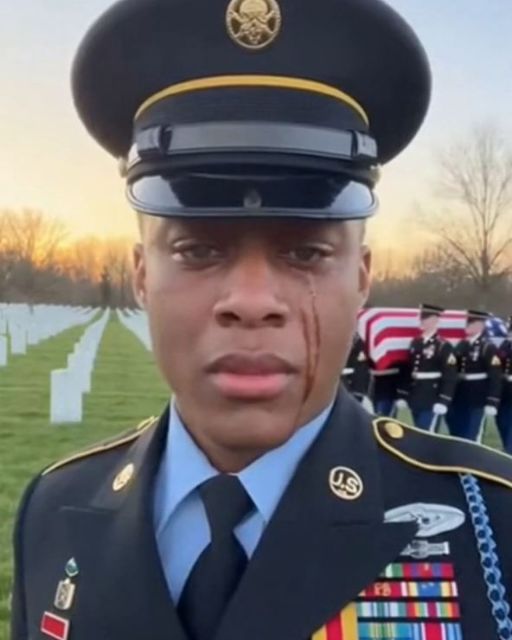
He was crying harder than anyone, even the family. Sergeant Jeremy stood over the casket of his best friend, his shoulders shaking with gut-wrenching sobs. They’d served two tours together. Inseparable. Everyone knew Jeremy was taking it the hardest.
The widow, Christine, walked over to him after the 21-gun salute. She was a pillar of strength, not a single tear on her face. We all thought she was going to comfort him, to share in the grief for her fallen husband.
But she didn’t hug him. She leaned in close, her lips almost touching his ear.
I saw Jeremy’s whole body go rigid. His sobbing stopped cold. The color drained from his face, and the grief was replaced by sheer, animal terror.
She pulled back, her eyes like ice, and said just loud enough for me to hear, “I know you were supposed to be watching his back. Now he’s in a box.”
My name is Corporal David Peterson. Mark, the man in the casket, was my squad leader. Jeremy was his number two. They were legends to guys like me.
What Christine said was brutal, but it made a twisted kind of sense. She was a grieving widow, lashing out. Survivor’s guilt was a heavy burden, and she was just piling more onto Jeremy’s shoulders.
But his reaction… it wasn’t guilt. It was fear.
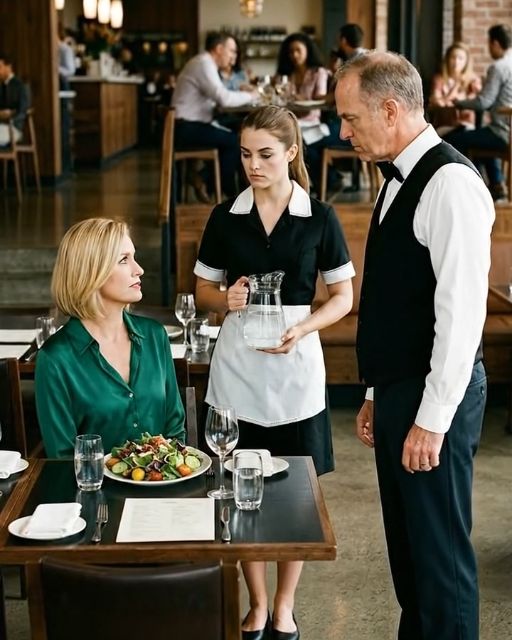
The reception was held at their small off-base house. It was filled with uniforms, quiet murmurs, and the smell of catered food nobody wanted to eat.
Jeremy was in a corner, nursing a single beer, staring at nothing. He looked like a ghost. I’d never seen him so broken, not even in the worst firefights.
I walked over to him. “Sarge? You holding up?”
He flinched, his eyes darting to mine. They were wide, panicked. “Leave it, Peterson.”
“We’re all torn up about Mark,” I said, trying to offer an olive branch. “It was a freak accident. Nobody could’ve…”
“You don’t know anything,” he snapped, his voice a harsh whisper. He pushed past me and headed for the back door, disappearing into the yard.
I watched him go, a cold knot tightening in my stomach. The official report on Mark’s death was clean, clinical. A catastrophic equipment malfunction during a routine training exercise in the motor pool.
A hydraulic lift failed. Mark was crushed. It was instant, they said. Painless. A one-in-a-million tragedy.
Jeremy had been the one to find him. His screams had brought half the base running.
Christine was standing by the fireplace, accepting condolences with a grace that seemed superhuman. Her eyes met mine from across the room. There was no grief in them. There was only fire.
A week passed. Life on base tried to return to normal, but it couldn’t. The empty bunk in the barracks was a constant reminder. Mark’s absence was a hole that couldn’t be filled.
Jeremy was a wreck. He was drinking heavily, snapping at the junior guys, missing formations. The command was giving him a long leash, chalking it up to grief.
But I knew better. I saw him on the training grounds, his hands shaking so badly he couldn’t zero his rifle. I saw him staring over his shoulder as if someone was following him.
This wasn’t grief. This was a man being haunted.
One evening, I found him behind the barracks, smoking a cigarette down to the filter. “Jeremy,” I said softly. “You need to talk to someone. The chaplain, maybe?”
He laughed, a bitter, hollow sound. “The chaplain can’t help me.”
“Then what’s going on?” I pressed. “What did Christine say to you? It was more than what I heard, wasn’t it?”
His head snapped up. “You heard that?”
“I was right there,” I admitted. “I heard what she said about you not watching his back.”
He seemed to deflate, a fraction of the tension leaving his shoulders. “That’s all it was, Peterson. Just a widow looking for someone to blame.”
It was a lie. I knew it was a lie, and he knew I knew. We stood there in an awkward silence, the lie hanging in the air between us.
The next day, Christine called me. I was surprised she even had my number.
“Corporal Peterson? This is Christine. Mark’s wife.” Her voice was steady, businesslike.
“Ma’am,” I said, standing a little straighter out of habit. “I’m so sorry for your loss.”
“Thank you,” she said, cutting through the pleasantry. “I need your help with something. It’s about Mark.”
We met at a coffee shop in town. She looked tired, the strength she’d shown at the funeral replaced by a raw, weary determination.
She got right to the point. “The official story is a lie.”
I shifted in my seat. “Ma’am, the investigation was thorough. It was faulty equipment.”
“No,” she said, her voice dropping. “It was Jeremy.”
The air went out of my lungs. “What? No. They were brothers. Jeremy would die for Mark.”
“I think he did die for Mark,” she corrected, her eyes locking onto mine. “And I think Jeremy is the reason why.”
She explained that for months before his death, Mark had been worried. He was losing sleep, constantly looking over his shoulder. He’d become secretive.
“He told me he’d stumbled onto something,” Christine said. “Something bad happening on base. He said he was gathering proof.”
My mind raced. Something bad? On our base? It seemed impossible.
“He said someone he trusted was involved,” she continued, her voice trembling for the first time. “Someone he considered a brother.”
The word hung in the air. Brother.
“Jeremy was with him at the motor pool,” she said. “The report says he was the first on the scene. I don’t believe that. I believe he was there when it happened.”
It was a monstrous accusation. Jeremy? Harm Mark? It was like accusing the sun of being cold. It didn’t compute.
“Do you have any proof?” I asked, my voice barely a whisper.
She slid a small, worn notebook across the table. It was Mark’s. I recognized his blocky, neat handwriting.
“He kept notes in here,” she said. “It’s all in code, things I don’t understand. Military jargon. Part numbers. Dates.”
I opened it. It was a ledger of sorts. Lists of serial numbers for sensitive equipment, like night vision goggles and advanced radio gear. Next to many of them were dates and question marks.
“He thought someone was stealing gear,” I murmured, the pieces starting to click together in a horrible way. “Selling it on the black market.”
“And the day before he died,” Christine said, her voice cracking. “He wrote one name. Jeremy.”
My blood ran cold. It was right there, on the last written page. Just his name. Nothing else.
“I don’t know what to do,” she confessed. “If I go to the command with this, they’ll say I’m a hysterical, grieving widow. They’ll protect their own. They’ll protect Jeremy.”
She was right. An unsubstantiated claim against a decorated Sergeant? It would be buried in paperwork.
“What do you want from me?” I asked.
“Mark trusted you,” she said. “He mentioned you in his letters. He said you were smart, that you paid attention to details. Help me find the truth, David. For Mark.”
I didn’t want to believe it. But the image of Jeremy’s terrified face at the funeral was burned into my mind. It wasn’t the face of a grieving friend. It was the face of a man with a damning secret.
I agreed to help.
I started asking questions, subtly at first. I talked to the guys in the motor pool, the supply clerks, anyone who might have seen something.
Most of them just repeated the official story. Tragic accident. Faulty lift.
But one mechanic, a private named Miller, seemed nervous. When I brought up the accident, he refused to meet my eye.
“I just check the engines,” he mumbled. “I don’t know anything about the lifts.”
I pressed him a little, asking about inventory checks. He got defensive. “Look, man, I just do what I’m told. Sergeant Jeremy signs off on the quarterly inventory. It’s all above board.”
Jeremy. Of course. As Mark’s second-in-command, he’d have access to the supply logs. He could alter the records, cover his tracks.
The next piece of the puzzle came from Christine. She’d been tearing her house apart, looking for anything Mark might have hidden.
In a hollowed-out book on his shelf, she found a small thumb drive.
She didn’t have a computer, so she brought it to my apartment. My hands shook as I plugged it into my laptop.
There was only one file on it. A voice memo. The file was dated the day of Mark’s death.
I clicked play.
Mark’s voice filled the room, and Christine let out a small gasp. It was a punch to the gut, hearing him again.
The recording was staticky, full of background noise from the motor pool.
“…told you to stop, Jeremy,” Mark was saying, his voice low and tense. “This has gone too far. We’re talking about millions in stolen gear. People could get killed with this equipment.”
A second voice replied, distorted but unmistakable. It was Jeremy. “You don’t understand, Mark. I’m in too deep. These guys… they’re not people you just walk away from.”
“Then we go to the CID,” Mark pleaded. “We tell them everything. They’ll protect you. You’re a good soldier, Jeremy. You just made a bad mistake.”
There was a scuffle, a grunt of effort. “I can’t!” Jeremy yelled. “They’ll send me to prison for twenty years! My life will be over! Just walk away, Mark. For me. For old times’ sake. Pretend you never saw the logs.”
“I can’t do that,” Mark’s voice was firm. “I took an oath. And I won’t let you throw your life away like this. We’re going to fix this, you and me. Right now.”
There was a long pause. Then the sound of a heavy metal clang, followed by a sickening crunch.
A gasp.
“Oh God,” Jeremy’s voice was a choked sob. “Mark? Mark! No, no, no…”
The recording ended.
Christine and I sat in stunned silence. Tears were streaming down her face, but she made no sound.
So that was the truth. It wasn’t premeditated murder. It was an argument. A terrible, tragic accident born from a criminal secret. Mark had confronted his friend, tried to save him, and in the ensuing struggle, the lift had been triggered.
Jeremy hadn’t killed his best friend. But he had let him die. He had panicked, covered it up, and let the world believe it was a simple accident.
His gut-wrenching sobs at the funeral were real. They were the sobs of a man drowning in a guilt so profound it was eating him alive.
Christine finally spoke, her voice a hollow shell. “What he whispered to you… at the funeral… it wasn’t just about watching his back, was it?”
I finally understood the real source of Jeremy’s terror.
“No,” I said quietly. “After she accused him, I saw her whisper something else. I couldn’t make it out then. But now I think I know.”
Christine looked at me, her eyes begging for the final piece.
“I think she must have whispered, ‘He told me everything.’”
That was it. Jeremy didn’t know what Mark had told her. He didn’t know about the voice memo. He just knew that his best friend’s wife was looking at him with eyes that said she knew his secret. He assumed Mark had confessed everything to her before he died.
His terror wasn’t just from being discovered. It was from being confronted by the woman whose life he had shattered.
The next day, we made our move. We didn’t go to the command. Christine was right; they would protect their own, and the recording could be argued away.
We went straight to Jeremy.
We found him in the empty barracks, sitting on his bunk, staring at a picture of him and Mark, arms thrown around each other’s shoulders, grinning in the desert sun.
He looked up as we entered. He saw the thumb drive in my hand, and all the fight went out of him. He knew.
“Christine,” he whispered, his voice cracking. “I am so sorry.”
“Sorry doesn’t bring him back,” she said, her voice surprisingly soft. There was no rage left, only a vast, empty sadness.
“I know,” he sobbed, the tears finally coming. “He was trying to help me. He was trying to save me from myself, and I… I panicked. I never meant for it to happen. I swear I didn’t.”
I placed the thumb drive on the bunk beside him. “The recording tells the whole story, Jeremy. The argument. The accident.”
He nodded, not even looking at it. “I was going to tell everyone. After Mark… after he fell… I was going to call for help. But then I looked down, and I knew how it would look. I knew about the stolen gear… they’d say I killed him to shut him up. So I ran. I just… ran and screamed. And I let them believe the lie.”
He looked at Christine, his eyes pleading. “Every day since… it’s like I’m buried with him. The guilt… it’s heavier than any rucksack.”
“Then it’s time to put it down,” Christine said.
And here came the real twist. It wasn’t one of vengeance, but one of quiet, heartbreaking grace.
“You are going to walk into the commander’s office,” Christine said, her voice finding a new strength. “You are going to tell them everything. About the theft ring, the names of the men you were working with, everything. And you’re going to tell them what happened to Mark.”
Jeremy stared at her, confused. “They’ll send me to prison.”
“Yes,” she said. “But Mark died trying to get you to do the right thing. He died believing you were still a good soldier underneath it all. Don’t let his last act be for nothing. Honor him. Tell the truth.”
It was the last thing I expected. Not a demand for punishment, but a plea for redemption. A chance for Jeremy to finally become the man his best friend always believed he could be.
Something shifted in Jeremy’s eyes. The fear was replaced by a flicker of something I hadn’t seen in weeks: resolve.
He stood up, squared his shoulders, and gave the cleanest salute I had ever seen. It wasn’t to me, or even to Christine. It was to the memory of his friend.
He turned himself in that afternoon. His confession blew the lid off the entire theft operation. Two senior NCOs and a civilian contractor were arrested. The base was turned upside down.
Jeremy was dishonorably discharged and sentenced to seven years in a military prison for involuntary manslaughter and his role in the thefts.
It wasn’t a happy ending. But it was a right one.
Christine was finally able to grieve. The truth, as horrible as it was, set her free. She knew her husband died a hero, not a victim of random chance. He died trying to save his friend’s soul.
Sometimes, the heaviest burdens we carry are the secrets we keep to protect ourselves. We think we are building walls, but we are actually building prisons. The truth, no matter how painful, is the only key that can ever set you free. It might not erase the past, but it allows you to finally face the future, unburdened and at peace. For Jeremy, prison was a consequence, but confession was his salvation. And for Mark, it was the justice and honor he deserved.