Principal Thompson had the conversation on autopilot. Kaden, the star quarterback’s son, had cornered another student, Leo, by the lockers. Again. Kaden’s father was a major donor. Thompson knew how this would end: a stern warning for Kaden and a hushed apology to Leo’s parents. It was a dance he hated.
That’s when he heard the rumble.
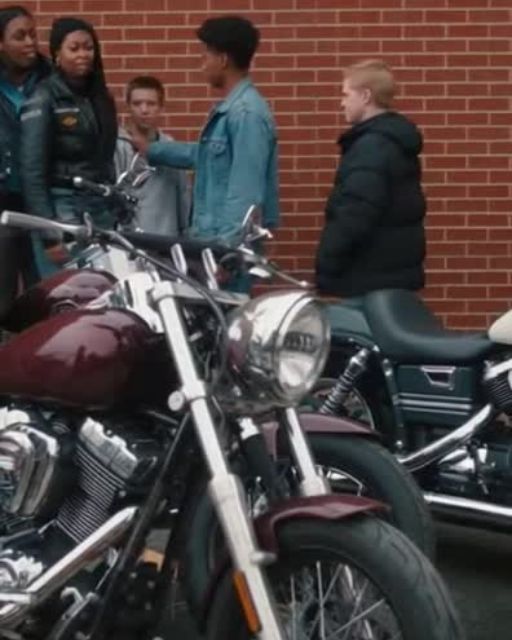
It started low, a vibration in his office window, then grew into a ground-shaking roar. He looked out to see six motorcycles—big, loud, chrome-heavy machines—pulling into the faculty parking lot with military precision. They parked in a perfect line, blocking in his Prius.
Thompson’s heart hammered against his ribs. He walked quickly to the front entrance, his mind racing through emergency protocols.
The bikers dismounted in unison. They were older, all leather and patches, with the kind of faces that told stories you didn’t want to hear. They moved as one, walking past the manicured hedges and straight towards the courtyard where Kaden was still holding court, laughing with his friends over a terrified Leo.
The lead biker, a mountain of a man with a graying beard, didn’t even glance at the principal. His eyes were locked on the scene. Kaden’s smirk faltered as the shadows of the six men fell over him.
“Problem here?” the leader asked, his voice a low gravel.
Kaden, full of his usual arrogance, puffed out his chest. “This is none of your…”
He never finished. The lead biker calmly reached up and took off his helmet.
Principal Thompson froze. He felt the blood drain from his face. It wasn’t a random outlaw. He knew that face from the district’s ‘Distinguished Alumni’ wall. It was Arthur Graham, Class of ‘78. A decorated veteran and now, apparently, the head of a motorcycle club.
Arthur ignored the bully completely. He walked right past him and knelt beside the trembling boy on the ground.
“Leo,” Arthur Graham said, his voice suddenly gentle. “Are you okay? Did he hurt you?”
Leo just looked up, his eyes wide with disbelief, and whispered one word.
“Grandpa?”
Arthur stood up slowly. His gaze didn’t land on Kaden. It swept right past the boy and locked directly onto Principal Thompson, standing paralyzed on the steps. Then, Arthur pulled out his phone.
He didn’t dial 911. He scrolled to a single contact and pressed the call button, holding the phone to his ear.
His eyes never left Thompson’s.
“You need to get down to the high school,” Arthur said into the phone, his voice calm but carrying an undeniable weight of command. “Right now.”
There was a pause. Arthur listened, his expression unreadable stone.
“No, it can’t wait,” he said finally. “Your boy is here.”
He hung up without saying goodbye. The silence that followed was heavier than the roar of the engines had been.
Kaden, who had been momentarily stunned, found his voice again. It was shakier this time.
“You called my dad?” he sneered, trying to regain his footing. “He’s just going to get you kicked off the property.”
Arthur didn’t even look at him. He turned his attention back to his grandson.
“Let’s get you up, son.” He offered Leo a large, calloused hand.
Leo took it, still looking dazed. The other five bikers hadn’t moved a muscle. They stood like statues, a silent, leather-clad wall between the world and this one small boy. They weren’t looking at Kaden; they were watching everything else, their gazes sweeping the school grounds with a practiced vigilance.
Principal Thompson finally found his legs. He walked down the steps, forcing a professional calm he did not feel.
“Mr. Graham,” Thompson began, his voice tight. “Perhaps we can discuss this in my office.”
Arthur met his gaze. “We’ll discuss it right here, Principal. Where everyone can see.”
He gestured vaguely at the windows of the school, where dozens of students were now pressed against the glass, watching the drama unfold.
Thompson swallowed hard. This was a public relations nightmare spiraling out of his control.
Kaden’s friends, who had been laughing just minutes before, were slowly backing away, melting into the background. They wanted no part of this. Suddenly, Kaden was all alone, caught between a boy he’d tormented and a group of men who looked like they chewed nails for breakfast.
The minutes stretched on, thick with tension. Then, a sleek black sedan screeched into the parking lot, parking haphazardly next to the line of motorcycles. A man in an expensive suit, his face a mask of irritation, got out and slammed the door.
It was Robert Albright, Kaden’s father. The man whose donations had just built a new wing for the gymnasium.
“What in the world is going on here?” Albright boomed, striding towards them. “Kaden? Who are these people?”
He was looking at the bikers with disdain, his eyes scanning them as if they were a stain on the pristine school grounds. His gaze landed on Principal Thompson with pure fury.
“Thompson, I expect you to handle this! Get this riffraff off school property before I call the superintendent!”
Then, his eyes finally settled on the leader of the group. He stopped dead in his tracks.
The anger on Robert Albright’s face evaporated, replaced by a wave of disbelief so profound it seemed to steal the air from his lungs. His jaw went slack. His expensive suit suddenly looked like a cheap costume.
“Arthur?” he whispered, the name a ghost on his lips. “Arthur Graham?”
Arthur just nodded slowly, his expression unchanging. “Hello, Robert.”
Kaden looked back and forth between his father and the biker, his confusion mounting. “Dad, you know this guy?”
Robert Albright didn’t answer his son. He couldn’t seem to tear his gaze away from Arthur. It was a look of awe, of respect, and of something that looked an awful lot like fear.
“We’ll take this to your office now, Principal,” Arthur said. It wasn’t a request.
This time, Thompson just nodded numbly and led the way.
The group filed into his office: Arthur, Leo, a visibly shaken Robert Albright, and a sulking Kaden. The other five bikers remained outside, standing guard in the hallway like sentinels. Their presence filled the entire administrative wing.
Thompson closed the door, the click of the latch sounding like a gunshot in the silent room.
Robert Albright finally spoke, his voice hushed. “Arthur, what is this? What’s happened?”
Arthur didn’t sit. He stood by his grandson, one hand resting protectively on Leo’s shoulder.
“Your son, Robert,” Arthur said, his voice a low, steady rumble. “Has been making my grandson’s life a living hell for the better part of a year.”
Albright looked at Kaden, who refused to meet his eyes, choosing instead to stare at the floor.
“Is this true?” Robert asked, though the answer was already plain on his son’s face.
“He’s a nobody,” Kaden mumbled. “It was just a joke.”
Arthur’s hand tightened on Leo’s shoulder. “A joke? Shoving him into lockers? Stealing his lunch money? Tearing up his homework?”
He took a step forward, and for the first time, Robert Albright physically flinched, taking a small step back. The power dynamic in the room was so skewed it was almost dizzying. The wealthy donor was cowering. The principal was a spectator. A man in a leather vest was in complete control.
“I didn’t call you here to yell, Robert,” Arthur continued, his voice softening slightly, which was somehow more intimidating. “I called you here for a history lesson.”
He looked from Albright to Principal Thompson.
“You see, Principal, Mr. Albright and I go way back. A long way back.”
Robert Albright sank into one of the chairs opposite Thompson’s desk, looking pale.
“It was about thirty years ago,” Arthur began. “I had just gotten out of the service. I had some money saved up. Not much, but it was everything I had in the world.”
He paused, letting the words hang in the air.
“And there was this kid. A smart kid, full of ideas, with a business plan sketched out on a napkin. He had nothing. No credit, no backers, no family to help him out. Every bank in the city had laughed him out of their office.”
Arthur’s eyes bored into Robert Albright.
“But I saw something in him. I saw that fire. So I took every penny I had, my entire life savings, and I gave it to him. I co-signed the loan. I put my name and my reputation on the line for this kid.”
Principal Thompson felt a cold dread creep up his spine. He was beginning to understand.
“That kid’s business,” Arthur said, his voice dropping to a near whisper, “was the beginning of Albright Industries.”
The silence in the office was absolute. Kaden’s head snapped up, his eyes wide with shock as he stared at his father.
“I never asked for anything in return, Robert,” Arthur said, his tone laced with a profound disappointment that was sharper than any anger. “I never wanted a stake in the company. I never wanted a title. All I wanted was for you to build something good. To be a good man. To pass on that kindness.”
He gestured towards Kaden.
“And this is what you built? A boy who uses his father’s name and money to hurt other people? A boy who thinks strength is about preying on the weak?”
Robert Albright covered his face with his hands. He made a choked sound. He wasn’t the powerful CEO anymore. He was just that kid with a plan on a napkin, facing the man who had believed in him when no one else would.
“I’ve been so busy,” Robert stammered, his voice muffled. “So busy with work… I just gave him everything he wanted. I thought that was enough.”
“It’s never enough,” Arthur said sternly. “You gave him a credit card, but you didn’t give him a conscience. You gave him status, but you didn’t give him character.”
Arthur then turned his gaze to Principal Thompson, and the administrator felt himself shrink in his chair.
“And you,” Arthur said. “You let it happen. You let the money this man donated blind you to what was happening in your own hallways. You were supposed to protect all these kids. Especially kids like Leo, who don’t have a powerful father to fight their battles.”
Thompson had no defense. He knew every word was true. He had taken the easy way out, time and time again.
“Things are going to change,” Arthur announced. “Today.”
He laid out his terms, not as suggestions, but as facts.
First, Kaden would apologize. Not just to Leo, but in front of the entire student body. He would explain what he did and why it was wrong.
Second, Kaden would spend every weekend for the next six months volunteering. Not at some cushy charity gala, but at the VA center downtown. One of Arthur’s biker friends, a man named Marcus who had lost a leg in combat, ran the place. Kaden was going to clean floors, serve meals, and listen to the stories of men who understood true sacrifice.
Third, Robert Albright would make a new donation to the school. A significant one. But it wouldn’t be for the football team’s new uniforms. It would be used to establish a comprehensive anti-bullying program, run by a third-party counselor, with a zero-tolerance policy that applied to every student, regardless of who their parents were. Principal Thompson would oversee it personally.
Robert Albright looked up, his face streaked with tears. He just nodded, unable to speak.
Kaden started to protest. “That’s not fair! I’ll be a loser!”
“No,” Arthur said, his voice cutting through the boy’s whining. “You’ll be a man. It’s about time.”
The next few months transformed the school.
The assembly where Kaden Albright stood on stage and gave his apology was legendary. It was awkward and painful, but it was real. He looked Leo in the eye and said he was sorry. The entire dynamic of the school’s social hierarchy shifted on its axis that day.
Kaden’s weekends at the VA center were brutal at first. He hated it. But slowly, something changed. He heard stories of courage and loss that made his own high school problems seem laughably small. Marcus, the veteran who ran the center, was tough on him but fair. He taught Kaden that respect wasn’t something you could demand; it was something you had to earn.
Principal Thompson, for his part, felt like he had been given a second chance. He threw himself into the new anti-bullying program. He was no longer a passive administrator but an active protector of his students. He walked the halls, he talked to the quiet kids, and he made it clear that the school was a safe place for everyone. The Albright donation was just the start; he secured grants and created a culture of accountability.
One Saturday afternoon, months later, Arthur brought Leo to the VA center. They found Kaden in the recreation room, not cleaning, but playing a game of chess with an elderly veteran in a wheelchair.
Kaden looked up and saw them. For a moment, there was a flicker of the old tension. Then, he gave a small, genuine nod.
“Hey, Leo,” he said, his voice quiet.
“Hey,” Leo replied, no longer afraid.
Arthur watched the exchange, a glimmer of satisfaction in his eyes. He walked over to the table.
“How’s he doing, Charlie?” Arthur asked the man in the wheelchair.
Charlie chuckled, moving his knight. “The kid’s a terrible chess player. But he’s learning. He listens.”
Later that day, Leo was in his grandfather’s garage, surrounded by the smell of oil and old leather. He was helping Arthur polish the chrome on his motorcycle.
“Grandpa,” Leo asked, his voice soft. “Why did you help Mr. Albright all those years ago?”
Arthur stopped polishing and looked at his grandson.
“Because nobody else would,” he said simply. “Sometimes, all a person needs is for one person to believe in them. It’s a powerful thing, that belief. It can build empires or it can build a good man. I was hoping for both.”
He put his hand on Leo’s shoulder, the same way he had that day in the school courtyard.
“Strength isn’t about how hard you can hit, kid. It never has been. Real strength is about how many people you can lift up. You remember that.”
Leo nodded, understanding. He looked at his reflection in the polished chrome, and for the first time, he didn’t see a victim. He saw a boy who was loved, a boy who was safe, and a boy who was learning what it meant to be truly strong. The rumble of the motorcycle engine was no longer a scary sound. It was the sound of protection, of loyalty, and of a promise kept. It was the sound of family.