
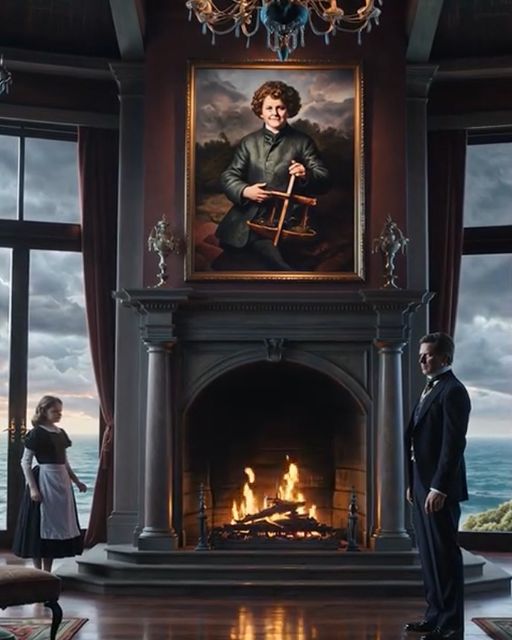
The order was simple. No one enters this wing.
Arthur Vance stood beneath the portrait, the only color in a room of grey stone and grey sea. Ten years the boy had been gone. Ten years of carving a space in his life for a ghost.
The clock on the mantel didn’t measure time. It measured absence.
Then he heard it. A soft footfall. A gasp.
The new maid. She wasn’t alone. A girl, maybe twelve, stood half-hidden behind her mother’s skirt, her eyes locked on the painting. Not on the billionaire, not on the wealth. On the face of the smiling four-year-old with his father’s hair.
“Leah,” the maid hissed, her voice a blade of panic. “I told you to wait.”
But the girl stepped forward, into the firelight.
Her voice was barely a whisper. “Sir,” she said, pointing a trembling finger. “This boy… he lived with me in the orphanage.”
The floor seemed to drop out from under him. The air thinned.
He had spent a fortune, broken men, and shattered his own soul proving that his son was gone forever. And this child, in a single sentence, built it all back up just to tear it down again.
It had to be a mistake. A cruel coincidence.
Then she started talking.
And the world began to unravel. She spoke of a big, goofy dog named Max. She knew about the seagulls on the pier he could never catch. She described a secret letter he’d left on the black iron gate of the park he was taken from, a detail the police had never released.
She said the boy wouldn’t talk to the staff, not really. But he told her his name started with an E, and that his father was coming for him. His father was rich and would find him.
Arthur’s heart hammered against his ribs.
Then came the line that stopped his breath.
“A week after he ran away, the orphanage burned down,” the girl said, her eyes wide. “They told us it was just bad wiring.”
Records gone. A history erased by smoke and ash.
He didn’t ask them to sit. He couldn’t sit himself. He moved the maid, Sarah, and her daughter into the east wing, posting guards at the door. He made a call to a man who owed him more than money.
The words felt foreign in his mouth. “Help me find my son.”
The information came back like a flood.
The fire wasn’t an accident. The fire marshal who signed off on the report retired a month later, paying cash for a condo in a quiet southern town.
The money for the payoff came from a charity. A shell corporation.
A shell corporation owned by a holding company deep inside Arthur’s own empire.
The girl, Leah, remembered one more thing. A man who visited the head nun. He wore a heavy gold ring with a dark green stone. She remembered how it caught the light when he pointed, his voice low and sharp.
Arthur felt the blood drain from his face.
He knew that ring. He’d seen it across a thousand dinner tables. On the hand of his own brother-in-law, patting his shoulder at the funeral that never was.
The drive was a blur of salt spray and roaring engine. He knew the road by heart, a path back to a life he thought was buried. To a grey beach house with a small wooden gull on the roof, spinning in the wind.
The key wouldn’t turn. He put his shoulder through the door. Wood splintered.
“Elias!”
The name, his son’s name, ripped out of him, raw and broken. It echoed through the empty rooms.
Only the sea answered.
He took the stairs two at a time, his feet remembering the path he’d once taken carrying a sleepy boy who smelled of sun and sand.
At the end of the hall, one door was open just a crack, spilling moonlight onto the floor.
A figure sat on the edge of the small bed, back to the door, staring out at the waves. Thin. Long hair hiding his face. He clutched a piece of driftwood like it was the only solid thing in the world.
Arthur stopped in the doorway, his breath caught in his throat.
The figure turned.
And ten years of silence shattered into a million pieces.
It was his face. Not the round, soft face of the four-year-old in the portrait, but a new one, sculpted by time and hardship. His wife’s eyes, the same deep, thoughtful grey, stared back at him from his own bone structure.
The boy, the young man, was fourteen.
He looked scared. He looked lost. He looked like he’d been waiting a lifetime in this one room.
“Dad?” The voice was a stranger’s, cracked and uncertain, but the word was a key that unlocked a decade of grief.
Arthur took a step. Then another. The space between them felt like an ocean.
He sank to his knees in front of his son, his composure, the iron will that built an empire, completely gone. He reached out a hand, not to touch, just to feel the air near him, to prove he was real.
“Elias,” he breathed. “It’s you.”
Elias flinched at the name but didn’t pull away. He simply watched his father with an unreadable expression.
“They called me Evan,” he said softly. “At the home.”
Arthur’s heart broke all over again. They had even stolen his name.
“How?” Arthur choked out. “How are you here?”
Elias looked down at the piece of driftwood in his hands, turning it over and over. “I ran away.”
He explained in fragmented sentences, the story tumbling out of him. He remembered the park, a man with a kind smile offering him candy. He remembered waking up in a car, far from home.
He remembered the orphanage, cold and grey. He never spoke of his real life, a small instinct telling him it was dangerous. He just told Leah, his only friend, that his father would come.
“I waited,” Elias said, his voice quiet. “Every day, I watched the gate.”
But Arthur never came. Because Arthur believed he was gone.
One night, he heard the head nun talking to the man with the green ring. They were arguing about him. The man said it was time for the boy to disappear for good.
That was the night he ran. He climbed the fence and just kept going. He lived on the streets for a while, a ghost in the city.
He saw the smoke a week later. He knew what it meant. They were burning his past, making sure he could never be found.
“How did you get here?” Arthur asked, his gaze fixed on his son. “To this house?”
“I remembered,” Elias whispered. “I remembered the bird on the roof. The sound of the waves.”
It was the only piece of his old life he could hold onto. He hitchhiked, worked odd jobs for cash, slowly making his way back to the only other home he’d ever known. He’d been living here for months, a squatter in his own memories, surviving on what he could find in the long-abandoned pantry.
“I didn’t know if you were still…” His voice trailed off.
“Alive?” Arthur finished for him. “I thought the same about you.”
A silence fell between them, thick with everything that had been lost. Arthur saw not just a rescued son, but a young man who had raised himself. A survivor.
He finally reached out and placed a hand on his son’s shoulder. The boy was real. Solid.
“Let’s go home, Elias,” Arthur said. “Let’s go home for real.”
The drive back was quiet. Elias stared out the window, watching the world he was stolen from rush by. Arthur kept glancing over, half-convinced he would vanish if he looked away for too long.
When they arrived, Sarah and Leah were waiting in the main hall, their faces etched with worry. Leah’s eyes widened when she saw Elias.
“It’s you,” she breathed.
Elias gave a small, shy smile. The first one Arthur had seen. “Hi, Leah.”
Arthur knew in that moment he owed this family everything. They weren’t just his staff anymore. They were the ones who had brought his world back from the dead.
He settled Elias into a room near his own, a room that hadn’t been touched in a decade, save for dusting. He watched his son look at the model airplanes and old storybooks, a stranger to his own childhood.
Then, Arthur did what he had to do. He made another call.
“Marcus,” he said, his voice cold as ice. “I need you to come to the house. It’s about a new investment.”
His brother-in-law, Marcus Thorne, arrived within the hour, full of false sympathy and slick smiles. He wore the ring. The heavy gold band with the dark green stone.
He walked into the study, pouring himself a drink from Arthur’s decanter without asking. “So, what’s this big opportunity, Arthur? Found a new way to double your fortune?”
Arthur didn’t answer. He just gestured to the hallway.
A moment later, Elias stepped into the doorway.
Marcus froze, the glass halfway to his lips. The color drained from his face, leaving a sickly, pale mask. The glass slipped from his fingers, shattering on the hardwood floor and spilling amber liquid like blood.
“It’s… not possible,” Marcus stammered.
“It is,” Arthur said, his voice dangerously low. “He remembered you, Marcus. He remembered your ring.”
The confession that followed was not born of remorse, but of cornered, pathetic rage. It was about jealousy. It was always about jealousy.
Marcus had resented Arthur from the day he married his sister, Eleanor. He hated Arthur’s success, his confidence, the way Eleanor looked at him. He felt like a shadow, constantly eclipsed by Arthur’s brilliance.
When Eleanor died in a car accident two years before Elias was taken, Marcus’s resentment festered into something monstrous. He blamed Arthur, irrationally, for her death. For not being there.
“You had everything!” Marcus spat, his composure cracking. “You had her, you had the money, you had the boy! You didn’t deserve any of it!”
Taking Elias wasn’t about a ransom. It was about inflicting the same pain he felt. He wanted to hollow Arthur out, to make him understand what it was to lose the center of your universe.
“I gave him a new life,” Marcus sneered. “A better one, away from you.”
“You put him in an orphanage and then tried to have him killed!” Arthur roared, the sound shaking the very walls.
But then came the twist. The final, sickening turn of the knife.
“It wasn’t for me,” Marcus said, a strange, triumphant look in his eyes. “You think this was just my idea?”
He spoke of Eleanor. How she wasn’t the perfect wife Arthur remembered. Before she met Arthur, she had been in trouble, tangled up with dangerous people from a past she worked hard to bury.
Years later, just before she died, they found her. They started making threats. They wanted money, a lot of it, using her connection to the billionaire Arthur Vance as leverage.
“She was terrified,” Marcus said. “She came to me, not you. She knew you wouldn’t understand.”
The car crash wasn’t an accident. It was a message. They had run her off the road to show they were serious.
After she was gone, the threats shifted to Elias. Marcus, in his twisted, grief-stricken mind, saw only one way out. He couldn’t go to the police, and he couldn’t tell Arthur, because he believed Arthur’s power was what had put the target on their backs in the first place.
So he made a choice. He would make Elias disappear. He staged the kidnapping, hiding him in a place no one would look for a billionaire’s son. He paid off the right people using funds from a private account his sister had left him. He planned to let Elias grow up anonymously, safe from the people who had killed his mother.
“I was protecting him!” he screamed. “From you! From your life! The fire… that was to stop them. They were getting close, asking questions. I had to erase him completely to keep him alive.”
Arthur stood there, his entire world tilting on its axis. The man he hated was not a simple monster driven by greed, but a broken man driven by a misguided, toxic love for his sister. He had committed an unforgivable act for what he believed was a justifiable reason.
It didn’t change what he did. It didn’t erase the ten years of pain. But it re-wrote the story into a tragedy far deeper than Arthur could have imagined.
The authorities arrived shortly after. Marcus didn’t resist. The fight had gone out of him the moment Elias walked into the room.
In the weeks that followed, a new, quiet routine settled over the house. It was awkward. It was difficult.
Arthur had to learn to be a father not to a four-year-old, but to a teenager who was a stranger. A boy who would flinch at loud noises and wake up from nightmares he couldn’t explain.
Elias had to learn to trust. To accept that he was home, that he was safe, that he didn’t have to fight for every meal or look over his shoulder every second of the day.
Leah became a bridge between them. She and her mother, Sarah, stayed, not as staff, but as family. Arthur set up a trust for them, ensuring Leah would have every opportunity he could provide. She was Elias’s oldest friend, the only one who knew “Evan” from the orphanage, and she could make him smile when no one else could.
They would sit by the fire, the three of them, and Leah would tell stories about the orphanage. Not the bad parts, but the small, silly moments. The time Evan had tried to teach a cat to fetch, or how he’d share his dessert with her. She was returning Elias’s own history to him, piece by piece.
One evening, months later, Arthur found Elias down at the beach, staring at the waves, just as he had been in the grey beach house.
“It’s different now,” Elias said, not looking at him. “The sound of the sea. It used to sound lonely. Now… it just sounds like home.”
Arthur stood beside him, shoulder to shoulder. He didn’t have all the answers. He couldn’t give his son back the ten years that were stolen.
He couldn’t erase the scars.
But he could be there for the healing. He could help build a new life on the foundations of the old one. He learned that unimaginable wealth couldn’t buy back time, nor could it mend a broken heart on its own.
True fortune wasn’t in his bank accounts or his corporate assets. It was standing right here beside him, a living, breathing miracle. It was in the fierce loyalty of a young girl who dared to speak up, and the quiet strength of a son who found his way home against all odds.
Hope is not a thing you find; it is a thing you build, one difficult day at a time. And love, true and enduring, is the only force in the world that can travel across a decade of silence and still be heard.