The patch wasn’t regulation.
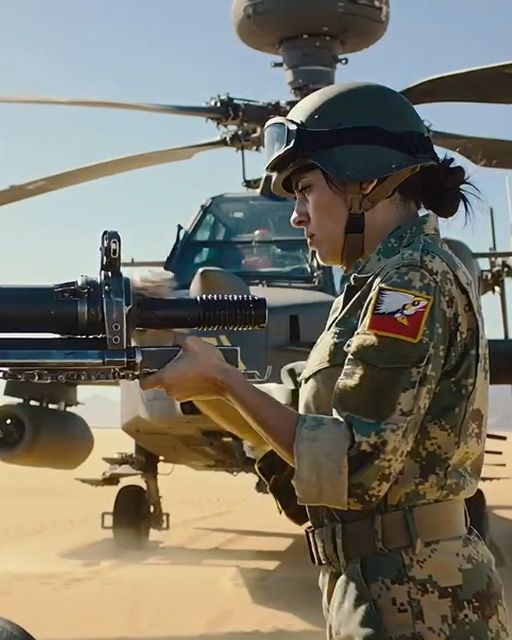
I saw it from twenty feet away, a faded smudge of black on her shoulder, tucked right under the official insignia.
She was just a sergeant, methodically wiping dust from the chain gun feed of my Apache. Head down. Lost in the work.
I walked closer, the heat of the tarmac baking through the soles of my boots.
“Careful with the feed belt,” I said. My voice was casual, but my eyes were locked on that patch.
She didn’t look up.
As I got closer, the design sharpened. A black falcon, wings spread, clutching a single lightning bolt. My breath caught in my throat.
That symbol wasn’t just non-regulation. It was a ghost.
It belonged to the Regiment. The night fliers. The unit my father commanded before his helicopter vanished over some forgotten mountain pass.
My voice came out tight, strained. “Where did you get that?”
For the first time, she stopped cleaning. She lifted her head, and her eyes met mine. There was no surprise in them. Only patience.
“It was a gift.”
“From who?” The words were barely a whisper.
She held my gaze. “Your father.”
The sound of the airfield died. The wind, the distant rotors, the clicking of cooling metal—it all just stopped.
Years of sealed files and redacted reports flooded my mind. The black box they never found. The official story that never added up.
And the one name that slipped through the censor’s ink. A single initial and a last name. A. Diaz.
I looked at her name tape. DIAZ.
The ghost. Standing right in front of me.
“You were there,” I said. It wasn’t a question.
She gave a slow, deliberate nod. “I was his crew chief. We weren’t supposed to get out.”
A weight I didn’t know I was carrying shifted in my chest. Grief. Rage. A decade of unanswered questions.
Then she reached into her duffel bag.
She pulled out a thick, worn envelope. The words CLASSIFIED RETURN were stamped on the front in faded red ink.
She handed it to me.
My father’s last message. Sealed since the night he died. My fingers trembled as I broke the seal.
Inside, on a single piece of paper, were four words in his familiar scrawl.
Trust her. She knows.
That was when I understood.
The mission wasn’t over. It had just been passed down to me, right here, on a sun-scorched strip of asphalt.
But the note wasn’t the secret. The note was just the key.
What it unlocked… that was the thing we were never supposed to find.
My name is Captain Sam Carter. I fly helicopters because my father flew them.
He was a legend, and I was just his shadow.
Diaz watched me, her expression unreadable. She had the calm of someone who had already seen the worst the world had to offer.
“Not here,” she said, her voice low. “Briefing Room Four. After sundown.”
She turned back to the chain gun, as if the last five minutes hadn’t just shattered my entire world.
I stood there, holding the note, the old paper warm in my hand.
For the rest of the day, I went through the motions. Pre-flight checks. Flight plans. Weather reports.
My mind wasn’t on the altitude or the wind speed. It was on a ghost and a ten-year-old lie.
Sundown painted the desert sky in shades of orange and purple.
Briefing Room Four was at the far end of the hangar, small and rarely used.
The only light came from a single green-shaded lamp on the table.
Diaz was already there, sitting in one of the hard plastic chairs. She had a thermos of coffee and two mugs.
She poured one for me without asking.
“Your father drank his black,” she said. “You?”
“The same,” I managed to say, my throat dry.
I sat down opposite her. The note lay on the table between us.
“The official report was a lie,” I started. “Weather malfunction. Pilot error.”
She snorted, a short, bitter sound. “Your father never made an error in the cockpit. Not once.”
“Then what happened up there?”
She took a slow sip of her coffee, her eyes never leaving mine.
“We weren’t on a routine patrol, Captain. We were carrying something.”
The air in the room felt heavy, thick.
“It was an unsanctioned mission. Off the books. Only three people knew about it. Me, your father, and his CO.”
“General Sterling,” I said, the name tasting like ash.
Sterling had been the one to deliver the news of my father’s death. He’d placed a hand on my teenage shoulder and spoken of honor and sacrifice.
Diaz nodded. “The very same.”
“What were you carrying?”
“Evidence,” she said simply. “A hard drive. Your father called it his ‘insurance policy’.”
It was proof of corruption that went all the way to the top. Faulty equipment contracts. Kickbacks. Lies that cost lives.
Sterling was at the center of it all.
“He was going to expose him,” I whispered.
“That was the plan. But someone tipped Sterling off.”
The memory of that night played in her eyes. The quiet dread. The feeling of being watched.
“We weren’t brought down by a storm, Captain. We were shot down.”
My knuckles turned white as I gripped the coffee mug.
“By who?”
“We never saw them. A missile lock from a ghost signature. It was one of ours. Or a system sold by one of ours.”
They were hunted. Betrayed by their own side.
“The bird was going down fast. Your father… he was incredible. He kept it stable just long enough.”
He had one parachute. Just one.
“He gave it to me,” Diaz said, her voice cracking for the first time.
He strapped it to her, pushed the hard drive into her hands, and gave her an order.
“He told me to find you. When the time was right. When you were ready.”
He told her to give me the note. To tell me where he hid the key.
“The key?” I asked, confused. “I thought the note was the key.”
She shook her head. “The note is the proof of trust. The key is a place.”
He told her to tell me to go to the workshop.
My heart hammered against my ribs. The old workshop.
It was a dusty, forgotten garage my father rented off-base. It was his sanctuary, filled with old tools, half-finished projects, and the smell of oil and sawdust.
I hadn’t been there since he died. I couldn’t bring myself to go.
“He knew Sterling would tear his life apart looking for that drive,” Diaz explained. “His house, his office, his locker.”
But the workshop was in my name. A gift for my sixteenth birthday.
“He hid it there,” I realized. “In plain sight.”
“He trusted you would know where to look. He said you always knew his secrets.”
A memory surfaced. Me, a kid, watching my dad fix an old motorcycle engine. He’d shown me his favorite trick.
He had a hollowed-out socket wrench. His ‘secret keeper,’ he called it. He’d hide spare cash or important nuts and bolts in there.
It had to be there.
“We have to go,” I said, standing up.
Diaz held up a hand. “Not so fast, Captain. If Sterling knew about the mission, he knows about me.”
She told me how she’d lived for the past ten years.
Moving from base to base. Taking low-profile assignments. Always watching her back.
She never stayed anywhere for more than a year. She never made close friends.
The patch was a risk. A calculated one.
She’d heard a Captain Carter was the new hotshot Apache pilot at this base. She had to know if it was him. If it was time.
“Sterling’s got eyes everywhere,” she warned. “He’s a powerful man now. Untouchable.”
“No one is untouchable.” The words were my father’s, but they came from my mouth.
We made a plan. Simple. Direct.
We’d leave the base separately. Meet at a diner an hour out of town. Then drive to the workshop together.
I felt a surge of adrenaline I hadn’t felt since my first solo flight. This was real. This mattered.
The drive was silent. The desert night was a vast, dark canvas pricked with stars.
The workshop was just as I remembered it. A single corrugated steel building at the end of a dirt road.
The old padlock was rusted but firm. I still had the key on my dog tag chain.
It scraped in the lock, and the door groaned open.
The air inside was stale, thick with a decade of dust.
Moonlight streamed through the grimy windows, illuminating the ghosts of my childhood.
The workbench. The old bike under a tarp. The rows of tools hanging neatly on the pegboard.
Everything was exactly as he’d left it.
“He said you’d know,” Diaz murmured from the doorway.
I walked to the tool chest. The big, red one in the corner. My hands were shaking.
I pulled open the top drawer. Sockets, wrenches, ratchets, all nestled in their foam cutouts.
There it was. The oversized three-quarter-inch socket. His secret keeper.
It felt heavy in my hand. Heavier than it should.
I twisted the base. It unscrewed with a faint squeak.
Inside wasn’t a hard drive. It was a single, brass key.
And a small, folded piece of paper.
I unfolded it. It was a string of numbers. A storage unit.
My heart sank. It wasn’t over. It was another step.
“What is it?” Diaz asked, stepping closer.
“A key. And an address.”
Suddenly, headlights swept across the open doorway, blinding us.
A black SUV had pulled up, its engine a low, menacing rumble.
My blood ran cold.
Two men in dark suits got out. They moved with a purpose that screamed federal agent or something much worse.
We were trapped.
“He found us,” Diaz breathed, her hand instinctively going to the sidearm on her belt.
“Don’t,” I said. “We can’t win a firefight.”
My eyes darted around the workshop. My father’s sanctuary. My playground.
I knew every inch of this place.
“The back wall,” I whispered to Diaz. “There’s a loose panel behind the oil drums.”
It led to a dry creek bed behind the building. We used to play hide-and-seek there.
One of the men started walking towards the door. His hand was inside his jacket.
“Sergeant Diaz,” he called out, his voice smooth and dangerous. “General Sterling sends his regards. He’d like his property back.”
I grabbed Diaz’s arm. “Now.”
We scrambled over to the oil drums. I heaved one aside, revealing the dark outline of the panel.
It was stuck. Rusted shut.
The footsteps got closer.
I put my shoulder into it, gritting my teeth. The wood groaned, then splintered, giving way.
We tumbled through the opening just as the men entered the workshop.
We didn’t stop running. We scrambled down the rocky slope of the creek bed, the darkness our only cover.
Behind us, I heard shouts. Then the sharp crack of a gunshot.
But they didn’t follow. They had what they came for. Or so they thought.
We made it to the main road, hearts pounding, covered in dust and sweat.
I looked down at my hand. I was still clutching the brass key and the piece of paper.
They had the socket wrench. The empty decoy.
My father was always two steps ahead.
We hitched a ride with a trucker who didn’t ask questions.
At the next town, we bought a burner phone and a bus ticket.
The storage facility was in a different state. A drab, anonymous place on the outskirts of Phoenix.
The number on the paper matched a unit at the back of the lot. Unit 3B.
The brass key slid into the lock. It turned with a satisfying click.
I rolled up the metal door.
The unit was mostly empty, except for one thing.
A heavy, military-grade footlocker.
Diaz and I looked at each other. This was it. The end of the line.
We lifted the lid.
Inside, nestled in protective foam, was a ruggedized laptop and a satellite phone.
And on top of it, another envelope with my name on it.
My father’s handwriting again. This one was thicker.
I opened it. It was a letter. A real one.
He wrote about his mission. About the betrayal. He told me how proud he was of me, of the man I was becoming.
He told me he was sorry for leaving me, but some things were worth fighting for.
Tears streamed down my face as I read his last words.
He explained everything. The laptop contained the unredacted files, the bank transfers, the audio recordings of Sterling making the deals.
It was an airtight case.
But here was the final twist. The one I never saw coming.
He told me not to take it to the military.
Sterling’s corruption ran deep. It had infected the very people who were supposed to investigate him. Giving them the laptop would be a death sentence for us and the evidence.
Instead, he gave me a name. A journalist.
A woman named Maria Flores, who he had trusted implicitly. She was the only one who could get the story out, unfiltered and undeniable.
The satellite phone was pre-programmed with her number.
That was his real insurance policy. Not the hard drive. Not the military.
The free press. The truth.
We made the call.
Maria Flores met us in a small cafe in a town I’d never heard of. She was sharp, cautious, and had eyes that missed nothing.
We gave her the laptop. We told her everything.
She spent two days verifying the data, her face growing grimmer with each passing hour.
Then, she looked up at us. “This is bigger than you know,” she said. “This will change everything.”
A week later, the story broke.
It was a firestorm. It led the national news for days.
General Sterling was arrested. His network was dismantled piece by piece. Congressional hearings were called.
The families of the soldiers who had been lost due to the faulty equipment finally got their answers. They got their justice.
My father’s name was cleared. He was posthumously awarded the Distinguished Service Cross for his courage.
At the ceremony, I stood tall in my dress uniform. Diaz stood beside me.
She was no longer a ghost. She was a hero.
Afterward, we sat by a small lake, skipping stones across the water just like my dad and I used to.
The weight was gone. The anger had been replaced by a quiet pride.
“He would have been so proud of you, Sam,” she said softly.
“He was proud of us both,” I replied.
We had finished his mission. We had brought the truth into the light.
My father had taught me how to fly. But in the end, he and Sergeant Diaz taught me what it truly means to have courage.
It’s not just about facing the enemy you can see.
It’s about having the strength to stand up to the one you can’t, even when you’re standing alone.
Truth is a heavy burden to carry, but it’s the only one that will eventually set you free.