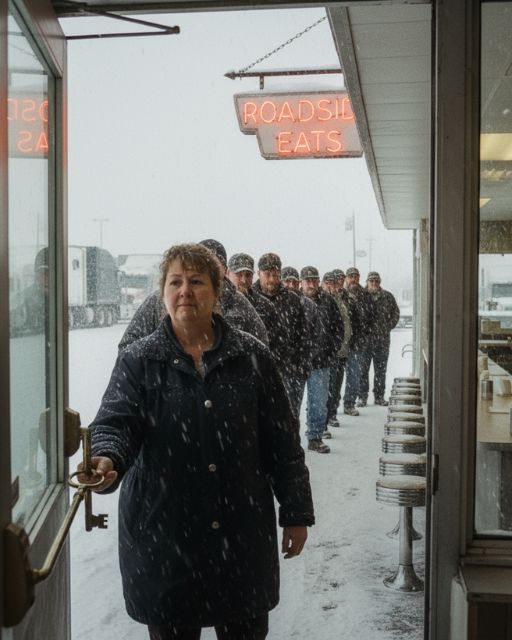
The storm came faster than anyone in Millstone had expected.
By the time I pulled into the parking lot of my little diner, snow was already falling in thick sheets, blanketing the roads in white.
I had no plans to open that night—it was too dangerous for anyone to be out. But then I noticed the line of eighteen-wheelers parked along the shoulder.
Their headlights cut through the flurries, and I could just make out a dozen men standing together, bracing against the wind.
One of them knocked on my door. His beard was frosted, his eyes tired.
“Ma’am,” he said, “is there any chance you could let us in for a coffee? We’ve been stuck for hours. Roads are closed. We won’t make it to the next stop tonight.”
I hesitated.
Running the diner alone was already hard, and twelve hungry truckers sounded overwhelming.
But then I looked at their faces—exhausted, worried, and desperate for warmth. My grandmother always told me: When in doubt, feed people.
So, I unlocked the door, switched on the lights, and waved them inside.
The men stomped snow off their boots and filled the booths in silence.
I brewed the first round of coffee, and before I knew it, I was flipping pancakes and frying bacon like it was a Saturday morning rush.
Laughter started to replace the quiet.
They thanked me over and over, calling me an angel in an apron.
But what I didn’t know was that letting them in would change more than just their night.
It would change my life—and the life of the entire town…
They stayed through the night, taking turns napping in the booths and helping me keep the fire stoked. One even offered to wash the dishes. His name was Roy, a broad-shouldered guy from Tennessee with the softest drawl I’d ever heard.
Another, Vince, had a guitar stashed in his rig. By morning, he was strumming old country songs while the others clapped along.
It didn’t feel like a blizzard anymore—it felt like a family reunion.
Outside, the snow didn’t let up. Roads were completely blocked. By morning, we were officially stranded.
The town was eerily quiet, and the radio confirmed what we already knew: no plows for at least another day, maybe two.
I figured I’d better make a food count. My pantry had enough basics to scrape by, but I’d never planned for a dozen mouths, three meals a day.
Roy noticed me pacing near the kitchen.
“You alright, Miss?”
I gave a half-smile. “Just thinking how to stretch ten pounds of flour into three days of meals.”
He turned to the others. “Boys, time to earn our keep.”
And just like that, the diner turned into a well-oiled machine. These men—who drove thousands of miles each week—suddenly became my staff.
Vince shoveled snow outside, clearing paths between the trucks and the diner. Another—Dennis, I think—fixed a leaky pipe under the sink using parts from his rig. One even patched a tear in the old vinyl booth using duct tape and a steady hand.
They weren’t just grateful—they were resourceful.
The second night was even cozier than the first. We made stew from canned vegetables and leftover brisket. Vince played his guitar again, and one of the men—Eli—told stories about the weirdest roadside diners he’d visited.
When I finally sat down, Roy slid me a plate and said, “You know, this place feels like home.”
It made my chest tighten a little.
Because the truth was, since my husband passed, it hadn’t felt like much of anything.
The diner had kept me busy. Gave me something to do, something to wake up for. But the laughter and warmth in that room—that was something I hadn’t felt in years.
On the morning of day three, the snow finally stopped.
A local farmer came by on his tractor and told us the main road was being cleared. We’d likely be able to drive out by sundown.
And just like that, it was almost over.
I tried not to feel sad, but I did.
I’d opened the door to help a few stranded men, but I didn’t expect they’d fill a hole I didn’t even know was there.
The truckers gathered their things and helped me stack chairs, mop the floors, and clean every corner of that little diner like it was their own.
Before leaving, Roy handed me a piece of paper.
“Look,” he said, “I know this ain’t your usual week. But what you did? That was special. So we got to talking…”
The paper had a phone number, a name I didn’t recognize, and the words: “Food Network. Regional producer.”
I blinked.
Roy scratched the back of his neck. “One of the guys, Nate, used to haul equipment for TV shows. Said he still knew someone. You’ve got a story, Miss. A real one.”
I laughed it off, thinking they were just being sweet.
But later that week, after they’d all gone and the snow was just black slush on the sidewalk, I got a call.
The woman on the other end introduced herself as Melissa from the Food Network. She asked if I’d be open to talking about what happened during the storm.
I nearly dropped the phone.
One interview turned into three.
A week later, a camera crew showed up to film a segment. They asked me to make my famous biscuits and gravy, and I swear I hadn’t felt that nervous since my wedding day.
But the part that got everyone buzzing wasn’t the food—it was the kindness. The laughter. The way the truckers and I had created something rare, even if only for 48 hours.
By the time the segment aired, I had customers driving from towns I’d never even heard of.
One woman told me she saw the story and cried into her oatmeal.
Someone started a GoFundMe to “Keep Millstone Diner Running Forever.” It raised more than $25,000 in two weeks.
I bought a new fryer, fixed the leaky roof, and finally replaced the cracked windows I’d been taping up every winter.
But the real change wasn’t in the diner.
It was in the town.
You see, Millstone had been drying up for years. Stores closing. Families moving away. Folks just… giving up.
But suddenly, there was traffic. Travelers. People walking Main Street again. The bakery across the road started opening earlier to catch my breakfast crowd. The antique shop next door expanded.
And then, something unbelievable happened.
The mayor declared the third Friday of every February “Kindness Weekend.” It started small—free coffee, neighborly favors—but last year, a busload of tourists from Chicago came down just to “see the diner that saved a town.”
As for the truckers?
Most of them stayed in touch.
Roy calls every few weeks, just to check in. Eli sent me a book of short stories he wrote on the road. Vince even brought his daughter by last summer.
They didn’t just pass through my life—they left a mark.
One afternoon, a local reporter asked me why I’d done it. Why I’d opened the door that night.
I didn’t know how to explain that it wasn’t some grand plan. I was just tired of being alone. And maybe, just maybe, I was hoping someone would need me again.
Funny how life works.
Twelve hungry strangers, one small diner, and a blizzard that froze everything—except our hearts.
If I’ve learned anything, it’s that kindness doesn’t need permission. It doesn’t need to be perfect. It just needs to show up.
Even when the roads are closed and the world feels like it’s gone quiet.
Especially then.
So next time you see someone stuck—offer a hand. You never know what door you might open.
Maybe, just maybe, it’ll change your life too.
If this story warmed your heart, don’t forget to like, share, and tag someone who still believes in good people.