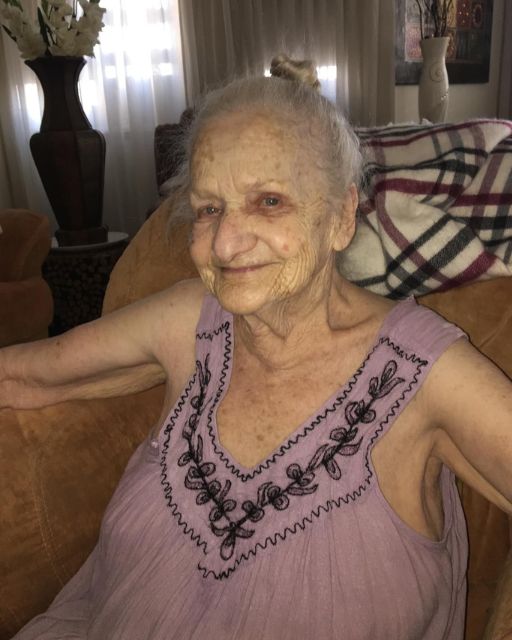
We hadn’t even cleared the front door and already Abuela was snapping at me: “I’m not going anywhere. I’ll be gone in this house, ¿me entiendes?”
I nodded. Pretended to drop it.
But her ankles were swelling like softballs, the fridge was barely cold, and I’d caught her trying to microwave a metal spoon. Something had to give.
That night, I went to grab a bag of frozen peas for her knee. Reached into the back of the freezer… and felt paper.
A sealed envelope. Yellowed. Addressed to Ramona Hernández in looping, spidery ink.
I asked her. She froze.
“I was saving it,” she muttered. “In case I forgot who I was.”
She opened it with shaking hands. Inside: a photo of her and a man I didn’t recognize—young, dancing, wild-eyed. And a note: “When you’re ready to go, remember—you already did the hard part.”
Her face changed. Like something cracked open.
Three days later, she let me schedule the tour. One assisted living home. “Just to look.”
But when we arrived, I could see her back straightening, her shoulders stiffening as if bracing for something terrible. The place was well-kept, clean, with bright walls and the sound of gentle piano music playing through hidden speakers. It should have felt like a sanctuary.
Instead, it felt like a trap.
Abuela took one look at the small chairs, the shiny floors, and the nurses with their name tags and smiles that didn’t reach their eyes. She took my hand tightly.
“Let’s go,” she said.
I was about to argue, to tell her that it was just a tour, just a look. But I stopped. She wasn’t going anywhere—at least not on her terms.
We left. No one followed us. No one even asked if we were okay.
That night, over dinner, I asked about the man in the photo. I had to know.
She didn’t answer right away. The silence hung heavy between us.
Finally, she spoke.
“His name was Santiago. We were young, wild, and full of dreams. We never thought we’d end up in a place like this.”
Her words were slow, as if they were being dragged from a deep, forgotten place.
“Did you love him?” I asked softly.
She didn’t look up. “I thought I did.”
I didn’t push. The rest of the evening passed in a quiet, almost strained normalcy.
But the next morning, I woke up to find her sitting at the kitchen table, the letter in front of her again, her fingers trembling as they traced the photo.
“I should have gone with him,” she whispered.
Her voice was thick with regret, laced with something deeper—something that hadn’t been there before. She was losing her grip, I could see it now. The walls she’d built around herself for so many years were crumbling, piece by piece.
Over the next few days, I noticed more subtle changes in her. She seemed distracted, forgetful. There were mornings when she couldn’t remember whether she’d eaten breakfast or not. The house, once full of small signs of life—photos, books, knick-knacks—now felt like an empty shell. The warmth was gone.
One evening, I walked into the living room to find her standing in front of the mirror, the photo of her and Santiago held up in front of her face. She was smiling at the reflection, but it wasn’t the smile I remembered.
“I should have gone with him,” she repeated. “I should have never let him go.”
I didn’t know what to say.
The next day, I came home early from work. The house was still quiet, but something was different. Abuela wasn’t in the kitchen, or the living room, or anywhere I’d usually find her. I called her name, but she didn’t answer.
I checked the back door and found it slightly ajar. My heart skipped a beat. I ran outside, but she was nowhere in sight.
“Abuela!” I yelled, panic rising in my chest.
I ran down the street, calling her name. And then, just as I was about to give up, I saw her.
She was sitting on a bench in the park, staring at the ground as if the weight of the world had settled on her shoulders.
“Abuela!” I called again, breathless as I reached her.
She looked up, her eyes wide but empty, as if she didn’t recognize me.
“I was waiting for him,” she said, her voice barely audible. “I thought maybe… maybe he’d come back for me.”
My heart sank. She wasn’t just losing her mind. She was losing herself.
I gently took her hand and led her back to the house.
That night, I sat with her while she slept. I watched her closely, hoping for a sign, any sign that she was still the woman I remembered. But all I saw was a shadow of the past, a woman who had buried her dreams and desires beneath layers of time and grief.
I made a decision.
The next morning, I called the assisted living place again.
This time, I didn’t give her a choice.
We were going.
And this time, it was different.
I told her we were just visiting an old friend, someone she used to know. Someone who would remind her of what it meant to be free.
The moment we stepped into the lobby, I could see the change in her. The tension in her shoulders started to ease, and the spark in her eyes flickered to life.
And when we met the elderly woman in the lobby, Abuela smiled.
“This is Carmen,” the receptionist said. “She’s been waiting to meet you.”
Carmen was a woman of her age, but there was something about her—the way she moved, the way she carried herself. She had a quiet grace, a strength that reminded me of Abuela when she was younger.
They embraced, and I saw it. That fleeting moment when my grandmother seemed to come alive again.
That’s when I realized: It wasn’t about the place. It wasn’t about the walls or the shiny floors. It was about the people. It was about the connection.
Abuela wasn’t ready to leave the house, but she needed to be reminded of who she was before the weight of the years turned her into someone she couldn’t recognize.
The next few weeks were filled with visits, small conversations, and moments of joy that had been missing for so long. Abuela started taking walks with Carmen, enjoying the little things that had once seemed impossible.
And then, one day, she looked at me and said something I never thought I’d hear.
“I think it’s time,” she said, her voice steady.
I didn’t question her. I simply nodded.
It was a quiet surrender, but it was a surrender nonetheless.
The house, the place that had been her fortress, no longer had the hold on her. She was ready to let go.
When we finally moved her into the assisted living home, she didn’t fight me. There was no resentment, no anger. Just a soft acceptance, as if she knew it was time to embrace a new chapter.
And for the first time in years, I saw my grandmother smile—truly smile.
She wasn’t the same woman who had fiercely refused to leave her home. She wasn’t the woman who had hidden away her dreams for decades.
She was someone new. Someone who had rediscovered herself.
And that, in itself, was a gift.
As I left her that day, I looked at the photo of her and Santiago, now resting in her new room, and I understood. Sometimes, the hardest part of life isn’t the letting go. It’s finding the courage to embrace the change.
Abuela had finally done both.
It was her time to let go—and in doing so, she had found freedom once again.
And the lesson was clear: There is no shame in letting go. The hardest part isn’t moving forward, but in realizing that you don’t have to do it alone.
Share this story if it touched you. Sometimes the hardest decisions lead to the most rewarding change.