I always thought it was just a stupid college tattoo. The little black raven with a broken wing on my wife Carol’s shoulder. Just a memory from a wild phase.
Then we had a minor fender-bender, and in the ER, an old doctor saw it while checking her for whiplash. The blood drained from his face. He instinctively took a step back, his eyes wide with a fear I’d never seen before.
“Where did you get this?” he asked, his voice a low whisper.
I tried to laugh it off. “Some parlor downtown, years ago. Why?”
He ignored me, looking only at Carol. “The Nest is empty,” he said, his voice cracking. “They’re all gone. They were all supposed to be gone.”
I had no idea what he was talking about. But on the drive home, a black car with tinted windows stayed two lengths behind us. It followed us all the way to our street.
I slammed the door and turned to her, my heart hammering against my ribs. “Who are you? What was he talking about?”
Carol finally looked at me, tears streaming down her face. She pulled up the sleeve of her shirt, showing me the raven again. “This isn’t just ink,” she whispered. “It means I’m the last one. And now that they’ve seen it, they know I have the egg.”
My mind reeled. “The egg? Carol, what are you talking about? You sound crazy.”
She shook her head, her whole body trembling. “The Nest was my family, Mark. We weren’t a sorority. We were a group of investigative journalists.”
She told me they were young, idealistic, and brilliant. They believed they could change the world with the truth.
They called themselves The Nest, and their symbol was the broken-winged raven. It was a reminder that even the damaged could still try to fly.
“We stumbled onto something,” she said, her voice barely audible. “Something huge. A web of corruption that went to the very top. A company called Argentis.”
I recognized the name. Argentis was a global conglomerate, praised for its philanthropy and technological advancements. Its founder, Silas Blackwood, was practically a saint in the public eye.
“He’s not a saint,” Carol said, a cold fire in her eyes. “He’s a monster. Argentis built its empire on stolen research, illegal arms deals, and silencing anyone who got in their way.”
The Nest had gathered all the evidence. Financial records, internal memos, recorded confessions. Everything they needed to burn Argentis to the ground.
They stored it all on a single, heavily encrypted data drive. They called it “the egg,” because it held the potential for a new beginning.
But someone found out. Someone on the inside betrayed them.
One by one, the members of The Nest started to disappear. Accidents, sudden illnesses, unsolved homicides.
Carol was the last one left. She faked her own death, erased her past, and ran. She met me a year later, a quiet librarian with sad eyes and a raven tattoo.
“I never thought they’d find me,” she sobbed. “I’ve been so careful.”
The fender-bender was just bad luck. But the doctor, he wasn’t. He knew the symbol. And his reaction was like a flare in the dark, signaling to them that a ghost was still walking.
The black car was still parked at the end of our street, a silent predator. We were trapped.
“What’s the plan?” I asked, my voice steadier than I felt. My world had been turned upside down in a matter of hours, but one thing was crystal clear.
I loved this woman. I loved the quiet librarian, and I loved the ghost of the fearless journalist she once was.
“We run,” she said, wiping her eyes. “But first, we need to get the egg.”
She went to the old bookshelf in the living room, the one filled with classics we never read. She pulled out a worn copy of “To Kill a Mockingbird.”
The book was hollowed out. Inside, nestled in velvet, was a tiny silver drive, no bigger than my thumbnail.
The egg.
We didn’t pack bags. We left everything behind. Our photos, our clothes, our entire life.
She told me to take out the battery from my phone. She did the same with hers. “They can track us through anything with a signal.”
We crept out the back door, through our neighbor’s yard, and into the dark alleyway behind our house. My heart was a drum against my ribs.
Every shadow looked like a man. Every rustle of leaves was a footstep.
We made it to the main road and hailed a cab, paying with the last of the cash in my wallet. We told him to take us to the bus station.
At the station, we didn’t buy a ticket. We walked straight through and out the other side, then walked ten blocks in the opposite direction.
“They’ll expect us to take a bus or train,” she explained. “We need to be unpredictable.”
We found a grimy, no-name motel that only took cash. The room smelled of stale smoke and despair.
I looked at my wife, this stranger who had slept beside me for five years. She wasn’t the fragile woman I thought I knew.
She was calculating, her eyes scanning every angle. She was a survivor.
“The doctor,” I said, the memory of his terrified face flashing in my mind. “His name was on his badge. Dr. Finch.”
Carol’s breath hitched. “Alistair Finch? He’s alive?”
“You know him?”
“He was a friend of The Nest,” she whispered. “A good man. He helped us with medical supplies, and he was our emergency contact. We thought he was one of the first ones they got.”
A glimmer of hope ignited in the dim room. If he was alive, maybe he could help us.
“We can’t risk it,” she said immediately, crushing that hope. “If they know I’m alive, they’ll be watching him. Going to him is a death sentence.”
The next morning, we bought burner phones. Carol made one call, a long-distance number she knew by heart.
It was a pre-arranged distress signal. She didn’t speak. She just let the phone ring three times and hung up.
“It’s a long shot,” she said. “It’s a contact, a journalist in another country. If he’s still there, and he’s still safe, he’ll know what to do.”
We spent the day moving, never staying in one place for more than an hour. We ate from vending machines and sat in the back of public libraries, trying to look invisible.
The paranoia was a physical thing. It felt like a heavy coat I couldn’t take off.
That evening, the burner phone rang. An unknown number.
A distorted voice on the other end said a single word. “Sundown.” It was a code phrase.
Carol replied with another. “Mockingbird.”
“He’s compromised,” the voice crackled. “Finch is compromised. They’re watching him. But he left something for you. A key.”
The voice gave us an address. A storage unit on the industrial side of town.
It felt like a trap. It screamed trap.
“We have no choice,” Carol said, her face pale but determined. “It’s the only lead we have.”
We took two different buses to get there, circling the location for an hour to make sure we weren’t followed. The storage facility was a maze of identical orange doors.
Unit 237. The lock was an old-fashioned combination lock. Carol’s birthday.
Inside, it was mostly empty, save for a single wooden box on the floor. My hands shook as I opened it.
There was a key to a post office box, a wad of cash, and a small, leather-bound journal.
Carol opened the journal. It was Dr. Finch’s handwriting. My blood ran cold as I read the first page over her shoulder.
It was a confession.
Dr. Finch hadn’t been a friend of The Nest. Not really. He was their doctor, yes. But he was also a man with a family.
Argentis had found out about his connection to the group. They didn’t threaten him. They threatened his daughter, his little girl who had a rare heart condition.
They offered him a deal. Give them the names and locations of The Nest, and Argentis’s top medical division would save his daughter’s life, free of charge.
He made an impossible choice. He chose his child.
He was the one who betrayed them.
He was the reason they were all dead. The reason Carol had been running for her life.
The journal was filled with years of guilt and self-loathing. He had followed Carol’s story from a distance, praying she had truly gotten away. Seeing her in the ER, alive, was both a miracle and his worst nightmare.
He knew Argentis would be on her instantly. He set up the storage unit as a desperate, last-ditch attempt at redemption.
“They will never stop hunting you as long as the egg exists,” he wrote. “You cannot leak it. Their digital security is too advanced; they will trace it and find you. You have to destroy it. It’s the only way to be free.”
I looked at Carol. Her face was a mask of stone. The man she thought was a friend was the architect of her pain.
“He wants us to destroy it,” I whispered.
“No,” she said, a single tear tracing a path through the grime on her cheek. “He’s telling us how to win.”
She flipped to the last page of the journal. There was a hand-drawn map.
“He wasn’t just giving us a way out,” she said. “He was giving us a weapon.”
The map led to a decommissioned radio observatory deep in the mountains, a place abandoned since the Cold War.
Dr. Finch explained in the journal. It was built with analog technology, completely off the modern grid. It had a satellite uplink powerful enough to broadcast a signal to the entire world.
A signal that couldn’t be traced or shut down by Argentis’s digital army.
It was a ghost signal. The perfect weapon for a ghost to use.
The post office box gave us what we needed. New IDs, a car key, and more cash. The car was an old, beat-up sedan parked five blocks away. It was untraceable.
We drove all night, into the heart of the mountains. The higher we climbed, the more I felt like we were leaving the modern world behind.
The observatory was a relic. A giant, skeletal dish pointed at the sky, surrounded by crumbling buildings. It looked like the end of the world.
We found the entrance to the underground control room, just like the map showed. The air was thick with the smell of dust and ozone.
The place was a time capsule. Giant computers with reel-to-reel tapes, vacuum tubes glowing faintly, an array of switches and dials that looked like something from a science fiction movie.
Carol, who had studied computer engineering before switching to journalism, knew exactly what she was looking at.
“This is it,” she breathed. “This will work.”
It took her hours to interface the tiny, modern data drive with the ancient analog system. I stood watch at the entrance, armed with a tire iron, my heart pounding with every gust of wind.
Just as she was ready to begin the broadcast sequence, we heard it.
The crunch of tires on the gravel road outside.
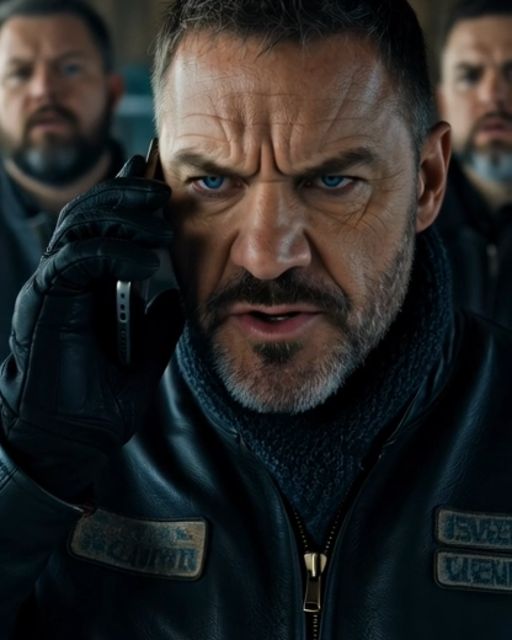
Two black cars, the same kind that had followed us from our home, rolled to a stop. Four men in dark suits got out. They moved with a chilling efficiency.
They hadn’t followed us. They had been waiting for us.
I looked at the journal, at Finch’s desperate scrawl. It wasn’t just a confession. It was bait.
Finch knew Argentis was watching him. He knew they would find the storage unit. He had gambled that they would let us lead them to the egg.
He had sacrificed us to clear his conscience.
“Mark,” Carol’s voice was calm, steady. “I need five minutes. The upload sequence is initiated. I just need to keep it stable.”
I looked at her, at the determined set of her jaw. She wasn’t afraid. She was finishing the job. She was doing it for her fallen family.
I gripped the tire iron. “You’ll have it,” I said.
I wedged the heavy steel door, leaving only a small gap. I wouldn’t be able to stop them, but I could slow them down.
The first man reached the door. He was big, imposing. He pushed, but the wedge held.
“Just give us the drive,” he said, his voice smooth and reasonable. “No one has to get hurt. Blackwood is a reasonable man.”
“Tell your boss his empire is about to come crashing down,” I grunted, putting all my weight against the door.
They started using a battering ram. The steel groaned with each impact. It wouldn’t hold for long.
“Three minutes!” Carol shouted from behind me.
The door buckled. A hinge snapped. They were coming through.
Then, from the woods behind them, a new sound. A single, sharp crack of a hunting rifle.
One of the men in suits dropped to the ground. The others scrambled for cover.
An old man emerged from the trees, his face etched with sorrow and resolve. He held the rifle with a steady hand.
It was Dr. Finch.
He hadn’t sacrificed us. He had followed us, using us as bait for a trap of his own.
“Get it done, Carol!” he yelled, his voice echoing in the quiet mountain air.
Argentis’s men returned fire. The next few minutes were a blur of noise and chaos. Finch was a surprisingly good shot, using the terrain to his advantage. He was buying us the time we needed.
“It’s done!” Carol screamed. “The signal is out! It’s everywhere!”
The remaining goons knew it was over. They scrambled back to their cars and sped away, leaving their fallen comrades behind.
I threw the door open and ran to where Dr. Finch was slumped against a tree, a dark stain spreading across his chest.
I knelt beside him. He looked at me, his eyes already glazing over.
“Tell her… tell her I’m sorry,” he rasped. “For everything.”
He looked up at the giant satellite dish, pointing towards the heavens like a silent witness. “The ravens… can fly now.”
Then he was gone.
The fallout was immediate and catastrophic for Argentis. The “egg” hatched online, and its contents spread like a virus. News outlets, government agencies, social media—no one could ignore it.
Silas Blackwood, the beloved philanthropist, was exposed as a monster. He was arrested trying to flee the country. His company imploded under the weight of a thousand scandals.
We walked down that mountain and never looked back. An intelligence agency, grateful for the takedown of a major domestic threat, quietly gave us new identities and a new life in a small town where nobody knew our names.
It’s been ten years. We have a daughter now. Her name is Alistair.
Carol still has the tattoo. The little black raven with the broken wing. It’s faded over time, but it’s still there.
Sometimes, when she’s getting dressed, I’ll see it, and I’m reminded of the life we left behind. I don’t see a target anymore. I see a badge of honor.
I learned that the quietest people often carry the heaviest burdens and the greatest strengths. My wife, the librarian, toppled an empire with a ghost signal and a story that refused to die.
And I learned that love isn’t just about the good times and the easy days. It’s about standing by someone when their past comes knocking, holding a door against the darkness, and having the faith to see it through to the dawn.
The truth, no matter how long it’s buried, will always fight its way to the light. It just needs someone brave enough to help it fly.