
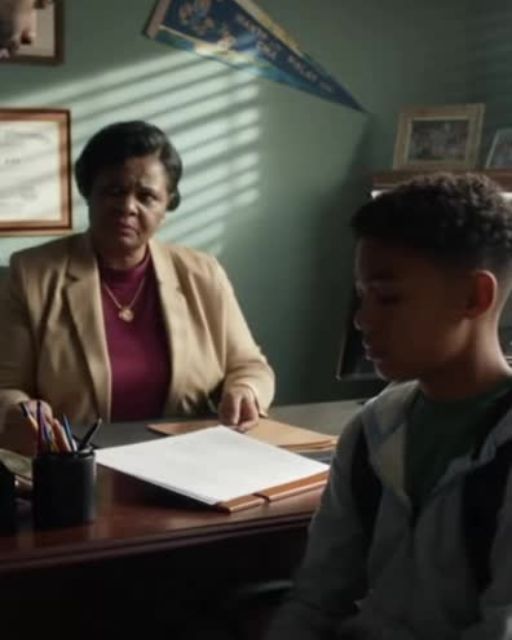
Principal Albright looked down at 10-year-old Leo, his face a mask of smug authority. “One more outburst, and you’re suspended. Do you understand me?”
Leo, who had been defending another kid from a bully, just stared at his shoes and nodded. His eyes were watering.
This was the third time he’d been in the office this month, and the third time Mr. Albright had refused to listen to his side of the story.
“I said,” the principal repeated slowly, enjoying the moment, “do you understand?”
That’s when the door opened.
It was Leo’s father, Graham. He wasn’t angry. He wasn’t yelling.
He was calm, and that was somehow more terrifying. He walked in, gave Leo’s shoulder a gentle squeeze, and looked at the principal.
“We’re done here,” Graham said, his voice quiet but firm.
Albright scoffed. “Excuse me? I am in the middle of a disciplinary action—”
Graham placed a single, thin manila folder on the polished desk. It landed with a soft, final thud.
“What’s this?” the principal asked, annoyed. “The boy’s medical records? Another excuse?”
“That,” Graham said, his voice perfectly even, “is a transcript. From my conversation with your wife this morning.”
The principal’s smirk vanished. His face went white.
“She was quite talkative,” Graham continued, “about the ‘special tutoring’ you’ve been giving one of the cheerleaders. The one you gave an A in calculus, despite her failing every single test.”
He paused, letting the words hang in the silent office.
“And that conversation is now in the hands of the school board superintendent.”
Principal Albright’s jaw worked, but no sound came out. The smugness had evaporated, replaced by a raw, cornered-animal panic.
He looked from the folder to Graham, then to Leo, as if seeing the small boy for the first time.
“You’re bluffing,” Albright finally managed to choke out, his voice a hoarse whisper.
Graham didn’t even blink. “Am I?”
He pulled out his phone, his movements deliberate and unhurried. “I can send the audio file as well, if you’d like. Her name is Eleanor, right? She has a very distinctive laugh.”
The principal flinched as if he’d been struck. He sank back into his high-backed leather chair, all the air going out of him.
“What do you want?” he asked, defeated.
Graham looked down at his son. “I want you to tear up whatever write-up you have for Leo.”
He then glanced towards the door. “And I want you to call in Marcus Peters and his parents. The boy Leo was protecting, Sam, has a black eye. Marcus is the one who should be sitting in this chair.”
“This is extortion,” Albright hissed, a last flicker of defiance in his eyes.
“No,” Graham said, his voice dropping to an almost gentle tone. “This is a course correction. You’ve been bullying my son and countless other kids because you can. It ends today.”
He gestured to the phone on the desk. “Make the call.”
Albright, his hands trembling slightly, did as he was told.
Graham stood by the door with Leo, watching the man who had terrified his son crumble. There was no victory in his posture, only a quiet, grim resolve.
Once the call was made, Graham opened the door. “Leo, why don’t you wait for me by the front office?”
Leo looked up at his father, his eyes wide with a mixture of awe and confusion. He nodded and scurried out.
Graham turned back to Albright, who now looked small and pathetic behind his large desk.
“This isn’t over,” Graham said softly. “The superintendent, Dr. Harrison, will be in touch. What you did with that student’s grades is a professional crime. What you did with that student is a moral one.”
He let that sink in.
“But what you did to my son, and kids like him, is the worst of all. You used your power to crush a child’s spirit. That’s a special kind of poison.”
Without another word, Graham turned and walked out, closing the door quietly behind him.
In the car, Leo was silent for a long time, watching the trees blur past the window.
Finally, he spoke. “Dad? What was in the folder?”
Graham sighed, keeping his eyes on the road. “It was just proof, buddy. Proof that Mr. Albright isn’t the man he pretends to be.”
“You mean with the cheerleader?” Leo asked, his voice small.
Graham glanced at him. “It’s more than that. It’s about honesty. Mr. Albright wasn’t being honest. He was using his job to get what he wanted and hurting people along the way.”
“Like me,” Leo said.
“Exactly like you,” Graham confirmed. “He saw you as a nail that needed to be hammered down because you stood up. People like him hate that.”
“How did you know about his wife?” Leo asked, the ten-year-old curiosity finally winning out.
Graham managed a small, sad smile. “Sometimes, you just have to listen.”
The truth was, it had been a terrible stroke of luck, or perhaps fate.
Graham’s work as an audio archivist for the local university meant he spent his days listening. He often took his lunch at a small cafe downtown to clear his head.
For weeks, he had noticed a woman there. She always sat alone, looking impossibly sad, stirring her coffee for minutes on end.
One rainy Tuesday, the cafe was nearly empty. She was there, and so was he. She dropped her wallet, and he picked it up for her.
Her name was Eleanor.
They started making small talk over the next few days. She never said her last name, and he never offered his. He was just a kind stranger she could talk to.
And talk, she did. Her loneliness and resentment poured out of her in a quiet, steady stream.
She spoke of a husband who was distant, a man who cared more about his image than his family. A man who was suddenly buying expensive gifts for someone else, gifts they couldn’t afford.
She mentioned his job as a principal, his obsession with a certain cheerleader, and the ridiculous grades he was giving her. She’d found receipts, text messages. She was heartbroken and angry.
Graham listened, his heart aching for her, but also for his son, who was coming home from school dejected day after day, talking about a principal who wouldn’t listen.
The pieces clicked into place with a sickening thud.
The day before the meeting, Eleanor had been particularly distraught. Graham, sensing his son was on the verge of being unfairly suspended, made a decision.
He asked her if she would mind if he recorded their chat, explaining his work involved oral histories and that her story felt important. She was so lost in her own misery, she just waved a hand and said, “I don’t care. No one listens anyway.”
He had the recording. He had the transcript. He hated using her pain as a weapon, but he would do anything to protect his son.
The next day, the school district moved faster than Graham had anticipated.
Dr. Harrison, the superintendent, was a woman who had worked her way up from being a teacher in the city’s toughest neighborhood. She had zero tolerance for bullies, especially adult ones.
She called Graham that afternoon.
“Mr. Miller,” she said, her voice crisp and professional. “I’ve received your email. I want you to know this is being taken with the utmost seriousness.”
“Thank you, Dr. Harrison,” Graham replied.
“I’m launching a full investigation, starting with a financial audit of the school’s discretionary funds. An accusation of grade-tampering is serious enough, but your recording implies there may be… incentives involved.”
Graham’s stomach tightened. He had only intended to stop Albright from hurting his son. He hadn’t considered the wider fallout.
“Do what you have to do,” he said quietly.
The investigation was swift and brutal. It turned out the affair was just the beginning. This was the first, believable twist that unraveled everything.
Albright, in his arrogance, had gotten sloppy.
He had been using the school’s parent-teacher association funds—money raised from bake sales and car washes—to finance his affair.
There were receipts for fancy dinners listed as “faculty meetings.” A weekend trip to a spa resort was disguised as an “educational conference.”
He had been cheating the parents and the children of his school for months. The altered grades were just one small part of a much larger, uglier picture of corruption.
Albright was placed on immediate, unpaid leave. His name was scrubbed from the school’s website overnight.
The news spread through the town like wildfire. Parents were outraged about the stolen funds. Teachers who had long feared Albright’s temper began to share their own stories of his bullying and intimidation.
It was a total collapse of a petty tyrant’s kingdom.
Leo, meanwhile, felt a strange sense of quiet. The school felt different, lighter.
The boy he had defended, Sam, came up to him in the schoolyard a few days later.
“Hey,” Sam said, the bruise under his eye now a yellowish-green. “Thanks.”
“It’s okay,” Leo mumbled, kicking at a loose stone.
“My mom said your dad is a hero,” Sam continued. “He got Marcus suspended. For a whole week.”
Leo looked up. He had never thought of his quiet, thoughtful father as a hero before. He’d just thought of him as Dad.
But now, he saw it. The quiet strength. The calm courage.
The second twist, however, was still to come. It wasn’t a dark one, but one that changed the very fabric of the school community.
Dr. Harrison had to appoint an interim principal while they searched for a permanent replacement.
She called a school-wide assembly a few weeks later. The air in the auditorium was thick with anticipation.
Dr. Harrison walked onto the stage and spoke about integrity, trust, and the importance of a safe learning environment.
Then, she announced the results of the financial audit. She explained that all the misappropriated funds had been accounted for.
“However,” she said, her voice ringing with authority, “we also found something else. For the past five years, a significant portion of our anonymous community donations have come from a single source. A source dedicated to funding our arts program, our special needs resources, and our after-school tutoring.”
She paused, looking out over the crowd of students, teachers, and parents.
“These funds kept three programs from being cut during the last budget crisis. Mr. Albright took credit for ‘creative financing,’ but in reality, he was simply cashing the checks sent by a former student.”
A murmur went through the auditorium.
“This benefactor wished to remain anonymous,” Dr. Harrison continued. “But in light of recent events, and with his permission, I’d like to thank him publicly.”
She looked towards the side of the stage. “Please join me in thanking Mr. Graham Miller.”
Leo’s head snapped up. He stared, speechless, as his own father walked onto the stage, looking a little embarrassed by the sudden, roaring applause.
Graham hadn’t told him. He had been quietly and generously supporting the very school that had been mistreating his son.
He hadn’t fought back with anger or threats. He had fought back with quiet integrity, and had been supporting them all along.
Graham shook Dr. Harrison’s hand and spoke briefly into the microphone.
“I just believe every kid deserves a safe place to learn and grow,” he said simply. “That’s all.”
He walked off the stage and came to sit next to Leo, who was still trying to process it all. The kids around them were patting Leo on the back.
His dad wasn’t just a hero for one day. He had been a hero all along, in a way no one had ever seen.
That evening, as Graham tucked Leo into bed, the weight of the past few weeks finally settled.
“Dad?” Leo said, his voice sleepy. “Why didn’t you tell me about the money?”
Graham sat on the edge of the bed. “Because it wasn’t about getting thanks, buddy. You do the right thing because it’s the right thing. Not for the applause.”
He smoothed Leo’s hair back from his forehead.
“Mr. Albright was loud,” Graham explained. “He used his voice and his power to make people feel small. But you don’t have to be the loudest person in the room to be the strongest.”
He pointed to Leo’s heart. “The real strength is in here. It’s in standing up for a friend, even when you’re scared. It’s in telling the truth, even when it’s hard. It’s in being kind, even when no one is watching.”
Leo’s eyes were heavy, but he was listening to every word.
“You showed that strength when you stood up for Sam,” Graham said, his voice full of pride. “That made me prouder than anything else.”
A small smile touched Leo’s lips as he drifted off to sleep.
The story of Graham and Leo became a quiet legend at the school. It wasn’t a story about revenge; it was a story about character.
The school got a new principal, a kind woman who listened to the children and knew each of them by name. The culture of fear was replaced by one of respect.
Eleanor Albright quietly filed for divorce. She sent a short, anonymous note to Graham’s house a few months later.
It just said, “Thank you.”
Graham continued his lunches at the cafe and his quiet donations to the school. He had exposed a corrupt man, not to destroy him, but to protect the innocent and restore balance.
The most important lesson wasn’t about the downfall of a bully, but the quiet power of a good man. It underscored that true strength isn’t about intimidation or authority. It’s found in quiet conviction, in the courage to stand for what’s right, and in the simple, unwavering love of a father for his son. It’s the lesson that integrity, whispered in a quiet room, can be more powerful than a lie shouted from a position of power.