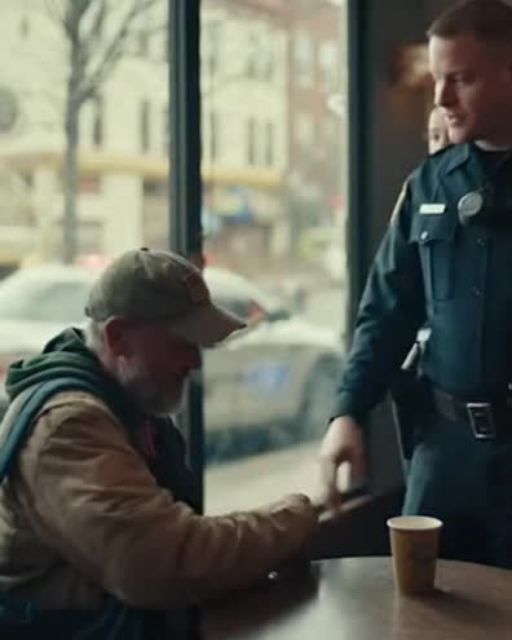
Chloe smirked as she told the old man to leave. She assumed the police, who she’d just called, were coming for him. “We reserve the right to refuse service,” she said, her voice loud enough for the other customers to hear.
The man, Arthur, looked down at his worn combat boots. He was scruffy, his jacket was faded, and in her pristine, minimalist coffee shop, he stuck out. He didn’t argue. He just gave a tired nod, his eyes lingering on the “Support Our Troops” sticker on the cash register. The irony was suffocating.
A few patrons shifted in their seats, suddenly fascinated by their lattes. My wife, Chloe, saw their discomfort as validation. She thought they were bothered by him.
Just as Arthur turned for the door, it swung open, the bell chiming cheerfully. Two police officers walked in.
Chloe beamed, stepping forward to greet them. “Thank you for being so quick, officers. This man was refusing to—”
The older officer walked right past her. He didn’t even glance her way. He went straight to Arthur and put a hand on his shoulder, his entire demeanor changing from authoritative to deeply respectful.
“Mr. Covington?” the officer said. “The mayor’s waiting for you outside. We’re your escort to the ceremony.”
Chloe’s smile vanished. She stared, her mind failing to connect the dots. The ceremony? The one the whole town was talking about? The one where they were honoring a decorated local hero?
That’s when she saw it. Pinned discreetly to the inside of Arthur’s faded jacket was a Purple Heart. The officer followed her gaze, then looked back at her, his expression turning to ice. He pulled out a notepad. “Ma’am,” he said, his voice suddenly cold and official. “We also have a complaint to discuss with you.”
The air in the shop thickened, becoming heavy and silent. The quiet hum of the espresso machine seemed to die down, as if holding its breath. I stood behind the counter, frozen, a dishcloth in my hand.
Chloe’s face was a canvas of confusion. “A complaint? Against me?”
The officer, whose name tag read Miller, didn’t flinch. “Yes, ma’am. A formal complaint has been filed by a former employee.”
I knew instantly who he was talking about. Sarah. A sweet girl, barely twenty, who Chloe had fired a few weeks ago.
Chloe scoffed, a nervous, high-pitched sound. “Sarah? She was a terrible employee. Always late, always giving away product.”
Officer Miller’s eyes narrowed. “Is that so? Because her complaint states she was fired for providing day-old pastries to a local homeless shelter, items you had instructed her to throw in the trash.”
My stomach dropped. I remembered that day. Sarah had asked me if it was okay, and I’d told her it was a wonderful idea. I never imagined Chloe would find out, let alone fire her for it.
“That’s our policy,” Chloe snapped, her voice regaining some of its usual sharpness. “It devalues the brand.”
“Devalues the brand,” Officer Miller repeated slowly, the words dripping with disbelief. He looked around the silent shop, at the uncomfortable faces of our few remaining customers. “And what value does your brand have now, ma’am?”
Arthur, who had been standing quietly, finally spoke. His voice was raspy but steady. “It wasn’t her fault, son. The girl has a good heart.”
The younger officer helped Arthur toward the door, where a black town car was now visible, the mayor himself stepping out onto the sidewalk. The mayor, a man Chloe had been trying to get a meeting with for months, looked toward the shop window with a frown.
Chloe saw him and paled. Her whole business plan hinged on appearances, on curating an image of upscale community involvement. She wanted the catering contract for city hall events.
That dream was currently walking out the door in a faded jacket.
Officer Miller stayed behind. He wasn’t finished. “The complaint also alleges wage theft.”
“What?” Chloe’s voice was a squeak.
“Sarah claims you regularly had her clock out and then continue working, cleaning up for another hour or so off the books. She has text messages from you to prove it.”
My blood ran cold. Chloe had been so proud of keeping labor costs down. I never asked how. I just accepted the healthy profit margins she boasted about. Now, standing in the wreckage of her pride, I felt like a fool. I was her husband, but I was also her business partner. I was complicit in my silence.
The few remaining customers began to quietly pack up their things. The first was a woman in a business suit. She placed her cup on the counter and looked not at Chloe, but at me.
“My father served in the same unit as Arthur Covington,” she said, her voice low and firm. “He saved three men from a burning vehicle. My dad was one of them.”
She paused, letting the weight of her words settle in the room. “I will not be coming back.”
She turned and left, the bell on the door chiming a mournful note.
Another couple followed, leaving their half-finished coffees on the table. They didn’t say a word. They didn’t have to. Their disgust was a physical presence in the room.
Soon, it was just me, Chloe, and Officer Miller. The pristine, minimalist shop suddenly felt vast and empty. It was a showroom for my wife’s cruelty.
“This is ridiculous,” Chloe stammered, trying to grasp for some semblance of control. “It’s the word of a disgruntled teenager against a respected business owner.”
Officer Miller took a slow, deliberate step closer. His gaze was unyielding. “Actually, ma’am, it’s a bit more than that. You see, Sarah is my niece.”
The world stopped spinning. Chloe’s mouth opened, then closed. For the first time since I’d known her, she had absolutely nothing to say.
“I advised her to handle this quietly,” he continued, his voice calm but lethal. “To just find another job. But she’s a lot like her grandfather. She believes in doing the right thing, no matter how hard it is.”
He gestured vaguely toward the door, where the town car was now pulling away. “Her grandfather is Arthur Covington.”
If the ground had opened up and swallowed Chloe whole, it would have been less dramatic than the effect those words had on her. The color drained from her face, leaving a pasty, grey mask. The carefully constructed façade of the perfect hostess, the savvy businesswoman, the community pillar—it all shattered into a million invisible pieces on the polished concrete floor.
I finally found my voice. “Chloe,” I said, the name tasting like ash in my mouth.
She didn’t look at me. Her eyes were locked on Officer Miller, wide with a horror that was slowly being replaced by a dawning, terrible understanding. She hadn’t just insulted a random old man. She had targeted the grandfather of the employee she’d cheated, all in front of that employee’s uncle, the cop. It was a perfect storm of her own making.
“We’ll be in touch,” Officer Miller said, his tone final. He put his notepad away, gave me a look that was a mixture of pity and contempt, and walked out. The bell chimed one last time, sealing the silence in with us.
For a long time, we just stood there. The shop was a tomb. Chloe’s hands were shaking.
“Can you believe this?” she finally whispered, turning to me. She was looking for an ally, for someone to validate her narrative that she was the victim.
But I couldn’t do it. Not anymore. The scales had fallen from my eyes. I saw every little cruelty, every dismissive comment, every obsession with image over substance for what it was. It wasn’t ambition; it was a deep, gnawing insecurity that she fed by belittling others.
“Yes,” I said, my voice flat. “I can believe it. I saw you fire Sarah. I saw you sneer at Arthur.”
“He looked like a vagrant!” she shot back, a flicker of her old fire returning. “I was protecting our investment!”
“Our investment?” I let out a hollow laugh. “Look around, Chloe. What’s left of it? You didn’t protect anything. You destroyed it. All because you couldn’t stand the sight of someone who didn’t fit your perfect little picture.”
I took off my apron and threw it on the counter. “The worst part is, I let you. I stood by and let you do it.”
I walked out from behind the counter, my steps echoing in the empty space. I didn’t know where I was going, but I knew I couldn’t stay there. I couldn’t be a part of her world anymore.
The days that followed were a blur of shame. The story spread through our small town like wildfire. It was on social media, whispered about in the grocery store. Our coffee shop, “The Daily Grind,” became a local pariah. People would walk by and point. Some even left negative reviews online detailing the incident.
Our sales plummeted to almost nothing. We’d be lucky to have five customers a day. Chloe tried to put on a brave face, but the strain was evident. The lawsuit from Sarah was officially filed, and the wage theft claim meant we were also being investigated by the Department of Labor.
One evening, about two weeks after the incident, an official-looking letter arrived. It was from the property management company that owned our building. Chloe ripped it open, her hands trembling.
It was an eviction notice. We were in violation of a “community decency” clause in our commercial lease. They were terminating our contract, effective in thirty days.
“They can’t do this!” Chloe screamed, throwing the letter on the table.
But I knew they could. I did a quick search online for the property company. It was a subsidiary of a larger real estate firm. The firm’s CEO was Mayor Thompson. The man who had personally come to pick up Arthur Covington. The man whose city hall catering contract Chloe had so desperately craved. It was another thread in the web she had so carelessly woven around herself.
That was the night I told her I was leaving. There was no big fight. Her energy was gone. She just sat on the couch, staring at the wall, a ghost in the house we had built on a foundation of her ambition and my willful ignorance.
I packed a bag and went to stay at a cheap motel on the edge of town. I needed to think. I needed to figure out who I was without her.
The next morning, I knew what I had to do. It wasn’t enough to just walk away. I had to try to make things right.
Finding Arthur Covington wasn’t hard. He was a local hero now. I found him sitting on a bench at the Veteran’s Memorial Park, tossing breadcrumbs to pigeons. He looked different without the weight of Chloe’s judgment on him. He looked peaceful.
I approached slowly, my heart pounding in my chest. “Mr. Covington?”
He looked up, and his eyes showed a flicker of recognition, but no anger. “Hello, son.”
I stood there awkwardly for a moment. “I… I’m Chloe’s husband. I was there. In the coffee shop.”
He nodded, patting the empty space on the bench beside him. I sat down, feeling like a schoolboy in the principal’s office.
“I am so sorry,” I said, the words feeling small and inadequate. “What she did was unforgivable. And what I did, by standing there and saying nothing… it was just as bad. There’s no excuse.”
Arthur was quiet for a long moment, watching the birds. “Anger is a heavy coat to wear,” he said finally. “It keeps you warm for a minute, but then it just weighs you down. I took it off a long time ago.”
He turned to look at me, and his eyes were surprisingly kind. “Your wife… she’s scared. People who are that scared do ugly things to try and feel strong.”
His insight was so simple, so profound, it stunned me. He saw right through all of Chloe’s bluster to the frightened person underneath. He saw what I should have seen years ago.
“My granddaughter, Sarah,” he continued, “she’s a tough kid. She’s already got a new job at the bakery downtown. They love her there. They told her she can donate all the leftovers she wants.” A small, proud smile touched his lips.
We sat in silence for a while longer. It was comfortable. I felt a sense of peace I hadn’t felt in years.
“What you do now,” Arthur said as I stood up to leave, “that’s what matters. Not what you didn’t do yesterday.”
His words became my guide. I settled my affairs with Chloe. We sold the business’s assets for pennies on the dollar to pay our legal fees. We sold the house. We went our separate ways. I heard she moved back in with her parents in another state.
I took a simple job as a handyman, working with my hands, fixing things that were broken. It was honest work. It was grounding. I used a portion of my earnings from the sale of the house to send a check to Sarah, to cover the wages Chloe had stolen from her and then some. I included a letter of apology.
She never cashed the check.
A few months later, I ran into her at the grocery store. She smiled when she saw me.
“I got your letter,” she said. “Thank you. But my uncle helped me get what I was owed through the official channels.” She held up the check. “I want to give this back.”
“Please, keep it,” I insisted. “For all the trouble.”
“I have a better idea,” she said, her eyes bright. She told me about a new program at the local shelter to help veterans transition into housing. They needed funding.
Together, we went to the bank. I endorsed the check, and we donated the full amount to the shelter’s new program, in Arthur Covington’s name. It felt like the first truly right thing I had done in a decade.
Life isn’t about the pristine, minimalist storefronts we build to impress the world. It’s not about the image we project or the people we look down on to feel taller. It’s about what’s inside. It’s about the quiet acts of kindness, the integrity you show when no one is watching, and the courage to fix what you’ve helped break. Arthur taught me that true strength isn’t about refusing service to someone who looks weak; it’s about offering a hand to someone in need. It’s a lesson that cost me everything I thought I wanted, and gave me back the one thing I truly needed: myself.