“She swallowed it! I know she did!”
My stepmother, Brenda, was practically foaming at the mouth. She pointed a manicured finger at me, screaming at the two police officers standing in our living room. “Arrest her! That ring is worth $15,000!”
I stood there, shaking. I had just moved back home to save money for grad school, and Brenda had been trying to get me kicked out since day one. Today, she claimed her engagement ring had vanished from the bathroom counter.
“Ma’am, we can’t arrest her without evidence,” the older officer said calmly.
“Then search her room! Search her car!” Brenda shrieked. “She’s a thief!”
My dad sat on the sofa, head in his hands. He looked exhausted. “Just let them look, honey,” he whispered to me. “Let’s get this over with.”
I nodded. The officers tore my room apart. They checked my purse, my car, even my shoes.
Nothing.
Brenda was pacing, sweating through her silk blouse. “She hid it! I know she did!”
The officer sighed. “Mrs. Miller, if the ring is stolen, we’ll have to file a report and check the local pawn shop databases. It’s standard procedure.”
Brenda froze. Her face went pale. “No,” she stammered. “No, that’s… that’s not necessary. Maybe I misplaced it.”
“Too late,” a voice boomed from the doorway.
We all turned. My dad was standing there. He wasn’t sitting on the sofa anymore. He was holding a small velvet box.
“Is this what you’re looking for, Brenda?” he asked, his voice ice cold.
Brenda’s eyes bulged. “You found it! Oh, thank god! See? I told you she—”
“I didn’t find it,” my dad interrupted, stepping closer. “I bought it back.”
The room went deathly silent.
He tossed a crumpled piece of paper onto the coffee table. It was a pawn slip dated three days ago.
“I got a call from the shop owner,” my dad said. “He thought it was strange that my wife was selling her engagement ring for cash.”
Brenda tried to speak, but no words came out.
My dad turned to the police officers. “You can leave. But I’d like to file a report for a different theft.”
He looked at Brenda, and for the first time, I saw tears in his eyes.
“Because when I went to the pawn shop to get the ring, the owner showed me what else she had sold last week.”
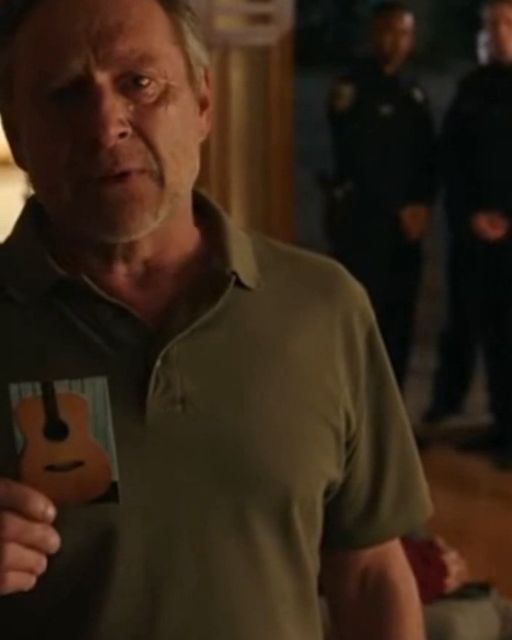
He pulled a second photo out of his pocket and held it up.
My blood ran cold. It wasn’t jewelry. It was a photo of my mother’s locket.
It wasn’t just any piece of jewelry; it was the silver heart-shaped locket my grandfather, a silversmith, had made for my mom when she was a girl. It was the one thing of hers I cherished above all else, the one thing my dad had promised would always stay in the family.
I kept it tucked away in a velvet-lined box in my old jewelry case, a place I thought was safe.
A strangled sob escaped my lips. That locket held a tiny, faded picture of my mom and me at the beach, my toddler self perched on her shoulders, both of us laughing into the sun. It was my most precious memory made tangible.
Brenda finally found her voice, a weak, pathetic whimper. “Thomas, I can explain.”
“Explain what?” my dad’s voice was dangerously low, a rumble of thunder before a storm. “Explain how you took my late wife’s memory and sold it for pocket change?”
The younger police officer shifted uncomfortably. “Sir, maybe we should…”
“No,” my dad said, holding up a hand. He never took his eyes off Brenda. “They need to hear this. The whole world needs to hear this.”
Brenda began to cry, but they weren’t tears of remorse. They were tears of a cornered animal. “I needed the money! I had debts! You wouldn’t understand!”
“Debts?” my dad scoffed, a bitter, humorless sound. “We have a joint account, Brenda. You have your own credit cards. What debts could you possibly have that would lead you to do this? To frame my daughter?”
She crumbled then, sinking onto the edge of an armchair. The truth came out in a torrent of ugly, desperate words.
It was gambling. Online casinos, late-night poker games with people she shouldn’t have known. It started small, a bit of fun, but it spiraled. She owed thousands to some very unsavory people. They had started making threats.
She pawned the engagement ring first, thinking she could win it all back in one big score and retrieve it before my dad noticed. When she lost that money too, she panicked.
“I didn’t know what to do,” she wailed, burying her face in her hands. “I saw the locket in her room when I was… looking for things. I knew it was old silver. I thought it would be worth something.”
My heart felt like a block of ice in my chest. She had gone through my things, looking for valuables to steal.
And then the most twisted part of her plan came out. She invented the story about me stealing her ring to create a diversion. She thought if she made a big enough scene, my dad would be so angry with me, so focused on my supposed crime, that he would never notice his own ring was gone for a few days. She planned to “find” it later, after she’d paid her debts.
“You were going to throw your own stepdaughter under the bus,” my dad said, his voice hollow with disbelief. “You were going to let her be arrested to cover your tracks.”
He looked at me, and the shame and regret in his eyes were a physical blow. I saw the man I knew again, the father who had been lost in a fog of grief and a new, distracting marriage.
The older officer finally spoke. “Mr. Miller, what she did with the engagement ring is a domestic issue. But the locket… that’s theft of personal property. The owner,” he nodded toward me, “can press charges if she wants to.”
All eyes turned to me. Brenda looked up, her makeup-streaked face a mask of desperation. “Please,” she whispered. “Sarah, please. I’ll pay you back. I’ll do anything.”
I thought about the past two years. The snide comments, the “accidental” spilling of wine on my mother’s photo albums, the constant little digs that made me feel like a stranger in my own home. I thought about the sheer terror I felt when those officers walked into my room.
But then I looked at my dad. His world was collapsing. He had loved this woman, or at least, he had tried to. He had built a new life with her, and now he was seeing it was all a lie. Sending her to jail felt less like justice and more like just another layer of pain on an already shattered family.
“No,” I said, my voice barely audible. “I don’t want to press charges.”
My dad looked at me, surprised.
“I just want her gone,” I said, a little stronger this time. “I want her out of this house. Today.”
My dad nodded slowly, a silent agreement passing between us. He turned to Brenda, his face set like stone. “You heard her. Pack a bag. I’ll have the rest of your things sent to your sister’s. The marriage is over.”
Brenda didn’t argue. She just got up, defeated, and walked up the stairs without another word. The police officers gave us a sympathetic look, said they would wait outside until she was gone, and quietly let themselves out.
The silence that filled the living room was heavier than any of the screaming that had come before it. My dad finally sank onto the sofa, the same spot where he’d sat with his head in his hands, and this time, he let the tears fall freely.
I sat next to him, not touching him at first. We just existed in our shared misery for a few minutes.
“I’m so sorry, Sarah,” he finally choked out. “I’m so, so sorry.”
“It’s not your fault, Dad,” I whispered.
“Yes, it is,” he insisted, wiping his face with the back of his hand. “I let this happen. I was so lonely after your mom… and Brenda was so vibrant, so full of life. I wanted to feel that again. I let myself be blind to who she really was. I saw how she treated you, the little things, and I told myself it was just an adjustment period. I didn’t protect you. I failed you.”
His confession broke down the last wall between us. I leaned my head on his shoulder, and we cried together. We cried for my mom, for the life we lost, and for the painful detour our lives had just taken.
After a while, he told me the rest of the story. The pawn shop owner, a man named Mr. Henderson, had a shop on the other side of town. My dad had never met him before. When Brenda came in with the engagement ring, Mr. Henderson was suspicious. He said she seemed frantic and desperate. He took the ring but felt uneasy about it, so he looked up my dad’s business number and left a message.
That was a few days ago. My dad had been mulling it over, trying to figure out how to confront Brenda without a huge explosion. He didn’t want to believe it.
But then, Mr. Henderson called again this morning.
“He said another item had come in that he knew belonged to our family,” my dad said, his voice thick with emotion. “He recognized it instantly.”
“He recognized Mom’s locket?” I asked, confused. “How?”
My dad took a deep breath. “Do you remember your mom volunteering at the community food bank every Saturday? For years?”
I nodded. It was one of my fondest memories of her, seeing how much she cared about helping others.
“Well,” my dad continued, “Mr. Henderson’s family fell on hard times about fifteen years ago. He’d lost his job, and they were struggling to make ends meet. He told me he and his wife used to go to that food bank. He said your mother was always the kindest one there. She never made them feel ashamed. She’d slip extra juice boxes into the bag for their son and always asked how his job search was going.”
He paused, his eyes distant. “One day, he told me, his wife was admiring your mother’s locket. Your mom took it off and showed it to her, told her the story about your grandfather making it. It was a small moment, but it stuck with him all these years. He never forgot her kindness, or that locket.”
Tears welled in my eyes again, but this time they were different. They weren’t from pain or anger.
“When Brenda brought it in,” my dad said, “he knew immediately something was terribly wrong. He knew your mother would never have sold it. He told me he felt it was his duty to protect her memory. He bought the locket from Brenda, but he didn’t put it out for sale. He held onto it, waiting. That’s when he called me the second time.”
My mother’s kindness, an act from fifteen years ago, had reached through time to protect me. It was a ripple effect of goodness I never could have imagined. A man she had helped in his darkest hour had, in turn, helped save her most precious legacy from being lost forever.
Brenda left within the hour, stuffing a single suitcase into her car and driving away without a backward glance. The police car followed her down the street, and then our home was quiet. It was a new kind of quiet, not empty, but peaceful.
The next few months were about healing. My dad and I talked more than we had in years. He helped me with my grad school applications, reading over my essays and offering encouragement. We cooked my mom’s old recipes in the kitchen, filling the house with the smell of her marinara sauce and chocolate chip cookies. We put her pictures back up on the walls where Brenda had quietly taken them down.
My dad filed for divorce. He also made sure Brenda got professional help for her gambling addiction, not out of love, but out of a sense of duty. He told me that forgiveness wasn’t about excusing what she did, but about letting go of the anger so it wouldn’t poison us, too.
A year later, I was settled in my new apartment near campus, fully immersed in my studies. My dad came to visit one weekend. He looked lighter, happier than I had seen him in a long time. He brought me a small, carefully wrapped box.
Inside was my mother’s locket, polished to a brilliant shine, resting on a bed of new velvet.
“It belongs with you,” he said, his eyes smiling.
I fastened it around my neck, the cool silver a familiar weight against my skin. It felt like a piece of my mom was with me, a guardian angel made of memory and love. We spent the day exploring my new city, talking and laughing, rebuilding our bond piece by piece.
That evening, as he was about to leave, he hugged me tightly. “I’m so proud of you, Sarah. Your mother would be, too.”
As I watched him drive away, I touched the locket at my throat. I realized that the worst betrayals don’t have to break you. Sometimes, they burn away the things that aren’t real, leaving only the truth behind. My family had been broken, but from the ashes, my father and I had found our way back to each other, stronger and more honest than before. And I learned that the love you put out into the world never truly disappears. It can return to you in the most unexpected ways, a quiet echo of kindness, right when you need it the most.