The sting on my cheek bloomed hot and sudden.
My glasses were on the tile, one lens cracked. A thick folder of his bad ideas lay scattered near my feet.
“Pick it up,” my son-in-law, Mark, said.
His voice was low. The kind of voice that expects to be obeyed.
This was my kitchen. In the house I paid for. The house he lived in while playing tycoon on three glowing screens in a spare bedroom.
He wanted my little place by the lake. Not for the memories of my late wife on the porch, but to plug a hole in a sinking financial ship.
I had already told him no. Twice.
“You live under my roof,” he said, stepping so close I could smell the coffee on his breath. “You eat my food. You will help.”
I reminded him, very quietly, who signed thechecks for that roof.
That’s when his hand came up.
But it wasn’t the hit that broke something in me. It was the sound from the doorway.
A sigh.
My daughter stood there, work bag still on her shoulder. She saw it all.
“Dad,” she said, her voice worn thin. “You know how much pressure he’s under. Why do you always have to fight him?”
I looked from her face to his. They were a team.
And I was just an obstacle.
A deep, cold quiet settled in my chest. I bent down, collected my glasses, and slipped them into my pocket.
I nodded.
“You’re right,” I said. My voice was steady. “We’ll sort it out tonight. I’ll make dinner. Bring the paperwork. Bring your lawyer, too. We’ll make it official.”
Mark’s face split into a grin. The victor.
He had no idea the war had just started.
That afternoon, I bought the best cuts of steak the butcher had. I bought a bottle of wine that cost more than my first car.
I set the table with the good china.
I was preparing a last meal.
At seven, the house smelled of victory. His victory. Mark arrived with his lawyer, Leo, both of them laughing.
Then the doorbell rang.
“Expecting someone?” Mark snapped.
“I am,” I said, and walked to the door.
Two figures stood on the porch. A man in a simple dark coat, with the unnerving stillness of a federal agent. And a woman in a charcoal suit, her face one I’d only seen on the financial news.
She was the CEO of the company Mark was trying to gut from his little home office.
“Please, come in,” I said. “You’re just in time.”
The color drained from Mark’s face.
He tried to recover, his voice too loud, his hands shaking as he poured wine. He launched into a speech about “leveraging assets” and “aggressive growth,” trying to paint himself as a peer.
He thought he was performing for them.
He didn’t know they were his audience.
We ate. The steak was perfect.
Finally, he slid the thick folder across the polished wood. “Time to sign, old man. Grab a pen.”
I didn’t move toward the folder.
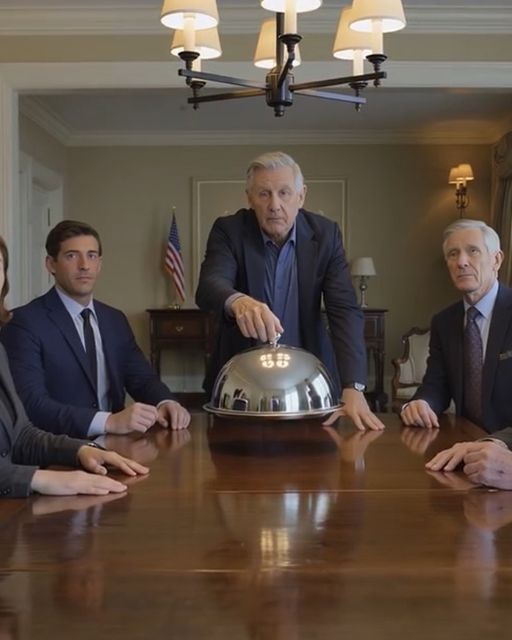
Instead, I stood, walked to the sideboard, and picked up a heavy silver serving platter, the dome hiding what was beneath.
I placed it in the center of the table.
Mark rolled his eyes. “We’re not doing dessert, Dad. We’re closing a deal.”
“This is the deal,” I said, my fingers on the handle.
I lifted the lid.
There was no cake. No pie.
Just a neat, thick stack of paper. Printed emails. Bank transfers he thought were hidden. Private messages he thought were deleted.
A perfect summary of his ruin.
He stared at the evidence. Then he looked up, at the two silent guests watching him from across the table.
And for the first time in his life, Mark had absolutely nothing to say.
The silence in the room was heavy, thick as tar. It swallowed the clinking of forks and the confident drone of Mark’s earlier speech.
The CEO, Ms. Albright, didn’t touch the papers. She just looked at Mark with a kind of weary disappointment.
The man in the dark coat, Mr. Davies, had eyes that missed nothing. They flickered from the stack of evidence to Mark’s panicked face.
Mark’s lawyer, Leo, a man who had been all smiles and back-pats an hour ago, was now statue-still. His fork was frozen halfway to his mouth.
My daughter, Sarah, was the one who finally broke the quiet. Her voice was a fragile whisper. “Dad? What is this?”
She was looking at me, not her husband. For the first time all day, she was really looking at me.
“This,” I said, my voice calm and even, “is the pressure Mark has been under.”
I reached out and tapped the top page. It was a wire transfer confirmation to an offshore account. An account not in his name.
“It started small,” I explained, my eyes on Sarah. “I tried to ignore it. A man is allowed his pride, his secrets.”
I’d noticed things. Bills that didn’t add up. Phone calls he’d take out on the patio, his voice a low, angry hiss.
The way he looked at our family photos, not with affection, but with the cold calculation of an auctioneer assessing assets.
He didn’t see family. He saw inventory.
“But it didn’t stay small,” I continued.
Ms. Albright finally spoke. Her voice was sharp, cutting through the tension. “Mr. Peterson,” she said to Mark, “for six months, you’ve been siphoning proprietary data. Our algorithms. Our client lists. You thought you were smarter than our entire cybersecurity team.”
She gestured to the papers. “You were not.”
Mark found his voice. It was cracked, desperate. “That’s… that’s fabricated! He’s a bitter old man! He hates that I’m successful.”
He pointed a shaking finger at me. “He’s trying to ruin me because I’m taking care of his daughter better than he ever could!”
Sarah flinched as if he’d struck her.
Mr. Davies, the quiet man, finally moved. He leaned forward slightly, his presence filling the room. “The data transfers are time-stamped, Mr. Peterson. The IP address traces back to this house. To the computer in the spare bedroom.”
His gaze was flat. Unforgiving. “We also have your encrypted chats with foreign competitors. We decrypted them this morning.”
Mark’s bluff collapsed like a house of cards. His face crumpled.
“Sarah… baby, they’re lying,” he stammered, turning to his wife. His last line of defense. “You have to believe me. It’s him or me.”
Sarah looked at the stack of papers. She looked at the cold, professional faces of our guests. Then she looked at the faint red mark still visible on my cheek.
Her own face was a storm of confusion, shame, and a terrible, dawning clarity.
“How did you know, Dad?” she asked me, ignoring her husband completely.
This was the part I dreaded. This was the part that would hurt her more.
“People like me, Sarah, we don’t look like much,” I began. “I spent thirty-five years as a forensic accountant for the Treasury. Not a thrilling job. I looked for needles in haystacks. I followed the quiet money.”
Most people thought I just crunched numbers. My own daughter thought my life’s work was boring.
But my job was to see the patterns people tried to hide. To understand the lies money tells.
“When Mark started talking about ‘creative financing’ for his ventures, my ears perked up,” I said. “He was using language I’d heard before. From men in courtrooms.”
But it was more than that. It was something my Eleanor, your mother, had given me.
Before she passed, she was getting frail. She knew she was leaving. One afternoon, she called me to her side.
She pressed a small, ornate key into my palm. “For your rainy day, my love,” she’d whispered. “Not for a storm. Just for a persistent, miserable drizzle. You’ll know it when you feel it.”
I had no idea what it opened. I’d put it away in my sock drawer, a sad memento of her last lucid day.
After the incident in the kitchen, after Sarah had sided with him, I felt that miserable drizzle start.
I went upstairs, pulled out the key, and started looking. It didn’t fit any lockbox or diary.
On a whim, I looked at the bottom of her old jewelry box. There was a false bottom, no bigger than a postage stamp. The key didn’t fit a lock; it was for prying it open.
Inside was a single slip of paper. On it, in her familiar, shaky handwriting, was a string of letters and numbers.
It looked like nonsense. But I knew her. I knew her love of books. It was a code.
The numbers corresponded to page, line, and word in her favorite book of poetry, which still sat on my nightstand.
It took me an hour to decipher it. It was the master password to their shared cloud storage account. An account Mark probably forgot even existed.
She had seen it. Years ago, my wife had seen the rot in Mark’s character. She saw the casual cruelty, the ambition that had no moral compass.
She didn’t tell me. She knew I wouldn’t have believed her, not against our daughter’s happiness. So she left me a tool. For a rainy day.
I logged in. It was all there. Drafts of his plans. Copies of incriminating emails he thought he’d scrubbed. A ledger of his real debts, hidden from everyone.
He was not just failing. He was drowning, and he was planning to use my home, my legacy, and his wife as a life raft.
I didn’t tell all of this to the dinner table. I just looked at Sarah.
“Your mother was a smart woman,” I said softly. “She looked out for us.”
That was all Sarah needed to hear. The mention of her mother broke the dam.
A single tear traced a path down her cheek. She finally turned to her husband.
“You hit my father,” she said, her voice trembling with a rage I hadn’t heard from her in years.
“He was provoking me!” Mark yelled, his desperation making him ugly.
“In his own house!” she cried back. “And all this time… all this pressure you were under… it was because you’re a criminal? A liar? You let me think he was the problem.”
She stood up, her chair scraping harshly against the floor. “You made me choose. And I chose you. I defended you.”
The self-loathing in her voice was a knife in my heart.
Leo, the lawyer, finally saw his escape route. He slowly pushed his chair back. “Mark, given this new information, I believe there is a significant conflict of interest. I must officially withdraw as your counsel.”
He stood, gave a curt nod to Mr. Davies, and practically fled the room without a backward glance. One rat leaving a very-much-sinking ship.
Mark was alone now. Truly alone.
He stared at Sarah, his face a mask of disbelief. He couldn’t comprehend that his powers of persuasion had failed.
“Sarah,” he pleaded, his voice dropping to a manipulative whisper. “We can fix this. You and me. We’re a team.”
“No,” she said, her voice now cold iron. “We are not. I think you should go with these people.”
Mr. Davies stood. It was time. “Mark Peterson, you’re under arrest for corporate espionage, wire fraud, and conspiracy.” He didn’t produce handcuffs. It wasn’t that kind of evening. It was a quiet, gentlemanly demolition.
“My colleague will escort you outside,” he said, nodding to a second agent who had appeared silently in the doorway.
Mark didn’t resist. All the fight had gone out of him. He looked like a balloon that had been pricked, shrunken and pathetic.
As they led him away, he looked back at me one last time. There was no anger in his eyes. Just a hollow emptiness. He’d gambled and lost everything.
Ms. Albright stood and offered me her hand. “Thank you, Arthur. You’ve done our company, and the authorities, a great service. We were building a case, but your evidence… it was the final nail.”
“I was just protecting my home,” I said, shaking her hand.
“You were protecting more than that,” she said, glancing kindly at Sarah.
Then they were gone.
The front door clicked shut, leaving a profound and deafening silence behind it.
It was just me and my daughter, standing in the wreckage of her life. The expensive steaks were half-eaten. The fine wine was forgotten.
Sarah sank back into her chair and buried her face in her hands. Her shoulders shook with silent sobs.
I didn’t go to her immediately. I gave her a moment, a piece of privacy in her storm of grief.
I started clearing the plates, the scraping of cutlery on china the only sound. It was a simple, normal task in the most abnormal of moments.
“How could I not see it?” she finally choked out from behind her hands. “How could I be so blind?”
I set the plates by the sink and came to the table. I sat in the chair next to hers.
“You weren’t blind, sweetheart,” I said gently. “You were in love. You wanted to believe in the man you married. That’s not a flaw. That’s a gift.”
“He twisted everything,” she whispered. “He made me feel like I was crazy for questioning him. He made me think you were the villain, trying to hold him back, trying to control me.”
“Men like Mark are good at that,” I said, my heart aching for her. “They create a world with themselves at the center and they convince you it’s the only world that’s real.”
She finally looked at me, her eyes red and swollen. “I’m so sorry, Dad. I’m so, so sorry. I let him… I stood there and I let him disrespect you. I took his side.”
“I know,” I said. And in that moment, all the anger I’d felt, all the hurt, it just washed away. All I saw was my little girl, lost and hurting.
“You don’t need to be sorry,” I told her. “We’re family. We get lost sometimes. The important thing is we find our way back.”
She moved from her chair and knelt on the floor beside me, laying her head on my lap, just like she did when she was a child with a scraped knee.
I stroked her hair. We stayed like that for a long time as the last light of day faded from the windows.
The next few months were hard. There were legal proceedings, public humiliation, the slow and painful process of untangling her life from his.
Sarah moved back into her childhood bedroom. At first, she was quiet, a ghost in my house. But slowly, she began to heal.
We spent evenings on the porch of the lake house, the one he’d wanted to sell. We didn’t talk much at first. We just watched the sunset paint the water in shades of orange and purple.
We were rebuilding, one silent sunset at a time.
One evening, she turned to me. “Mom knew, didn’t she? That’s why she left you that key.”
I nodded. “She saw something we didn’t. She trusted I’d figure it out when I needed to.”
A small smile touched Sarah’s lips. “She always was the smartest one in the family.”
“She was,” I agreed.
In the end, Mark’s grand ambition earned him a federal prison sentence. His name was a warning, a footnote in the financial news.
My life didn’t change much. I still live in my house. I still take my walks by the lake. But everything feels different. The air feels cleaner. The house feels lighter.
My daughter is with me. She’s started her own small business, a landscaping company, pouring her energy into making things grow. She is finding her own strength, a strength that was there all along, just buried.
Sometimes, the worst storms aren’t the ones that knock down the house. They’re the ones that come inside, quietly, and try to rot it from within. Strength isn’t always about yelling the loudest or hitting the hardest. Sometimes, it’s about patience. It’s about knowing when to set a table for your enemies, and having the courage to serve them exactly what they deserve. It’s about protecting what you love, not with fists, but with truth. And realizing that the quietest person in the room is often the one you should listen to the most.