“Just try not to look lost.”
My father’s words, a low chuckle meant to be kind. It wasn’t.
My mother adjusted her pearls, her eyes fixed on my brother, Mark, standing ramrod straight on the parade grounds. “He’s right. You’re not exactly military material, sweetie.”
They had no idea who they were talking to.
I just nodded. A tight, practiced smile. The armor was invisible, built over decades of their casual dismissals.
They thought I worked in “logistics.”
They thought I flew in under an alias because I was ashamed of my dead-end government job. The truth was classified. The truth kept men like my brother alive.
Then the music swelled. The crowd got to its feet.
A four-star general, a man carved from granite and steel, took the podium.
He called my brother’s name. The applause was a thunderclap. My parents were glowing, their faces shining with a pride I had never earned.
And just when it should have been over…
The general paused.
His gaze swept the crowd, a hawk searching for something specific.
His eyes landed on me.
The field went quiet. A thick, sudden silence.
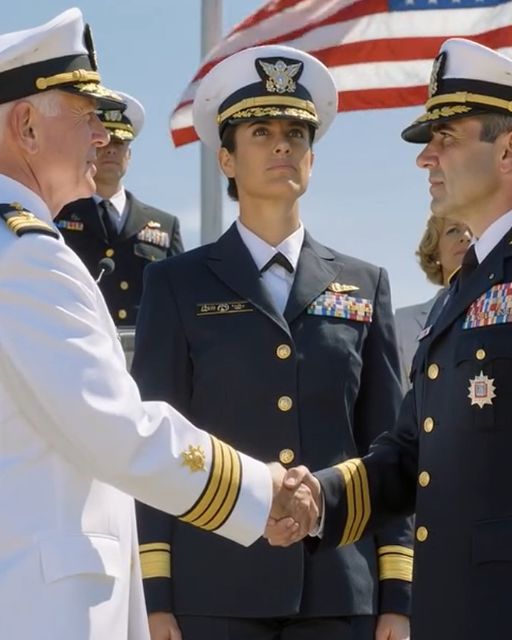
“Before we conclude,” the general’s voice boomed, cutting through the air. “There is one more officer here today who deserves our recognition.”
My mother’s smile faltered. My father leaned forward in his seat, his brow furrowed in confusion.
“Her work is necessarily unseen,” the general continued. “But the men on this stage… they are alive because of it.”
An aide handed him a folder. The red “TOP SECRET” stamp seemed to burn in the sunlight.
“She has commanded joint missions under the highest classification. Today, for the first time, we are cleared to acknowledge her.”
The world slowed down. The heat, the distant flags, the breathing of the person next to me.
The general turned. His eyes locked with mine.
“Commander Riley, front and center.”
A gasp rippled through the stands.
My mother’s hand flew to her mouth. My father froze, a statue. My brother, the golden son, turned his head so fast I thought it would snap. His jaw was on the floor.
I stood up.
My own uniform, the one they’d never seen, caught the light.
The general snapped a salute. My brother, his hero, immediately followed suit, his eyes wide with a look I’d never seen before. Awe.
My parents didn’t move. They just stared.
Later, in the stunned quiet after the crowds had gone, my father finally found his voice. It was a whisper.
“Why didn’t you tell us?”
I looked at him, then at my mother, their faces a canvas of confusion and regret.
“You never asked.”
The three words hung in the air, heavier than any medal.
The drive to the celebratory lunch they’d planned was suffocatingly silent. Mark was in the front passenger seat, occasionally glancing in the rearview mirror, his eyes trying to solve a puzzle he never knew existed.
My parents were in the back with me. My mother kept smoothing her dress, a nervous tic I hadn’t seen in years. My father just stared out the window, his reflection a pale, tight-lipped ghost.
The restaurant was one of those fancy steak-and-seafood places they loved, the kind Mark always chose. It was meant to be his day.
We were seated at a round table in a quiet corner. A waiter came and went, pouring water, taking drink orders in a murmur.
No one looked at the menus.
Finally, my mother broke. “A commander? Sarah, I don’t understand.”
Her voice was frail, all the earlier confidence stripped away.
“It’s a rank, Mom.” I said it gently. There was no victory in this, only a profound ache.
“But… your job. You said you coordinated supply chains.”
“That’s part of it,” I conceded. “The part I was allowed to tell you.”
My father cleared his throat. “The alias you fly under… we thought… we thought you were embarrassed.”
He couldn’t finish the sentence. Embarrassed of them. Embarrassed of your life. The unspoken accusations had always been there.
“It’s for security, Dad.”
Mark finally spoke, his voice low and serious. “She’s a ghost, Dad. She doesn’t exist on paper. That’s how people who do her job stay safe. How they keep people like me safe.”
His validation was a strange, new sound. It felt like the ground shifting under my feet.
My mother’s eyes filled with tears. “But we’re your parents! We had a right to know. We could have been proud of you too!”
The ‘too’ was the part that stung. Proud of me in addition to Mark.
“Would you have been?” I asked, my voice barely a whisper. “Or would you have told me it wasn’t a suitable job for a woman? That I should be careful? That I should think about settling down?”
The words were an echo of a hundred past conversations about a hundred other, smaller choices I had made. The computer science degree they thought was ‘odd’. The government job they saw as ‘unambitious’.
My father flinched. He knew I was right.
“It wasn’t just about the classification,” I continued, finding a strength I didn’t know I had. “It was easier this way.”
“Easier for who?” my mother cried.
“For me,” I said, meeting her gaze. “It was easier than watching you try to hide your disappointment.”
The truth landed on the table with the weight of an anchor. The bread basket sat untouched.
The rest of the lunch was a blur of forced pleasantries and long, painful silences. My parents tried. They asked clumsy questions about my work, questions I couldn’t answer. They fumbled for praise, offering compliments that felt like they were reading from a script.
“It must be so stressful,” my mother offered.
“You must be very brave,” my father mumbled into his steak.
They were praising the uniform, not the person wearing it. They were proud of the idea of Commander Riley, but they still didn’t know Sarah.
We drove back to their house, the place where I grew up, a house that felt more like Mark’s museum than my home. His football trophies lined the mantelpiece. His graduation photos were on every wall.
There was one picture of me, from my college graduation. I was off to the side, slightly out of focus.
We sat in the living room, the air thick with things unsaid.
Mark had been quiet for hours, his mind clearly turning over the day’s events. He was looking at me, really looking at me, maybe for the first time since we were kids building forts out of couch cushions.
He leaned forward, his elbows on his knees. “Operation Nightfall,” he said, his voice quiet but intense. “Three years ago. Eastern Afghanistan.”
My blood ran cold. It was a highly classified mission.
I gave a slight shake of my head, a warning. “Mark…”
He ignored me, his eyes locked on mine. “We were pinned down. Ambushed. Comms were out. We were blind, waiting to die. The command structure had us written off as a total loss.”
My parents stared at him, their faces pale. This was not a story he had ever told them.
“Then, out of nowhere,” he continued, “a new voice came over a backchannel. A woman’s voice. Calm. Clear.”
He paused, his own voice cracking with emotion. “She was a whisper in the static. She gave us an exit route that didn’t exist on any map. It took us through a series of old, collapsed tunnels. She guided us step by step. She knew where every enemy patrol was. She knew their numbers, their weapons. It was like she was floating above us, seeing everything.”
He looked at me, his eyes shining with unshed tears. “We called her ‘Athena’. The mission report said the intel came from an ‘unspecified intelligence asset’. They told us we were just lucky.”
He took a deep breath. “It wasn’t luck, was it, Sarah? Athena… that was you.”
I didn’t answer. I couldn’t. The rules were absolute.
But my silence was its own confession.
The room was utterly still. The only sound was my mother’s soft sob. She was looking at me, but I think she was seeing Mark, bleeding out on some forgotten mountainside.
My father looked like he’d been punched. The casual dismissal, the gentle mockery… it all curdled in the face of this new reality. The daughter he thought worked in “logistics” had reached through the static and pulled her brother from the grave.
“I…” he started, his voice a hoarse rasp. “I had no idea.”
“That’s the point of my job, Dad,” I said, my voice softening. “No one is supposed to.”
The weeks that followed were strange. My parents called. A lot. They left long, rambling voicemails. They sent gifts – a ridiculously expensive watch, a gift certificate to a spa. They were trying to buy their way back into my life, to plaster over the cracks with expensive apologies.
It didn’t work. The distance between us wasn’t about money or gifts. It was about years of being unseen.
I was on a short leave, staying in a small, anonymous apartment near the base. I was sorting through old boxes when my father called. I almost let it go to voicemail, but something made me answer.
“Sarah? Can I… can I come over?” he asked. He sounded different. Tired.
An hour later, he was sitting on my stiff rental couch, holding a lukewarm cup of coffee. He wasn’t the confident, jovial man I’d known my whole life. He looked smaller, older.
He was quiet for a long time, just staring at a photo I had on the bookshelf. It was of me and my small team, our faces smudged with dirt, taken after a successful operation. We weren’t smiling, just looking at the camera with a shared, bone-deep exhaustion.
“You look so serious,” he said.
“It’s a serious job.”
He nodded slowly. He put the coffee cup down on the coaster I’d provided.
“I need to tell you something,” he began, his eyes fixed on the floor. “Something I’ve never told anyone. Not even your mother.”
I waited.
“When I was twenty, I enlisted. Army,” he said. “I wanted to be a hero. I wanted to be the guy they made movies about. Just like… just like you see Mark.”
I was stunned. My father, the insurance salesman who hated camping and complained about yard work, had been in the army.
“It didn’t last long,” he said with a dry, humorless laugh. “Six months. I couldn’t cut it. The physical part, the discipline… I wasn’t built for it. I washed out of basic training. Honorable discharge for ‘failure to adapt’.”
He finally looked at me, and his eyes were full of a shame that was forty years old. “Failure to adapt. That’s what the paper said. I felt like the biggest failure on the planet.”
Suddenly, a lifetime of puzzle pieces began to slide into place.
“I came home, went to business school, met your mother,” he went on. “I built a good life. A safe life. But I never got over it. That feeling of not being man enough.”
He gestured vaguely. “And then Mark came along. He was strong, athletic, fearless. He was everything I wasn’t. I pushed him, Sarah. I pushed him towards the military because I wanted him to succeed where I had failed. I needed him to.”
His voice dropped to a whisper. “I was living through him. His victories were my victories.”
“And me?” I asked, my own voice quiet.
He let out a long, shuddering breath. “You were smart. So smart. You understood things I never could. Computers, strategies, complex problems. It was like a foreign language to me. Your strength wasn’t something I could measure on a football field or a rifle range. I couldn’t understand it.”
He looked at me, his face etched with regret. “And because I couldn’t understand it, I dismissed it. It made me feel small, like that twenty-year-old kid again who couldn’t adapt. It was easier to make a joke about you being ‘lost’ than to admit my own son was a hero and my daughter was a genius I couldn’t even begin to comprehend.”
The confession hung in the air, raw and painful. It wasn’t an excuse. It was a reason.
He wasn’t mocking me all those years because he thought less of me. He was mocking me because he thought less of himself.
For the first time, I saw him not as my father, the unassailable judge of my life, but as a man haunted by his own ghosts.
My anger, that cold, hard stone I had carried for so long, didn’t vanish. But it softened. It changed its shape.
A few months later, I was home for a real holiday. Not just a flying visit between deployments.
The house felt different. My graduation photo was gone from the wall. In its place was a new frame. It held two pictures, side by side. One was of Mark in his full SEAL gear, looking every bit the warrior.
The other was the photo from my bookshelf, the one of me and my team, looking tired but resolute.
My mother came and stood beside me. “Your father thought they belonged together,” she said softly.
At dinner that night, the conversation was still a little stilted, a little careful. But it was real. Mark told a funny, self-deprecating story about a training exercise. My mother talked about her garden club.
Then, my father turned to me. He didn’t ask about missions or medals.
“So,” he said, a genuine curiosity in his eyes. “That computer science degree. What was the hardest class you had to take?”
It was a simple question. A normal question.
And as I started to tell him about advanced algorithms and data structures, I saw him lean forward. He didn’t understand all the words, but he was listening.
He was finally, truly listening.
Mark caught my eye from across the table and gave me a small, subtle nod. A nod that said, ‘It’s about time.’
We were a family, cracked and damaged, but slowly, carefully, putting the pieces back together in a new, more honest way. The pride was still there, but it was no longer lopsided. It was balanced.
True strength isn’t always what you can see. It isn’t always the loudest voice in the room or the most decorated soldier on the field. Sometimes, it’s the quiet resolve, the unseen effort, the calm voice in the static that guides others home. And sometimes, the hardest mission of all is learning to see the value in those you love, not for what you want them to be, but for the incredible people they already are.