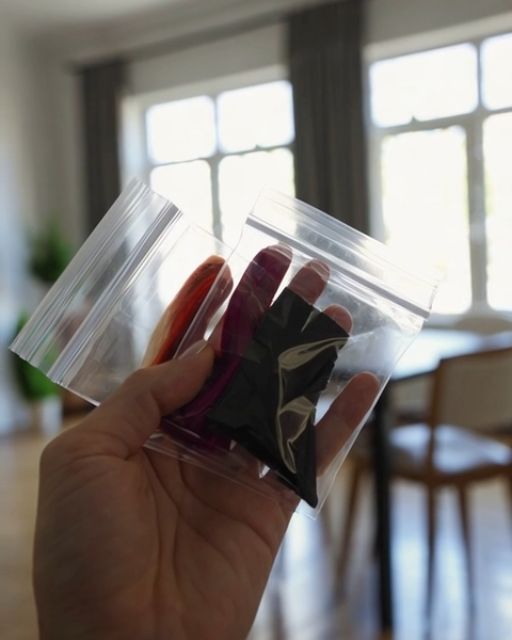
I found bundles of women’s hair hidden inside my husband’s pillow — not a few strands, but actual labeled locks: “12in, red,” “gray – coarse,” etc.
My blood ran cold. They were stuffed into a zip bag and hand-stitched inside the pillow. I had no idea what it meant. I freaked out and called 911.
Minutes later, cops were in our living room examining everything when my husband walked in, holding another plastic bag of hair. I’ll never forget what happened in the next few minutes.
He froze. Stared at the police, then at me. His mouth moved like he wanted to explain, but no sound came out. The officer stepped toward him, asking where he got the bag and if there were more.
My husband — Colin — looked panicked but then slowly said, “It’s not what it looks like. Please let me explain.” He dropped the bag onto the coffee table and sat down.
One officer was already unzipping the new bag. Inside were more locks of hair, also labeled, some even braided. I sat across from Colin, still shaking. “You better explain fast,” I said, barely keeping my voice steady.
“I collect them,” he said. “Not for anything bad. I swear. They’re from the hospice center.”
Everyone went quiet.
“What?” I said.
He ran his hands through his hair and sighed. “I never told you this because I knew you’d think it was weird. I volunteer at a hospice center downtown. I started doing it a year ago, after my dad passed. I never handled it well. And one of the patients… she asked me to save a lock of her hair. Said her daughter wouldn’t want it. Said she wanted someone to remember her.”
The officer narrowed his eyes. “So you’re telling us these are from deceased individuals?”
Colin nodded. “Yes. Some of them asked me directly. Others left them in envelopes with their belongings. The staff said it was okay. They know me there. I stitched them into the pillow because… I didn’t know where else to keep them.”
The room fell into a strange silence.
I wanted to believe him. I really did. But who does that? Collects locks of hair from people who passed away and sleeps on them like a… memory foam of souls?
The officers took down a report but didn’t arrest him. One of them even called the hospice center to verify, and to my shock, they backed up his story.
Still, I couldn’t sleep that night. My husband had been sleeping on the couch for months, saying he “tossed and turned too much,” and didn’t want to wake me. Now I wondered if it was about guilt. Or grief. Or both.
The next morning, I asked him to tell me everything.
He looked exhausted. “It started with Ms. Rosemary. She was the first. She said her family abandoned her. Didn’t want to remember her. So she asked me to remember her instead. I didn’t know what to do. She gave me a lock of her white hair and said, ‘Keep it close. I want to be part of the world, not buried and forgotten.’”
I listened, unsure of how to feel. He continued, “Then came Mr. Abdi. He didn’t have any family left. He wrote me a letter and enclosed his wife’s braid. Said it was the only thing that kept him going after she passed, and he wanted someone to keep it safe.”
“So you became the keeper of forgotten memories?” I asked.
He nodded. “I didn’t plan on it. But every time I thought about throwing them away, I felt sick. Like I was discarding someone’s story. So I labeled them and… kept them with me. I guess I thought I was honoring them.”
Part of me was touched. The other part was deeply disturbed.
“I need time,” I told him.
And I meant it.
For a few weeks, we barely spoke. I’d see him come and go with the same tired look in his eyes, but I didn’t ask questions. I started reading about grief rituals in different cultures. Some kept ashes. Some wore jewelry made of hair. Maybe Colin wasn’t that far off.
Still, I couldn’t shake the feeling that something else was going on.
One day, I visited the hospice myself. Pretended I was looking for volunteer opportunities. The nurse at the front desk immediately smiled when I mentioned Colin.
“Oh, Colin’s a sweetheart. Everyone here loves him. He’s the only one who stays past visiting hours just to hold someone’s hand.”
That softened me a bit.
But then I noticed a bulletin board on the wall — photos of residents and volunteers. My husband was in a few pictures… smiling, arms around patients. But there was one photo that made my stomach drop.
It was him, sitting beside a woman in a wheelchair. She had bright red hair — the same shade as the lock I’d found labeled “12in, red.” Her head was completely bald in the photo.
The date on the picture was from six months ago.
I left quickly, heart pounding.
When I got home, I pulled the bag of hair from his pillow and studied it again. Something didn’t sit right. The label was neat, like a tag you’d find in a store.
And then, I found the receipt. Hidden in his toolbox drawer — an online order for “human hair bundles, ethically sourced.” The item matched the red lock exactly.
My hands shook.
Why would he lie about this one?
That night, I confronted him again.
He stared at the receipt and sighed. “Okay. Not all of them are from the hospice.”
I blinked. “So… what, some are real, some are fake?”
He nodded. “I wanted to tell you. But I didn’t want to stop. It became a… thing. A compulsion. I didn’t realize how far it had gone.”
It turns out, Colin had started collecting real locks from hospice patients, but when fewer people gave him any, he started buying hair online. He labeled them as if they were real. He said he told himself it was the same — remembering people who might’ve died somewhere in the world.
“I guess I couldn’t stop thinking about all the people who pass away alone,” he said. “And if no one remembers them, what happens to their stories?”
I cried. For him. For them. For myself.
I asked him to go to therapy. He agreed without hesitation. He even apologized for keeping it secret for so long.
Weeks passed. Then months.
We slowly rebuilt things.
Colin kept volunteering, but stopped collecting hair. Instead, he started writing short stories about the people he met — their quirks, their regrets, the things they loved. He put them all in a journal titled The Ones Who Stayed.
One day, he showed me the notebook. “This feels better,” he said. “Like I’m remembering them with words instead of things.”
I smiled. That version of him — the one who cared too much — I could love.
Then, something unexpected happened.
A local newspaper got wind of his journal through the hospice. They ran a story on him: Volunteer Honors Lives Through Stories.
The piece went viral. People from all over wrote in, thanking him for remembering those the world often forgets. A woman from New York wrote, “Your story about Mr. Abdi reminded me of my own grandfather. Thank you.”
That was the real twist. What began as a secret — something strange and unsettling — became a light for others.
Colin was invited to speak at community events. He even started a writing group for hospice volunteers who wanted to share patient stories.
And me?
I started going with him. Listening. Writing my own entries.
I realized I’d judged him too quickly, out of fear. Yes, it was unusual. Yes, he should’ve told me. But underneath it all was a heart trying not to forget.
Now, the pillow is empty. The hair is gone. But our home is full of something better — stories. Laughter. Memory.
And a quiet understanding that sometimes, people carry grief in the strangest ways.
If there’s one thing I learned, it’s this: don’t rush to throw away what you don’t understand. Ask. Listen. There may be something beautiful hidden under the oddest truths.
Would you have believed him if it were your husband? Or would you have walked away before hearing the whole story?
Share this if you’ve ever discovered something strange that turned out to be something unexpectedly meaningful. And don’t forget to like — maybe someone out there needs to hear this.