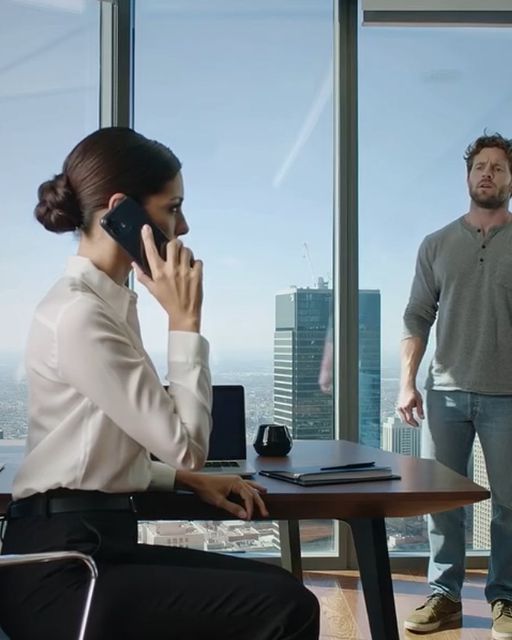
“I’m divorcing you.”
The words came through the phone flat, rehearsed. Like he’d practiced them in a mirror.
Then, the follow-up. “And I sold the condo. You need to be out by the end of the month.”
A laugh rattled down the line. A dry, scraping sound he always thought was confidence.
I said nothing. My office was silent except for the low hum of the servers. My world was supposed to be crashing, but all I felt was a strange, cold calm.
“You sold the condo,” I repeated. It wasn’t a question.
“Yeah, Sarah,” he sneered, letting his mistress’s name slip. He thought it was another knife to twist.
But he didn’t know.
He couldn’t possibly remember a boring Tuesday from months ago. The stack of financial papers on the kitchen counter. The impatient way he’d waved his hand.
“Just handle the boring stuff,” he’d said, his eyes glued to the game on TV as he scribbled his signature.
So I did. I handled it.
I handled transferring the deed entirely into my name.
The phone in my hand felt heavy. My blood wasn’t running cold. It felt like it had stopped moving altogether.
Mark thought his little speech was a bombshell. He had no idea the fuse was already lit under his own feet.
I hung up without another word.
My next call was to my friend Anna, a lawyer whose voice could cut glass.
She didn’t hesitate. “He can’t sell what he doesn’t own.”
There was a pause.
“If he took money from someone for it,” she said, her tone dropping, “he didn’t just make a mistake. He committed fraud.”
Fraud.
The word echoed in the quiet room. It didn’t taste like revenge. It tasted like simple, brutal math.
Mark thought he had just thrown me out on the street.
He had no idea he’d just locked himself in a cage and handed me the only key.
His laugh was the last thing I heard, a ghost of a sound from a man who had already lost everything and was still too proud to notice.
The drive home was automatic. My hands knew the turns, but my mind was a million miles away, replaying the last ten years of my life.
I thought about all the “boring stuff” I had handled. The taxes he forgot. The insurance policies he let lapse. The investments I researched and managed while he was out on “client dinners” that always ended too late.
He saw it as drudgery. He saw me as the household administrator, someone to keep the lights on while he lived the exciting part of life.
I saw it as building a foundation. I just never realized I was building it for myself.
I walked into the condo. Our condo. No, my condo.
It looked the same. The grey sofa he’d insisted on. The oversized television that was his pride and joy. The photos of us on the mantelpiece, smiling from vacations I had planned and paid for.
They looked like strangers. The woman in the photos had a hopeful light in her eyes that I didn’t recognize anymore.
I sat on the sofa and waited. The silence was a heavy blanket.
An hour later, my phone buzzed. It was Mark.
“Did you get my message? I’m serious. Start packing.”
I ignored it.
Another message. “Don’t make this difficult, Eleanor. It’s a done deal.”
He always used my full name when he was trying to sound intimidating. It used to work.
A third message, an hour after that. “The new owner is going to want to see the place tomorrow. I expect you to be gone.”
The sheer arrogance of it was breathtaking. He really believed he held all the cards.
That night, I didn’t pack a single box. Instead, I made a pot of tea and sat by the window, watching the city lights blink on.
For the first time in years, I felt a sense of peace. The uncertainty was gone, replaced by a strange and solid clarity.
The next morning, I met Anna at a small coffee shop downtown.
She had a file in front of her. Her expression was all business.
“Okay,” she began, “I did some digging. He created a fake deed document. It’s a pretty clumsy forgery, but it was enough to fool a private buyer who didn’t do his due diligence.”
She slid a piece of paper across the table. “He took a deposit. A significant one.”
My stomach churned. It was one thing to know it in theory. It was another to see the numbers in black and white.
“So what happens now?” I asked, my voice barely a whisper.
“We have two paths,” Anna explained. “The civil path, where we sue him into oblivion during the divorce. And the criminal path.”
She let that hang in the air.
“The buyer, a Mr. Henderson, can press charges for fraud. That carries jail time, Eleanor.”
I thought of Mark’s stupid, confident laugh. I thought of the way he’d dismissed me for a decade.
“It’s not my choice to make,” I said slowly. “It’s Mr. Henderson’s.”
Anna nodded, a small smile playing on her lips. “Exactly. But first, we secure your home. I’ve already filed an emergency motion and notified the land registry. No one is selling your condo.”
She told me to go home and change the locks.
The locksmith was a kind man with gentle eyes who didn’t ask any questions. As he worked, I felt a layer of grime being scrubbed away from my life.
With a final click, the new lock was in place. It was a sound of finality. A door closing on my old life.
Just as the locksmith’s van pulled away, Mark’s sleek sports car turned into the driveway.
He got out, looking smug. He was with another man, older, well-dressed, who looked vaguely uncomfortable. This had to be Mr. Henderson.
Mark strode to the door and tried his key. It didn’t fit. He jiggled it, his confident expression faltering.
He tried it again, with more force. Nothing.
He looked up and saw me standing in the window. His face, for the first time, registered confusion.
He pulled out his phone and I watched it light up in my hand. I didn’t answer.
His confusion morphed into anger. He started banging on the door.
“Eleanor! What is this? Open the door!”
Mr. Henderson was looking back and forth between us, a deep frown creasing his forehead.
“Is there a problem, Mark?” the older man asked, his voice calm but firm.
“No, no problem,” Mark said, forcing a laugh. “She’s just being… dramatic.”
He banged again, harder this time. “Open this door right now!”
I simply watched him. I didn’t feel anger. I didn’t feel sadness. I felt like a scientist observing a specimen in a jar.
Finally, he gave up. He turned to Mr. Henderson, his face red with frustration, and began spinning a story. I could almost hear it through the glass. My wife, she’s emotional, she’s not taking the news well.
Mr. Henderson listened patiently. He didn’t look convinced. He just looked tired.
After a few more minutes of Mark’s frantic gesturing, they left.
The next call was from Anna.
“Mr. Henderson’s lawyer just contacted me,” she said. “He wants a meeting. With you.”
My heart hammered against my ribs. “With me? Why?”
“He said he wants to ‘understand the situation’ from the person who actually owns the property.”
The meeting was set for the following day at Anna’s office. I was a nervous wreck. This man had been cheated out of a lot of money. He had every right to be furious, and I was worried his anger would be directed at me.
Mr. Henderson was already there when we arrived. He was tall, with white hair and a kind, weary face. He stood up when I entered the room.
“Mrs. Davies,” he said, extending a hand. “Thank you for meeting me. Please, call me Robert.”
His handshake was firm. His eyes held no malice, only a deep, searching curiosity.
We sat down. Anna laid out the facts calmly and professionally, presenting the official deed and the timeline of events.
Robert listened without interruption, his hands folded on the polished table.
When she was finished, he was silent for a long moment.
“I had a feeling something wasn’t right,” he finally said, more to himself than to us. “Mark was too eager. Too desperate to close the deal.”
He then looked directly at me. “May I ask you a personal question, Mrs. Davies?”
I nodded, my throat dry.
“This man, your husband… did he ever mention his father? William Davies?”
The name was familiar, of course. My father-in-law. He’d passed away before I met Mark. Mark rarely spoke of him, except to say he was a ‘sharp businessman.’
“He was my father-in-law,” I confirmed.
Robert leaned back in his chair, and a look of profound sadness washed over his face.
This was the twist I never saw coming.
“William Davies and I were partners, many years ago,” Robert began, his voice low and steady. “We started a small construction firm from nothing. We were brothers, not just partners.”
He paused, collecting his thoughts.
“Then, we landed a big project. The biggest of our careers. William handled the finances. He told me the project had gone bust, that we were bankrupt. He showed me falsified papers, much like your husband showed me, I imagine.”
My breath caught in my throat.
“I lost everything,” Robert continued. “My house, my savings. My wife left me. I had to start over from scratch, working manual labor jobs just to eat. All while William used my money, our money, to build a new life for himself. He bought a big house, sent his son, Mark, to the best schools.”
The pieces started clicking into place with a horrifying certainty.
“I’ve followed Mark’s career from a distance for years,” Robert said. “I wasn’t looking for revenge. I was just… curious. I wanted to see if the apple had fallen far from the tree.”
He looked at me, his eyes filled with a strange sympathy.
“When he approached me about a private, off-market sale for this condo, desperate for cash, I knew. It was his father all over again. The same greed. The same carelessness.”
“So you knew the sale was fake?” Anna asked, her voice sharp.
“I suspected it,” Robert admitted. “I let him think I was an easy mark. I paid the deposit knowing it would lead me here. To the truth. I just didn’t expect to find you caught in the middle of it.”
He sighed, a sound that carried the weight of decades.
“He is his father’s son. And now, he has made his father’s mistake. He got greedy, and he got caught.”
The room was silent. Mark’s pathetic attempt at revenge on me was just a footnote in a much larger, older story of betrayal. He wasn’t a mastermind. He was just a cheap copy of his father.
“I will be pressing full criminal charges for fraud,” Robert said, his voice regaining its firmness. “Not for the money. But for the principle. Some debts need to be paid.”
In the weeks that followed, Mark’s world completely unraveled.
Faced with a fraud lawsuit from Robert and a divorce filing from me that laid out his every deception, he crumbled.
His calls came, frantic and unhinged. They started as threats, then turned to desperate pleas, and finally, to pathetic, whining apologies.
He didn’t understand. He thought he was a player, a winner. He couldn’t grasp that his own actions, his own greed and arrogance, were the only things that had brought him down.
The mistress, whose name he had used like a weapon, was gone. She was just a symptom of the shallow life he’d tried to build.
Our final meeting was in Anna’s conference room to sign the last of the divorce papers.
He looked terrible. He was gaunt, his expensive suit hung off him, and the arrogant glint in his eye was gone, replaced by a hollow, defeated look.
He didn’t look at me. He just signed the documents, his hand trembling slightly.
As he was about to leave, I spoke his name.
He flinched, then turned to face me.
“I just want you to know,” I said, my voice even and calm. “You did this to yourself, Mark. All of it.”
For a fleeting second, I saw a flicker of understanding in his eyes. But it vanished as quickly as it came, replaced by the familiar sneer.
“Whatever, Eleanor,” he muttered, and walked out of my life forever.
He was sentenced to three years for fraud. He lost his job, his reputation, and every cent he had tried to steal.
Robert Henderson, a man whose life had been ruined by the Davies family, finally got his justice. He kindly offered to buy the condo from me at a generous price, but I politely declined.
It was my home now. It was the foundation I had built.
I spent the next few months reclaiming the space. I sold the grey sofa and the giant television. I painted the walls a warm, sunny yellow. I filled the rooms with books and plants and art that I loved.
One afternoon, while packing away the last box of Mark’s things from the back of a closet, I found a small, dusty photo album.
It was filled with pictures of him as a child, with his father, William. In every photo, his father was teaching him something. How to sail, how to dress, how to wear a confident smile.
He wasn’t just a copy of his father; he was a carefully trained protégé. He never had a chance to be anyone else. I felt a brief, surprising pang of pity for the boy in the photos, before he learned that the world was something to be conquered, not shared.
I closed the album and put it in the box. His past was not my future.
My life isn’t loud or flashy. It’s quiet. It’s peaceful. It’s built on the “boring stuff” – honesty, hard work, and the simple kindness of friends like Anna.
I learned that the loudest people in the room are often the most fragile. True strength isn’t in the victory speeches or the cruel laughter. It’s in the quiet resilience of handling your life, of knowing your own worth even when someone else tries to tell you you’re worthless. Mark thought he was tearing my world down, but all he did was clear the rubble so I could finally build something real.