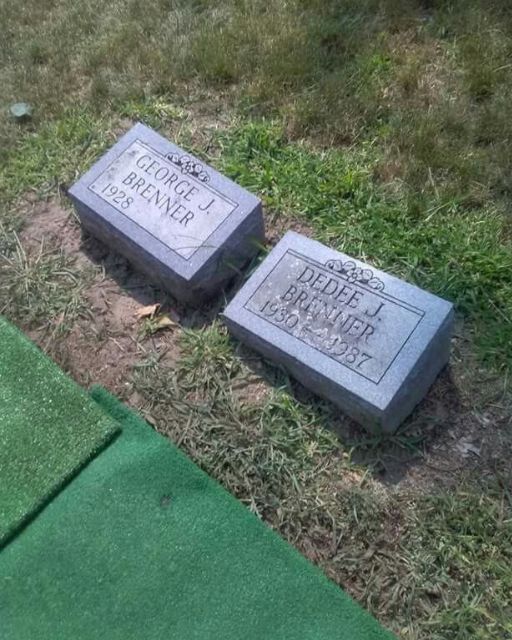
We waited months for it. Granite, just like he requested. “Plain and proud,” he’d always say. I drove my mom out to the cemetery myself. She brought a folding chair, a rose, and his old deck of poker cards to leave at the base.
But when we got there, she froze.
Not because of the engraving itself—but the year. 1928.
“Wait,” she said. “That’s wrong.”
I pulled out the email from the headstone company, thinking maybe it was a typo. Nope. That’s what we submitted. That’s what Grandpa told us to submit.
But I remembered something. A document I found when I cleaned out his garage last winter. Folded inside a WWII ration book: a worn-out ID from Cleveland dated 1931. It had his name. Same signature. Same mole above the brow.
Which would make him three years younger than the stone says.
It wouldn’t matter—except that Grandpa had always talked about his past in such a way that I couldn’t imagine him fudging details. He had been a storyteller, sure, but his stories were always about the things he did, the places he’d seen. Dates? Never. Numbers and specific timelines were always vague. But that ID in my hands had been a shock.
“Mom,” I said slowly, the words suddenly feeling heavier than I’d expected. “Do you remember Grandpa ever telling us when he was born?”
She looked at me, confused. “I think he told us 1928, didn’t he? What difference does it make?”
I couldn’t help but feel a tightening in my chest. “The headstone says 1928, but I found something in his old stuff. His ID says 1931.”
My mom blinked a few times, her face slightly flushed. “What do you mean, his ID says 1931?”
“The ration book from WWII… it was in the garage, buried under some old tools. There was an ID in it. His name, same signature… and it said 1931, not 1928.”
She stared at the headstone, still unmoving. The weight of what I was saying seemed to settle in. I could see the confusion in her eyes, but something else was there too—something darker, like a cloud hanging over her thoughts.
Grandpa had never been forthcoming about the little details of his life. He liked to tell us that he didn’t need to be remembered for dates. That was just his way of saying his past didn’t matter as much as what he’d done and who he’d been for the people he loved. But now, there was a crack in that illusion. A small, yet undeniable lie.
The confusion lingered in the air as we stood there, the wind picking up, making the leaves swirl in patterns at our feet.
“What do you think it means?” I asked.
My mom took a deep breath, her voice quiet, almost hesitant. “I don’t know, honey. Maybe he made a mistake when he told us… or maybe he wanted to be older. It’s not like he didn’t have his reasons.”
“I don’t know if I can believe that,” I said, turning away from her and focusing on the headstone. The dates were carved in stone now, and there was something permanent, cold about them. They weren’t just numbers—they were part of Grandpa’s legacy.
A few days later, I went back to the cemetery alone. I didn’t tell my mom. Something about it all felt unresolved, and I needed to figure it out for myself. I sat on the grass in front of the headstone, just looking at the dates for a while. The stone seemed so final, as though the mystery surrounding Grandpa’s life had been sealed for good.
It was then that I noticed something else: his name. Grandpa had always gone by “Benny,” even on the few official documents we’d ever seen. But on the ID I found, his full name was Benjamin Davis. It felt strange to say it out loud. “Benjamin.” It wasn’t a name I’d ever associated with him.
After sitting there for what felt like hours, I got up and walked back to the car, my mind still racing. I didn’t know what I was hoping to find. I wasn’t going to get any answers here.
I drove back home, my thoughts jumping between memories of Grandpa’s old jokes, his love for fishing, and the many times he’d said that we shouldn’t dwell on the past. The more I thought about it, the more I realized that maybe he wasn’t hiding something bad. Maybe he just didn’t want to be seen as the person who had lived through hardships. Maybe, for him, the past had no room for shame, and what mattered most was who he became afterward.
The next time I saw my mom, I could tell she was still processing what had happened. We didn’t talk about it right away, but as the days went by, we both felt the weight of the question hanging over us.
And then, the call came.
It was from the lawyer handling Grandpa’s estate. He wanted to meet with us. “There’s something you should know,” he said. “Something important regarding your grandfather’s will.”
My mom and I exchanged looks before agreeing to meet him the following morning.
When we arrived, the lawyer greeted us with a somber expression. He handed us a folded envelope. “This letter was found among your grandfather’s personal documents,” he said quietly. “I think it’s best that you read it for yourselves.”
The letter was in Grandpa’s handwriting, but it was dated years before his passing. The contents were unexpected.
“Dear family,” it began, “I’ve been keeping something from you all for a long time. It’s not something I’m proud of, but I think it’s time to come clean.”
My heart skipped a beat as I read the next few lines.
“I was born in 1931, not 1928. I changed the date on my ID many years ago for reasons I can’t fully explain. My life hasn’t been as simple as I’ve made it seem. But one thing I want you to know is that I did it because I wanted to be someone who had lived longer, someone who had seen more. In my mind, I thought it would make me a better man, a more experienced one. But what I’ve learned is that the years don’t define us. It’s the choices we make that do.”
I felt a lump form in my throat as I read the rest of the letter, Grandpa explaining how his younger years were filled with struggles and challenges that he never wanted to burden anyone with.
“Being older made me feel like I’d earned a certain respect. It wasn’t a lie to make myself seem important; it was a way to get away from the fear of being seen as less than. I hope you understand. I love you all more than words can say.”
The letter was signed, “Benny,” and that was it.
My mom folded the letter, her eyes misty. “I knew there had to be something,” she whispered. “He always carried so much with him, so many things he never talked about.”
We sat in silence for a few minutes before I spoke up.
“Do you think he was ashamed of who he really was?” I asked.
My mom shook her head slowly. “No. He was just… trying to be someone he thought he should be, instead of who he really was.”
We stayed at the lawyer’s office for another hour, going over the rest of Grandpa’s will. But my mind kept returning to the letter. Grandpa had spent so many years trying to protect us from his past, but in the end, he’d revealed it all in his own way.
As I drove my mom back to her house, we both sat in silence, the weight of everything sinking in. But there was something else, something small, that made it easier to bear. Grandpa had been honest in his own time, even if it took a letter from beyond the grave. And that, in its own way, felt like a final, redeeming act.
That night, I sat in my room and thought about everything Grandpa had been. He wasn’t perfect. He wasn’t a saint. But the man he became was someone who had done his best, someone who had loved and lived in his own complicated way. He had learned that it’s not about the years you live, but the way you live them.
And that was the legacy I would carry with me.
Grandpa may have lied about his age, but in the end, he had been more honest with us than I ever expected.