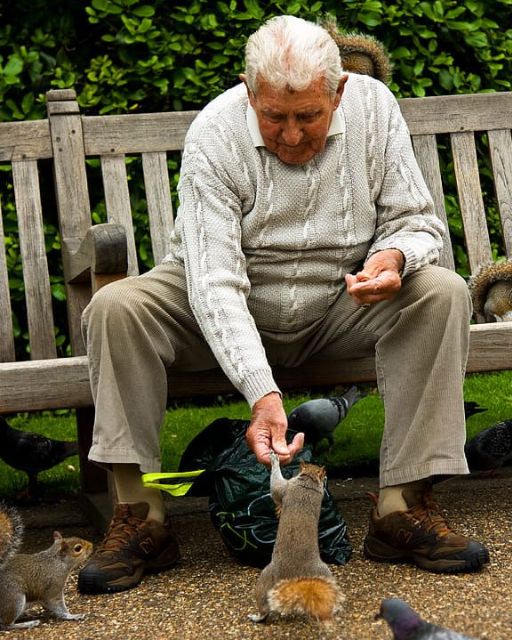
We all thought it was sweet. Rain or shine, he’d shuffle down to the park with his green shopping bag, park himself on the bench near the hedges, and hand-feed the squirrels like old friends.
Neighbors started calling him “The Nut Man.” A few even brought their kids by to watch. I didn’t think twice about it—just assumed it was peanuts or sunflower seeds.
But last Sunday, I came early to surprise him. Sat on the opposite bench, out of view.
That’s when I saw it. He wasn’t feeding them food. He was giving them these tiny scraps of paper. Rolled up tight. One squirrel grabbed one, darted into a bush, and another came back moments later with something else in its mouth—wrapped in plastic.
He tucked it in his sock.
I didn’t understand. It didn’t make sense. My grandfather had always been a quiet man, the kind who never talked much about the past. I’d always admired him for his simple, routine life. But this? It was like something out of a mystery, something I hadn’t expected. I needed to know what he was up to.
The next day, I decided to follow him.
I watched from behind a tree as he walked down the familiar path to the park, his green shopping bag swaying gently by his side. He sat down on the bench as usual, and within moments, the squirrels appeared, eager to greet him. But this time, I was paying closer attention.
As he handed the tiny rolled-up pieces of paper, something clicked in my mind. They weren’t just any pieces of paper. They were… notes. There were markings on them—symbols, like a language I didn’t recognize.
And then, it hit me. He wasn’t just feeding squirrels. He was communicating with them.
I had to know more. After waiting a while, I decided to confront him. But when I approached, he didn’t seem surprised. There was no “caught in the act” moment. Instead, he looked at me with a knowing smile, like he had been waiting for this very conversation.
“I knew you’d notice eventually,” he said, his voice soft and calm, as if we were talking about the weather.
“Grandpa, what are you doing?” I asked, still unable to shake the unease in my stomach.
He leaned back on the bench, watching the squirrels come and go, their little hands grasping the tiny scraps of paper. “You ever wonder what happens to the things people lose, kid? Their forgotten dreams? Their lost hopes?”
I was confused. “What do you mean?”
“Everything you lose in life gets passed along somehow,” he continued. “I’ve been feeding the squirrels my whole life. But what I really give them isn’t food. It’s something deeper. It’s the things that people don’t want to carry anymore. The scraps. The pieces of themselves they leave behind.”
His eyes gleamed with something I hadn’t seen before—something like quiet wisdom, mixed with a hint of sadness.
I couldn’t wrap my head around it. “You mean you’ve been giving them… people’s stuff?”
He nodded. “The lost letters. The forgotten photos. The things people toss aside, thinking they’re worthless. I find them, and I give them to the squirrels. They take them, carry them off, and leave them somewhere else. Maybe someone will find them again. Maybe someone will make sense of them. But the point is, they don’t stay buried forever.”
The pieces of the puzzle started to come together, but I still didn’t fully understand. My grandfather had always been a man of routine, a man who kept to himself. This wasn’t like him at all. And yet, in some strange way, it felt like it was.
“What do you mean by ‘the things people lose’?” I asked slowly, trying to follow his train of thought.
He gave me a soft laugh, almost as if I had asked a silly question. “People think their lost things don’t matter. But they do. I find them in the most unexpected places—discarded in parks, left behind in old homes, forgotten on trains. I find pieces of lives in the strangest corners of the world.”
I was speechless. “But… why squirrels?”
“They’re small,” he said, smiling again. “They’re clever, quick. They can carry small things in places we can’t get to. They can travel far, and no one pays attention to them. It’s like the world’s best-kept secret.”
I stared at the squirrels darting around, watching them snatch up the little bits of paper and disappear into the bushes. Something about it all felt… strange, but oddly beautiful.
That afternoon, my grandfather walked me to the park’s edge, where the city’s old oak trees stood tall. He pointed to a spot under one of the trees. “There,” he said. “That’s where I left something for you.”
I knelt down, brushing aside some leaves. Beneath them, there was a small, old envelope. The edges were frayed, and the ink on it was barely legible. It looked like an old letter, yellowed with age.
“Open it,” he urged gently.
I took a deep breath and carefully pulled the letter from the envelope. It was an old photograph—a picture of a young man and woman, smiling at each other. They looked familiar, but I couldn’t place them. My heart skipped a beat when I saw the names scrawled on the back of the photo.
It was my parents, but much younger. They were holding hands. They looked so happy. I’d never seen a photo like this before.
“Where did you get this?” I whispered, my voice trembling.
“It’s yours,” my grandfather said softly. “It’s something I’ve been holding onto for years. It’s yours, because you’re the one who’s ready to understand. To let go.”
I stood there, staring at the photo, overwhelmed by the emotions rushing through me. I had spent so many years angry at my parents for leaving me behind. But this photo—this was a piece of their past that I never knew existed. A piece of them I’d never seen.
I had never felt so connected to them, even though they were miles away.
“Grandpa, I…” I didn’t know what to say. My throat felt tight.
He smiled, as if he had already known what I was thinking. “Sometimes, the things we lose don’t really disappear. They just find new homes.”
I felt tears welling up, but I held them back. This wasn’t a sad moment; it was a moment of understanding. A moment of connection.
“Thank you,” I said, my voice quiet but full of gratitude. “I didn’t realize how much I needed this.”
He patted me on the shoulder. “That’s the thing, kid. You never know what you need until it finds you. And sometimes, it’s in the most unexpected places.”
The following days were a blur. I couldn’t stop thinking about the letter, about the things people lose and how they’re passed on. My grandfather’s quiet routine had opened my eyes to something deeper, something more meaningful than I could have ever imagined.
A few weeks later, I started finding pieces of my own past in strange places. Old receipts, a book I’d lost years ago, and even a letter from my old friend, one I thought I’d never hear from again. It was like the world was telling me that the things we leave behind matter—that they’re never truly gone. They just take on a different life.
The squirrels, I realized, weren’t just carriers of lost things. They were reminders. Reminders that nothing we lose is ever truly lost. It’s simply waiting to be rediscovered. Waiting for the right person, the right moment.
And maybe, just maybe, the things we think are forgotten can bring us closer to what we need to find.
My grandfather passed away quietly a year later. But I know he’s still out there, somewhere—feeding squirrels, sending lost things on their way, and reminding the world that even the smallest things have meaning.
I still visit the park, and I still see the squirrels. Every now and then, I find something small—something unexpected—that leads me back to him.
I understand now. The things we lose aren’t lost forever. They just find new ways to touch our lives when we need them most.
So, next time you lose something—whether it’s a memory, a piece of yourself, or just a small trinket—remember, it might just be waiting to be found. By someone, or something, who’s ready to carry it.
And when you find it, you’ll know: some things are meant to be lost, only to be rediscovered at the right time.