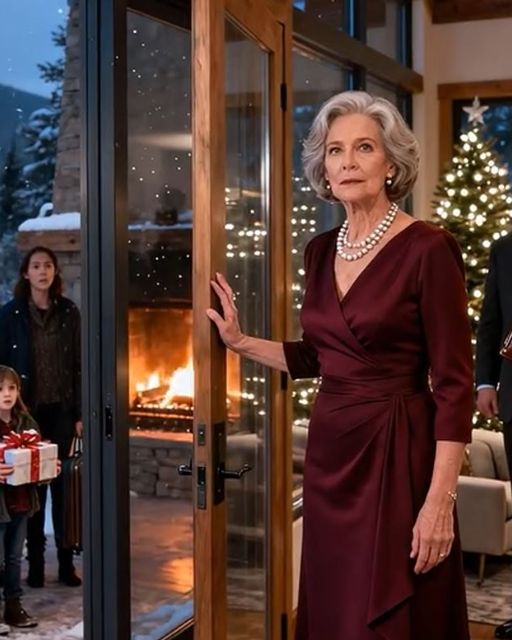
The fifth year of silence was the worst. No call, no text. Just a picture on social media of everyone opening gifts, my grandchild wearing a sweater I’d mailed a month before. I was 62, a widow, and officially a ghost. So I took my husband’s life insurance money and did the one thing they never thought I would. I bought a house. Not just a house, a huge stone and glass place up in the mountains with three guest suites and a fireplace you could stand in. My house. My rules.
I was there for two weeks. The quiet was bliss. Then, the day before Christmas Eve, the motion sensor on the driveway pinged. It was my son Michael’s car, then my daughter Susan’s right behind it. They didn’t ring the bell. Susan pulled a key from her purse and unlocked my front door.
They walked in with luggage, smiling like they owned the place. “Mom, we were so worried! You all the way out here alone.” Michael said, hugging me a little too tight. “We decided to surprise you! We’re all staying for the holiday.”
Something felt wrong. They weren’t looking at me, they were looking at the house. Sizing up rooms. Pointing at walls. Susan brought in a cooler and started clearing a shelf in my new fridge. “This is much better for family gatherings,” she said. “More room for you to manage.”
I felt a cold knot in my gut. An hour later, I was helping Michael bring in a heavy briefcase from his car. The clasp popped open and a thick folder slid out onto the garage floor. “I got it,” I said, bending down to pick up the scattered papers. He tried to grab them, but my hands were already full. I saw our family name on the top page. It wasn’t a Christmas card list. It was a formal document from a law firm I didn’t know. Under that was a letter from a geriatric specialist I’d never met, outlining his travel fees. I looked at the title on the main document. It was a petition for emergency guardianship, citing “cognitive decline and reckless financial decisions,” and stapled to the back was a pre-signed assessment from the doctor who was, according to the letterhead, scheduled to arrive tomorrow.
My blood ran cold. My hands trembled, but I forced them steady. I neatly stacked the papers and handed the folder back to Michael.
He snatched it, a flush creeping up his neck. “Just some boring work stuff, Mom. You know how it is.”
I gave him a small, fragile smile. A smile I hadn’t used in years, the one I reserved for dealing with difficult people without causing a scene. “Of course, dear. Let’s get you settled in.”
I walked back into the grand living room, my heart hammering against my ribs like a trapped bird. Cognitive decline. Reckless spending. They thought I was losing my mind because I finally decided to spend money on myself instead of waiting by the phone for their calls.
My grandchildren, eight-year-old Sarah and ten-year-old Ben, came running in. “Grandma! This house is huge! Can we pick our rooms?”
I knelt and hugged them, burying my face in their hair to hide the tears that threatened to fall. They were the only reason I’d kept trying for so long. They were innocent in all this. “Of course, you can, my sweethearts. Pick any room you like, except the big one with the blue door. That one is mine.”
As they scampered up the magnificent wooden staircase, Susan came over, wiping her hands on a towel. “Don’t let them get too excited, Mom. It’s a lot of space for you to keep up with. Michael and I were thinking, once things are sorted, we could hire a nice live-in helper for you.”
The condescension in her voice was a physical thing. I felt it on my skin. “I’m doing just fine, Susan,” I said, keeping my voice even.
That night, I didn’t sleep. I sat in an armchair by the massive window, watching the snow fall on the pines. They thought I was weak. They thought I was a foolish old woman who stumbled into a fortune. They had forgotten who I was. Before I was their mother, I was an accountant. I had managed my husband Robert’s construction business finances for thirty years. I knew numbers. I knew strategy.
They were playing checkers. I was about to play chess.
The next morning, Christmas Eve, I made pancakes. I was cheerful. I asked about their jobs, their lives, the lives they had so carefully walled off from me. They answered in platitudes, their eyes constantly scanning the architecture, the expensive furniture, the land outside. They were divvying up my life before I was even gone.
Around eleven, a sleek black car pulled up the driveway. “Oh, that must be Dr. Evans,” Michael said, a little too casually. “A friend of a friend. He was in the area and I asked him to stop by, just to check on you. Make sure you’re settling in okay.”
A man in a tailored suit stepped out. He looked more like a banker than a doctor. He had a practiced, sympathetic smile that didn’t reach his cold eyes. He was the hired gun.
“It’s a pleasure to meet you, Martha,” he said, taking my hand. His was clammy.
We sat in the living room. Michael and Susan hovered like vultures. “So, Martha,” Dr. Evans began, opening a notebook. “Michael tells me you’ve made quite a big change recently.”
“I have,” I said, smiling warmly. “Isn’t it wonderful? I’ve never felt more alive.”
He asked me the date. I told him. He asked me who the president was. I told him. Then he moved on to more subtle questions. “This house must have cost a pretty penny. Are you worried about managing such a large asset?”
I leaned forward. “Doctor, my late husband and I built a business from nothing. We managed payrolls for over a hundred employees and multi-million dollar contracts. I think I can handle a mortgage and a heating bill. Can you?”
He was taken aback for a second. Susan shot me a look, a clear warning. I ignored it.
He tried a different tactic. “Your children are just concerned. Sometimes, after a great loss, we can make impulsive decisions. Decisions that aren’t in our own best interest.”
“My husband Robert passed away nearly two years ago,” I said, my voice soft but firm. “My ‘great loss’ was the five years of holidays I spent alone, wondering if my family was okay. This house wasn’t an impulse. It was a choice. I chose to stop waiting for a life that wasn’t coming and to start living the one I had left.”
I saw a flicker of something in his eyes. Doubt? Or maybe annoyance. He was supposed to be assessing a confused old lady, and I wasn’t playing the part. He wrapped up his “assessment” quickly, promising to send his notes to Michael. As he left, I saw Michael slip him a thick envelope. It was all a transaction.
Once he was gone, I excused myself to my room, saying I needed a rest. I closed the door, my hands shaking now with adrenaline, not fear. I pulled out my phone and dialed a number I knew by heart.
“David? It’s Martha.”
David had been Robert’s best friend and our lawyer for forty years. He was a bulldog in a courtroom and a teddy bear with his family. “Martha! Merry Christmas Eve! How are you settling into the fortress? Is it as magnificent as the pictures?”
“It is, David. But we have a problem. The wolves are at the door.”
I explained everything. The key. The luggage. The guardianship papers. The sham doctor. I heard him sigh heavily on the other end of the line. “I was afraid of this, Martha. Robert was too.”
“What do I do, David?”
“You do exactly what we planned,” he said, his voice firming up. “You let them play their hand. They want to have a formal meeting? You agree to it. I’ll be there. Just tell me when.”
We finalized the details. I hung up, a wave of resolve washing over me. This wasn’t just my fight. It was Robert’s, too.
I went downstairs. “Michael, Susan,” I said, my voice calm. “I found the papers. The guardianship documents.”
Panic flashed across their faces. Susan started to stammer, “Mom, it’s not what you think! We’re just… we’re worried.”
“I understand your concern,” I said, cutting her off. “So let’s do this properly. Let’s have a meeting tomorrow. On Christmas Day. Your lawyer can come. And the doctor can present his findings. But my lawyer will be here too.”
Relief washed over them. They thought I was surrendering, simply asking for a formality. They saw a frail woman who wanted a lawyer to make sure her “transition” of assets was handled neatly. “Of course, Mom,” Michael said, patting my arm. “That’s very sensible.”
Christmas morning was the strangest I’d ever experienced. The kids opened the presents I’d bought for them, their delight a stark contrast to the tension radiating from their parents. Michael and Susan were acting like hosts in my home, directing me to sit down while they prepared a Christmas ham. It was a surreal performance.
At two o’clock, the doorbell rang. It was Michael’s lawyer, a slick man named Peterson, and Dr. Evans, looking smug. They all sat around my large dining room table. Michael cleared his throat and placed the petition in the center.
“Mom, as we discussed, this is for your own good,” he began. “Dr. Evans has concluded that you’re showing signs of… confusion, and this large purchase confirms our fears. We want to take care of you. We want to manage your estate so you can live comfortably without any stress.”
Susan nodded, a tear tracing its way down her cheek. The performance of a lifetime. “We love you, Mom. We just want you to be safe.”
Right on cue, the doorbell rang again. “I’ll get it,” I said, standing up.
I opened the door to David. He was dressed in a sharp suit and carried a beautiful, worn leather briefcase. “David! Merry Christmas. You’re right on time.”
When we walked into the dining room, I saw the color drain from Michael’s face. He knew who David was. He knew David wasn’t some small-town lawyer I’d found in the phone book.
“David Mills,” my lawyer said, offering a hand that no one shook. “I’ve been Martha and Robert’s counsel for four decades.”
Peterson, their lawyer, looked uneasy. “This is a simple family matter, Mr. Mills.”
“On the contrary,” David said, setting his briefcase on the table with a solid thud. “This is a matter of a carefully executed last will and testament.” He opened his briefcase and pulled out a document, bound in blue. “This is Robert’s actual will, of which I am the executor. I’m sure you’ve seen the version that left Martha as the sole beneficiary of the life insurance policy.”
Michael nodded slowly. “Yes. That’s what prompted our concern. A lump sum of that size…”
“That lump sum,” David interrupted, “was a test. Robert was no fool. He saw the way you were both distancing yourselves. He worried about what would happen to Martha when he was gone.”
He slid a page across the table. “This is the ‘Character Clause’ from Robert’s primary trust, where the bulk of his estate—around eight million dollars, plus properties—is held. The clause states that the trust was to remain sealed until one of two conditions was met.”
David looked directly at Michael, then Susan. “Condition A: If, within two years of his passing, you, his children, demonstrated consistent and loving care for your mother, the trust would be dissolved upon her death and split evenly between you.”
He let that hang in the air for a moment. “Or Condition B: If you demonstrated profound neglect, or worse, attempted to take financial or legal advantage of your mother… you would both be immediately and irrevocably disinherited.”
Silence. The only sound was Sarah and Ben playing in the other room.
“The life insurance policy was the bait,” I said, my voice finally finding its strength. “We knew you couldn’t resist the smell of money. We knew you wouldn’t care about me, but you’d care about what I had.”
Michael was pale, speechless. Susan was shaking her head. “No… Dad would never… You’re lying.”
“It gets worse,” David said, his tone grim. He pulled out another set of papers. “Robert was a meticulous planner. He suspected you might try something like this, a fraudulent claim of incompetence. He hired a private investigator six months before he passed. We have five years of records. Every missed birthday. Every unanswered call. Every holiday you spent in Aspen or the Caribbean while your mother was alone. It’s all documented.”
He then looked at Dr. Evans. “And as for you, Doctor. A quick search reveals you had your license suspended two years ago for providing false medical assessments in exchange for payment in two other guardianship cases. The state medical board will be very interested to hear you’re still practicing.”
The doctor stood up so fast his chair screeched against the floor. He was out the door in seconds, without a word.
Peterson, the lawyer, was already packing his briefcase. “My client was acting on information he believed to be true. I believe our business here is concluded.” He scurried out after the doctor.
Now, it was just me and my children.
“So this house…” Michael whispered, his voice hoarse. “This was all a trap?”
“No,” I said, and for the first time, my voice broke with real sorrow. “This house was my last hope. I bought it hoping you’d see it and think, ‘Mom is all alone in that big place, we should go be with her.’ I hoped you’d come with love in your hearts, not legal papers. You failed the test, Michael. You both did.”
Tears were streaming down Susan’s face now. “So what happens? What happens to the money?”
“As of this moment,” David said, “you are officially disinherited from Robert’s trust. You will receive nothing.”
“But… the children!” Susan cried. “What about Sarah and Ben?”
This was the part that had kept me up at night, the one detail I had agonized over with David. I looked at my children, at their greedy, panicked faces, and then I thought of my grandchildren, laughing in the next room, pure and good.
“Robert and I made a provision for that,” I said. “The entire contents of the trust will now be placed in a new, separate trust for the grandchildren’s education and future. They will be able to access it when they turn twenty-five. David will manage it. You will never be able to touch a single cent.”
The finality of it all settled in the room, heavy and cold. They had lost everything, not because of me, but because of themselves. Their greed had been a poison, and it had finally rotted away their inheritance, their family, and their father’s memory of them.
They left without another word, collecting their bags and their children in a stunned silence. I didn’t watch them go.
I stood by the window with David, watching the snow fall on my beautiful, quiet mountain.
“You did the right thing, Martha,” he said gently.
“It doesn’t feel like a victory, David,” I whispered.
“No,” he agreed. “It feels like peace. The peace you’ve earned.”
That Christmas was the first truly peaceful day I’d had in years. It was quiet, but it wasn’t lonely. It was the silence of a new beginning, not a bitter end. I had my home, my freedom, and the knowledge that my grandchildren would be safe and secure, protected from the very people who should have been their protectors.
The greatest lesson I learned wasn’t about money or mansions. It was that family isn’t just about blood. It’s about respect, about love, and about showing up. And sometimes, the hardest and most necessary act of love is protecting yourself, drawing a line in the snow, and finally choosing to build your own door, with your own key.